From 12 m² to a dream studio. Interview: Edyta Michalak from Pilates Art Studio Częstochowa
Most business textbooks repeat the same rules: you need a lot of starting capital, you should tailor your offer to the mass-market client, and you should never put up entry barriers so you don’t lose profits. Edyta Michalak, founder of Pilates Art Studio in Częstochowa, did exactly the opposite.
When her funding application was rejected, the dream of having her own reformer was thrown into question. Her first clients came to the rescue – buying training packages in advance and becoming the foundation of her business. She started in a small room of 12 m² with a single machine. Today she runs a spacious studio with a full range of equipment and consistently refuses to let new people straight into group classes without a prior two-month period of individual preparation.
In the conversation below, Edyta talks about determination, building client loyalty, working beyond her limits, the studio development strategy that brought the success she dreamed of, and why technique and understanding the body should always come before quick profit. Enjoy the read!
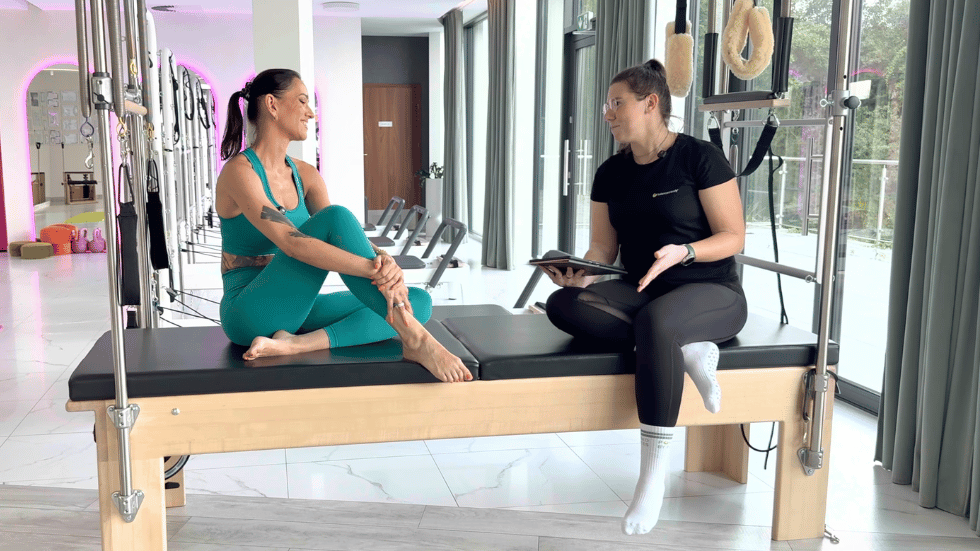
[Iza] Is it possible to open a profitable Pilates studio without your own capital at the start? And would you dare to turn away clients who want to join your group classes because they haven’t gone through a two-month individual training period? My guest today did both. And right now, in Częstochowa, she runs a thriving Pilates studio. A warm welcome to Edyta Michalak from Pilates Art Studio. Edyta, today we’re sitting in a beautiful space, but I know that’s not how your journey began. Can you tell us about it?
[Edyta] The short version or the long version? Briefly, then. I started with forms of movement other than Pilates – I trained in fitness and bodyART, and I spent a little time in the gym. But my spine wasn’t in very good shape, and fortunately, when I came across the equipment, it was the therapeutic version of Pilates that I encountered, and I fell in love with it. At that time, though, I was someone who ran training sessions at the gym; I had no premises and no equipment. A training course I wanted to attend was coming up. People I’d already told how wonderful this equipment was – which I’d come across at a workshop completely by accident – had already heard plenty about it, various clients of mine, about what I wanted, because I was totally fascinated by the possibilities the reformer had in my imagination at that point, since I’d had it beneath me for literally just a moment, and I decided I knew exactly what I was going to do with it.
Anyway, it ended with me getting a rejection for funding, just a moment before the course I was preparing for so eagerly. I had already arranged the whole schedule, told everyone I wouldn’t be at classes next week because I was going away to learn, to get ready to teach them beautiful classes. And it turned out that, well… I wasn’t going to get the money I’d been waiting for.
But among my clients I had angels… guardian angels were among them, who saw so clearly my desire to work on this equipment, who felt this dream of mine so strongly, that we decided that, in the form of a package paid for in advance, we’d settle up for the sessions I would only be teaching them later, and in that way they’d make my dream come true.
So by selling sessions in advance, my service, I had the means to attend the course… I had the means that, right after the course, three days after the course, the equipment landed in a tiny room – I had a little 12-square-meter room at my disposal back then, and the first reformer, which stands there in the middle… over there, on that side behind the pillar, appeared in that first little room.
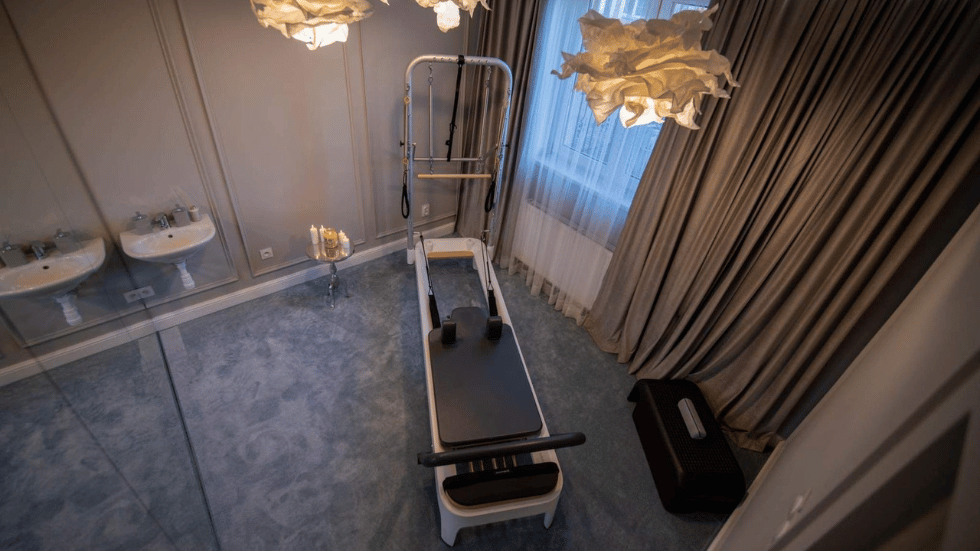
And then I worked on that equipment. I worked on it for 3 years, persistently, in those 12 square meters, showing in the meantime that I truly understood what I could do with the equipment. Bringing myself to a wonderful state, because I had reached a point where I practically couldn’t walk, and it was hard for me to move. Even though I’d exercised my whole life, my spine refused to cooperate at some point, and at first I didn’t know how to deal with it, since movement caused pain. It turned out that on the equipment I was able to reverse that process; I knew it was time-consuming, that we’re working with soft tissue, that we can’t speed this work up, and that I had to be patient.
And those were the first patient 3 years, during which the people who worked with me and used the training found out that it helps them too, that my way of looking at working on the equipment really works, and that they really understand the way I explain the exercises and their bodies understand it and it brings results.
In the meantime it turned out that it would be good to have my own business, so I started working for myself, no longer under someone else, no longer in another place. And that was the second moment when I received money from the Labor Office, because I had submitted the paperwork for funding, all the necessary documents. With that I bought a barrel, and I bought my first chair, I remember. But there was no space to work on them, because I still had that little 12-square-meter room.
A critical moment came when I was working 12 hours a day on that one piece of equipment every day, with a waiting list of people for a spot, and I could no longer fill it, no longer provide it. So I moved to the next premises – a decision made practically overnight. 50 square meters instead of 12, the equipment could fit there. But the move only made sense if there was an option to work in pairs, that is, to group the people who had already been training with me for those 2 or 3 years, so that theoretically we’d already gone through all the technique needed on this equipment many times, and these people could listen to the same instructions while standing next to each other.
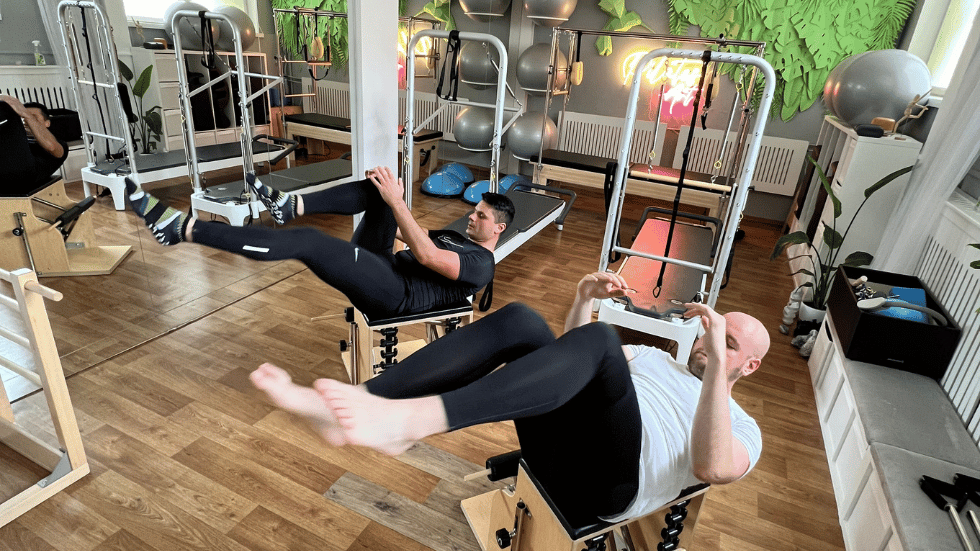
Then came a second moment when, again without funds or means, despite all that enormous work, the same thing happened – on the same principle, with people who knew how it is to work with me, what we’d achieve, and that either way they wanted to train with me, we counted up packages, we counted packages in advance. With the next money I bought another, second reformer, which also stands over there at the end with a tower, because it’s the same thing, all the additional elements, and a second chair. And in that second space, at 50 meters, we worked for another 2 years, where again everything filled up. Again all my working hours were taken, again there was no room to take on more people. And I decided that moving from 50 meters to 100 would be a half measure, because it would fill up within half a year. I decided that the next space had to be the final one, in my imagination it was to be the most beautiful, and, as they say, dreams come true.
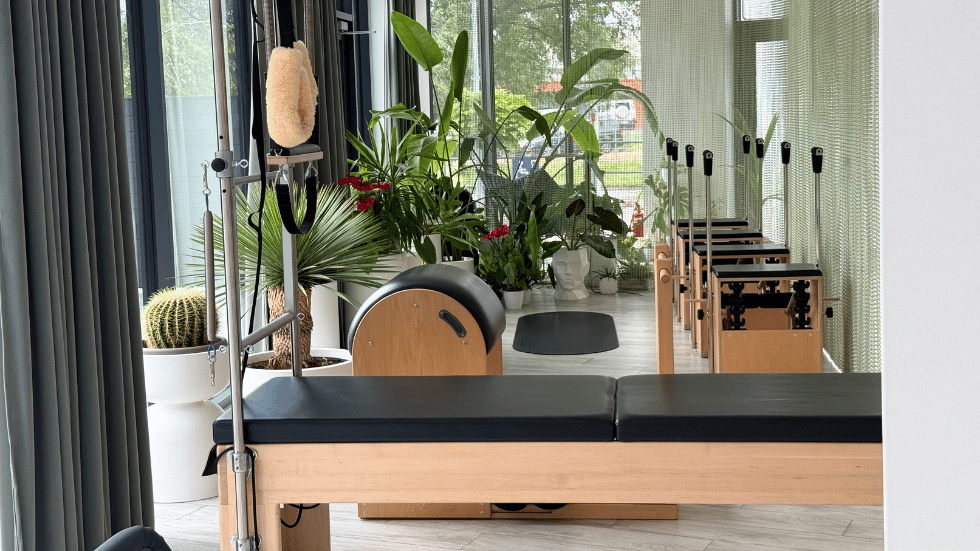
We’re in the place that took shape in my head 7 years ago as a totally maximal vision of what I’d want. Now we can fit 8 people here – that is, by design that’s the number we work with. And this equipment and this premises were furnished and finished in exactly the same way. It turned out that I didn’t have the funds needed to bring my dream to completion, but there were people who wanted to work with me and knew they would want to keep working with me, and we did it once again the same way. For over a year I worked in such a way as to pay back, or contribute to, the pool of money I needed to open this version of the studio. That time has now passed.
I earned my way, again it took a huge number of hours, but that was the goal, to get to this point, so it worked out. Everything is in place. I had nothing. I had nothing, I had people, I had wonderful people – that’s what really made it happen, that these were people who believed in what I can do, based on what they saw, on the results that were there, but really, I wouldn’t have managed on my own. It’s all thanks to my clients.
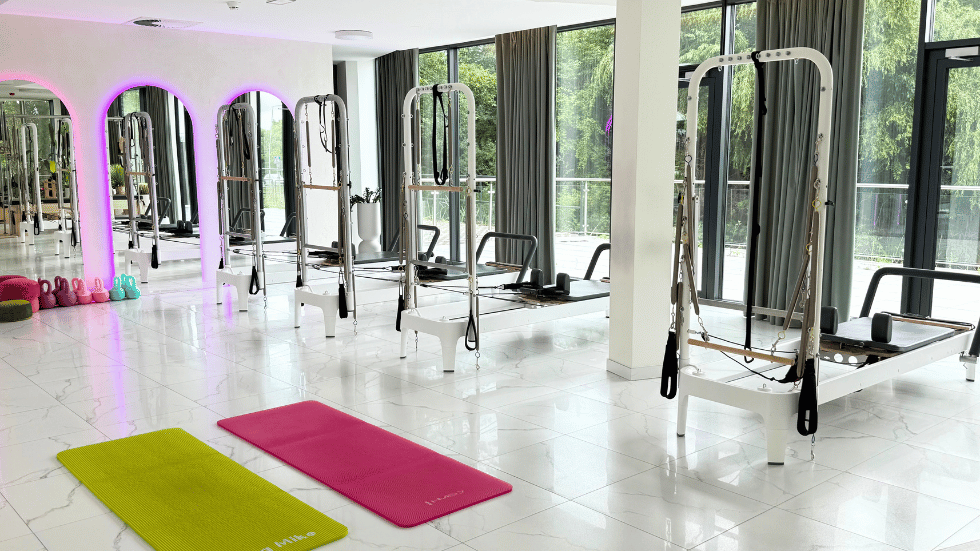
[Iza] Right, let’s note here that we’re talking about clients, because generally you run the studio entirely on your own.
[Edyta] Yes. On my own, because the way I see these exercises, the way I want to explain them, isn’t the version taught in training courses. That is, of course I’ve completed all the courses and I understand everything that was in them, but I run it through my own body and my own understanding a bit. And honestly, if someone from outside came to teach classes too, I don’t know how that person looks at things. I don’t know how she understands all the knowledge she’s acquired, or how she’s able to draw it out of clients, of the people who come.
I haven’t met a person who, at the first, second, or subsequent meeting – because we sometimes tried to train people here – had the same eyes, the same understanding, and I’m just at peace when the people who sign up are truly under my wing. I still have the strength to work with everyone, to take care of them. I assume that if someone comes to me for help, they want to work with me, and it would be different to hand over to someone else those who came for help to me.
[Iza] Let’s remind everyone again, as I mentioned at the start, that signing up for your classes isn’t such a simple path – I don’t just go to the schedule, click, and I’m signed up for a group. Tell us how you came up with this.
[Edyta] Based on all the work I went through in those first years, where everyone worked with me individually and worked for a year, two, three, I decided that this was where the whole strength lay – that we had time to discuss and examine the whole technique, the understanding of Pilates work, the concept itself, down to every centimeter, to be there while the body changes its alignment, so that other elements come to the surface, right? It’s not simple, it’s not noticeable at first glance. It’s only by looking closely at a person, talking with them, talking about how they feel a given exercise, because the fact that we show something and it gets copied once or twice doesn’t mean the body interpreted it the way it was meant to be interpreted.
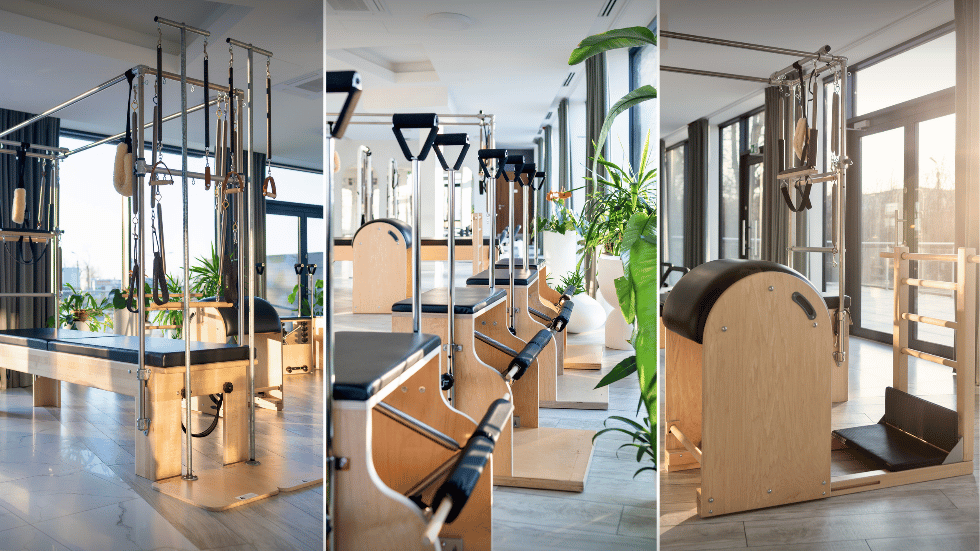
So the system now, with such a large number of people signing up, is that for at least the first two months we work individually. I don’t put people into groups straight away, because I think a person who hasn’t had contact with the equipment before, finding themselves among other people who suddenly do what’s needed on cue, can feel lost – not to mention that the Pilates concept itself, in a frightened body, definitely isn’t absorbed in the right way. That’s why I love that I have those first two months to get to know everyone, also to notice what they need, what their body needs, where some functions have been lost. There’s time to talk about it, to draw attention to things in a non-stressful way, not in a hurry. Through various exercises we also have time to talk about how the equipment works – so it’s both getting familiar with the reformer, and with the tower, and with the Wunda Chair, and with the way the body receives stimuli from this equipment.
And then, when they get to groups, we already know our shared language, I know what a given person needs, I know when to watch whom. Sometimes it may look funny, because I’m working with someone on one side, and from a distance I shout: Anka, fix your abdomen! For example. Because I know she’s not holding it, and here I’m not correcting a foot, and over there with one eye I’m checking that everything’s okay. So it’s wonderful that we know each other, that it’s already such a homely atmosphere in the group. When they’re acquainted with one another, the women know each other, the atmosphere between them is completely different inwardly. I know we help each other. Sometimes it looks really nice between the clients, too, when they give each other tips, because they already know a lot as well, thanks to having the technique laid out for them, because we present it completely differently at the start, and that understanding settles into the body somehow differently, and we can talk about the exercises on a completely different level.
[Iza] Mhm. And from a totally business, financial point of view – don’t people suddenly walk away when they hear: listen, to get in with me, you have to wait 2 months?
[Edyta] I’d say the majority, the larger percentage, says yes, because a moment later they hear why it is that way. Because I don’t end the conversation on “you have to wait, goodbye” – I try to explain why it’s important to me, that I want to get to know this person, I want to know what we have to work on, and that I gently encourage them, of course I don’t force anyone, but I believe they’ll be happy with it. And if someone understands the message and wants to take on their body more seriously and calmly, with consistency in these exercises, knowing they’ll be spending more time on it, not less, and that it’s not a one-off whim but work for the long term, there’s no problem going through this system. However, it happens that someone wants to go straight to classes and at that point says: “oh, oh, no, then thank you.” I don’t have a problem with that either.
[Iza] And does it happen that they come back to you from such groups?
[Edyta] It does happen that they come back. It happens that they come back, or sometimes someone tries things with me, then somewhere else, and comes back, because they say: well, that’s not the same explanation, not the same eyes, here I really understand what I’m supposed to do, and somewhere else there’s chaos – so yes, I like comparisons.
I also like the version where, for example, someone waits for a spot with me, has time to go elsewhere in the meantime, because they wanted to start exercising already, they’re itching to – fine – and then after our first meeting, after that first conversation of an hour and a half, because usually we stretch it out, conversation plus training, that’s our first meeting, I hear at the end: wow, this is different from what it was before. And I say: I know. I know. But we can’t speed that up, and for me that brings a calm later in my work too.
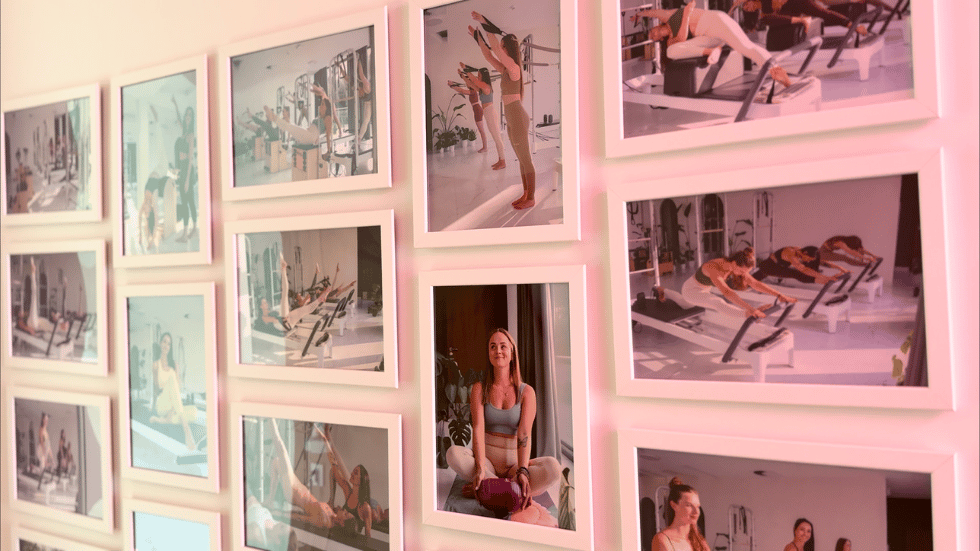
[Iza] Right, there’s only one Edyta here.
[Edyta] Yes. And later I can build on what I’ve forged earlier, so it doesn’t depend on someone else; it depends on the person who comes, on how much they want to listen to all these remarks and really make use of the time when we’re one-on-one. Because I also give a discount for that period – given that I force everyone into this system, I lower the price for personal training for those first 2 months, which somehow relaxes everyone. Let’s say I take a little off for myself, but ultimately it’s not taking, it’s a plus both for me as the instructor and for the person who comes, because in my opinion we all gain from it. Apart from the waiting time, but there’s a price for everything.
[Iza] Let’s go back to the equipment now, because you say you started with a reformer. Did it come with a tower right away?
[Edyta] Right away with a tower.
[Iza] And why was that?
[Edyta] Being in a studio that was fully equipped 7 years ago, I noticed the possibilities the tower offers, because the tower is, you could say, a smaller version of the Cadillac. So apart from the suspended elements, we have practically everything combined in one piece of equipment. I figured that with 12 meters I didn’t have space yet, but that I’d surely live to see the moment when I’d have the space and could work with the tower in the other direction too, because we can lie, right, on the bed, use the springs in this direction and all these systems that are there, and we can also pull the springs in the other direction, where space has been left so that this part can be used as well. Well, I assumed I’d live to see it, and I did. So, believing in growth and in being able to do more on this equipment later, I decided I’d go only for these towers, and now it’s great, because we all use this extended part in groups.
[Iza] And tell me, do you see a big difference between the 7-year-old reformers and the ones you bought along the way?
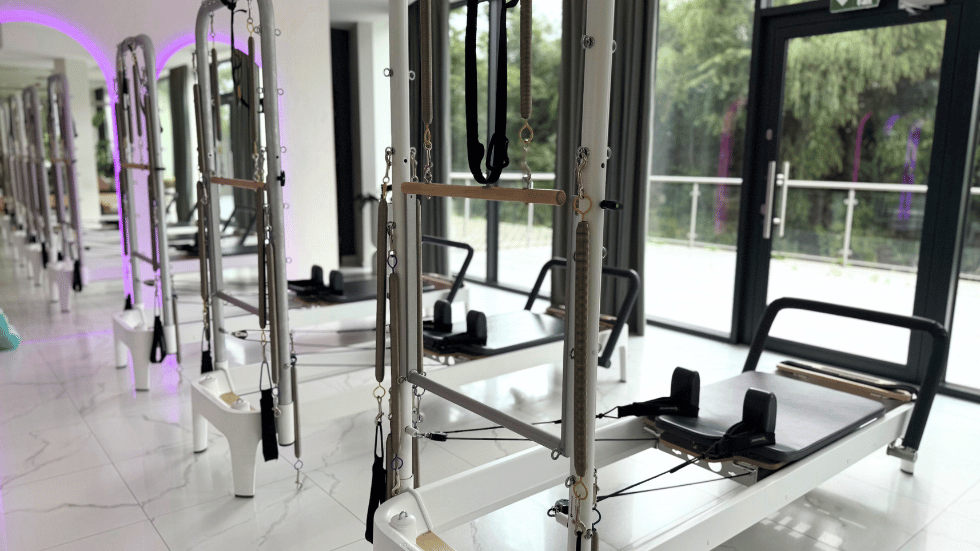
[Edyta] Not a big difference, but I know they’re built from different elements – for example the footbars, I mean from a different material, right? So you can see system differences, some novelties that came in, maybe some different material solutions. Because the 7-year-old one has a heavier footbar, it moves quite heavily, while the later ones are fairly light, right? As if the material itself is simply light. So you could feel that the system had changed, that something started working differently in the meantime. I can recognize them because the tower is enameled. So mine, the older ones, are brushed, and the newer ones brought into the studio are enameled, and that’s about it.
Generally speaking, the oldest reformer works the most, and I’ll add that not only was it heavily used earlier, when there was only one, but now I put every new person on it. It’s positioned so that it’s most convenient for me to circle around it, and it turns out that this oldest, 7-year-old reformer still works 10–12 hours a day to this day, right? Being used for both personal sessions and groups, so I’m impressed. I’m impressed by the durability of the equipment, truly.
Because of course things happen, but since I teach, these elements aren’t slammed or banged around; everyone here knows how to handle the equipment and that’s part of the education at the start. So it’s wonderful to hear the quiet, not the clanking during breaks and when people step off the equipment and so on. I’m very proud of this. Everyone knows very well how to handle this equipment. And its lifespan is probably extended because of that too. So yes, great, it works perfectly.
[Iza] Besides reformers, you also have other equipment. Tell us a bit about why this equipment ended up in your studio and, above all, what it is.
[Edyta] Well, as I picked up right at the beginning from all the information, the Pilates system is based on all the equipment together at once, as a concept that connects. So picking out just a piece of this equipment doesn’t give all the stimuli to the body that could be worked through. So it was simply a path that had to be walked step by step. The courses were divided by equipment, and basically, as I got to them, that’s how I arrived at each next piece of equipment. It also made sense to do a course if you were going to have that equipment at your place shortly afterward, so I decided that in the 12 meters I’d put a chair in that first little room. I squeezed in a chair back then, so that at least what’s directly doable was available while I was getting ready to move to a larger space.
But above all, I liked that it’s yet another task for the body to find itself on the Wunda Chair, and another again on the barrel – on the barrel you arch, and no other equipment gives you those bends, arches, and that support during them. So that was mainly it: wanting to cover everything, you have to have everything in that case, right? Of course now additional little elements are coming in, additional equipment is appearing that supplements the work, but that base alone takes a lot of time, so I’ll certainly keep adding, I’ll probably delve into some extras too. But at the start it’s a novelty for everyone that with these 5 pieces of equipment, all the exercises, we’ve got a few years to master technically and beautifully what can be done on them.
[Iza] I don’t know whether this has come across clearly yet – you’re also a bodyART instructor? What is that?
[Edyta] 17 years. 17 years. It’s a training that drew me in at first with its name, because I’m kind of “body” and kind of “art,” so… No, generally it went like this: my first fitness boss is Marta Tymoszewicz-Bednarz, the owner of the Polish bodyART school. And a week after she took me on to work at her fitness club in Wrocław, she was about to run the second bodyART course in Poland at the time – the first was probably earlier in Warsaw, I imagine, yes, it was in Warsaw, and the second one was in Wrocław, there with us. So she just tossed out the question whether I wanted to take part in this course, obviously hoping very much that I would, and when I heard the name, I said: of course. What turned out is that the training is deadly in terms of intensity – of course it depends on which version of bodyART you teach – but the functional movement, and the way you can combine movement with that stabilization, again taken from Pilates, and the way the breath is then guided, well, it enchanted me. In general I really like smart training – not just reproducing a movement a set number of times in sets, but really making sure the little body understands what’s happening to it during exercise and why we do these exercises and not others, and those are the kinds of trainings I try to use here and to stimulate not just in one way but to infect my clients with movement in different ways.
[Iza] So this bodyART is aimed at your current clients, because nobody from outside is likely to just walk in?
[Edyta] The problem is that my clients have taken all the spots. When I announced I was introducing bodyART – because earlier I mainly wanted to show off the equipment, that was the novelty – but the license has to be renewed every 2 years, and recently it was the 20th anniversary of bodyART in Poland, so Robert Steinbacher was brought in from New York to visit us. Poland was the first country that worked with him, so it’s very sentimental. It was the 20th anniversary of bodyART, and it was fresh in my mind, so to speak, I said: ah, there’s this strength from Pilates, from our equipment here, we should put it in 3D, and that bodyART fit in beautifully.
Anyway, when I announced to the women that we’re adding a class, that I’m dedicating an hour to it, which is also a more intense workout for me as the instructor, because I’m not standing in front of the equipment but really exercising along with everyone, I have to measure my strength against my intentions – and one hour, and it’s full. And then we clear away the equipment, and we have room not for 8 people like during group classes on the equipment, but for 16. And then it’s full, you can’t squeeze in more. I’d have to dedicate another hour, and here I wonder how much strength I really have for everyone. But again, if I took someone else on, it wouldn’t be the kind of instruction I’d want to give everyone, and the circle closes.
[Iza] Exactly. You mentioned the women – do men visit your studio too?
[Edyta] Yes, they do, and from the very beginning. Fortunately I had mixed groups from the very beginning. It’s quite nice – mixed groups, mixed lineups in the sessions. Generally with men it was first of all about post-surgery and post-accident matters, stretching, because they usually already do strength training at the gym themselves, or trainers run it for them. But there are problems with stretching, with ranges, and during such trainings someone usually thinks stretching at the end isn’t needed at all, and that comes back to bite later. So we started with that, but very quickly I also like to show the men that this isn’t such an easy workout, that you can squeeze a lot out of yourself here too, that a lot of strength, stabilization, and other additional elements are needed, which they find interesting.
And once I left them, put differently, I left them the idea of which exercises they’d put into such a workout – they were supposed to name the ones they like, and I said: I’ll keep an eye on your technique. And I was curious which exercises they’d pick. All of them hardcore! I thought: aha, so they don’t like stretching, so that’s what we need to work on! Above all, because it’s known that the little body goes after what it can already do, and skips movements it can’t do or likes less, right? I said: well, they showed right away that stretching is hard for them, and that’s what can really draw our attention. But of course it depends on the need, because I like to meet the group without having laid out a training plan beforehand, instead seeing the people, hearing what they’re talking about as they come in: oh, that hurts, and over there I pulled something today, I slept crooked. Then I practically put together on the fly the training I think will be perfect and spot-on for that day, and often at the end I hear, for example: it’s like you read my mind! I say: no, I didn’t read it, I just heard what you said when you walked into the room!
So I found out that planning trainings in advance, assuming someone will be in this or that state when they arrive, also isn’t really great, because we lose time, since I end up reworking the session anyway once I actually meet the people. Yes, there are men, the groups meet 2 times a week, they don’t fill the whole group, but more are in preparation, so…
[Iza] So they’ll fill up soon.
[Edyta] They’ll fill up soon, they’ll fill up soon. These current ones, they laugh, because for now they take up one side, and when there are more of them they’ll have to split between 2 pieces of equipment – the women already know this by heart, that during one hour we use reformers and something additional on the other side, and halfway through we switch, that’s more or less how it works. Well, the men were used to being on one side, and now that they have to split, they’ve concluded it’s harder, because they have to do the same exercise longer! Because when I have them on one side, I change things up a bit more, rotate – they do a bit, I see they’re getting tired, somehow I have this need, I don’t know why, to react right away when I see, say, a hold for a moment – and when they’re left alone with the exercises, they have to work longer on that one side, so either they’ll sit and look around or they’ll do it – it turns out you have to keep exercising the whole time, that it’s more tiring.
[Iza] Edytka, you’ve really gone from zero to a completely full equipment park. Tell me, or rather: what one piece of advice would you give a person who is where you were a dozen or so years ago?
[Edyta] A lot of patience in acquiring knowledge – that’s the foundation. Because that’s really what we build on later, not on flying videos, but on what the client actually receives from us here on the spot, because in my opinion it’s the good reviews, and what that person feels and how they feel after the whole hour, that then spreads good word of mouth. I worked myself to death. I worked myself to death, but I like working, and maybe that’s why it was easier for me, because for me 10 hours, 12 hours at work, where I’m wrapped up in a goal I want to achieve, isn’t work, it’s a pleasure, because I’m that much closer, a few more sessions closer, a few more smiles, and that gave me strength.
What will motivate someone else, I don’t know. If it’s only finances, I feel sorry for them, because in my opinion that isn’t what it’s about, what can be drawn from this equipment. The whole work with health is the big plus, and if along the way it turns out that more finances appear because the work is done so well, then that’s the reward! It’s a kind of side effect that runs alongside, but also a nice reward, that so many people have now gotten hooked on this equipment that they really want to keep using it, because these are also clients who’ve been with me this whole time. These are people who know why they come, they don’t want to change just for the sake of changing places, because they’re not sure what they’d get elsewhere, and here they already are and they stay, and that’s nice. That way we can meet in ever larger groups.
[Iza] Great, and I wish you rubber time – time that stretches – so you can take on even more people who’ll leave here with such a smile. So if you care not only about going to Pilates but about understanding the whole system, we warmly invite you to Edyta at PilatesArt Studio in Częstochowa on Rocha Street.
[Edyta] You’re very welcome.
Thank you very much for this lovely conversation; I hope it will inspire many people to take action and to fight for what’s theirs, because it can be done.
[Edyta] It can, it can.
[Iza] And if you’d like to see all the equipment Edyta has here in her studio, visit our website balance-body.pl for more information and subscribe to our channel for more interviews and more interesting news from the world of Pilates. Thank you very much.
Success as a reward for knowledge and patience
The story of Pilates Art Studio shows that in the health and movement industry, genuine knowledge and care for the client always speak for themselves. Day after day, Edyta Michalak shows that you don’t have to take shortcuts or copy well-worn marketing patterns to create a place full of life, trust, and the loyalty of clients who stay for years. In her version, refusing immediate entry into a group isn’t an obstacle but a promise of safety and top-quality coaching care. It’s worth mentioning here that Edyta studied therapeutic Pilates with Aneta Figurska at OpenMind in Szczecin.
If you dream of your own studio or want to move to a higher level as a trainer, remember Edyta’s most important advice: arm yourself with patience in acquiring knowledge, listen to the bodies of your clients, and business success will come as a natural reward for good work. People from the Częstochowa area can see this for themselves on Rocha Street, and we invite equipment-Pilates enthusiasts to our website balanced-body.pl for a dose of inspiration and equipment knowledge.
Visit Pilates Art Studio:
IG: https://www.instagram.com/pilates_artstudio/
FB: Edyta Michalak Pilates Art
Address: Św. Rocha 219 A; 42-221 Częstochowa

I am a graduate in Managerial Economics as well as Finance and Accounting, with a specialization in Marketing. Since 2018, I have been working as a Copywriter at Balanced Body, where I create marketing content for the fitness and Pilates industries. One of my particular strengths is translating complex topics into accessible language and accurately analyzing the needs of target audiences. Outside of work, I am passionate about fire shows and volleyball, which helps me better understand the needs of physically active people.

I have been involved in movement for years—I am a certified bodyART instructor with over 17 years of experience, and I built my Pilates foundation under the guidance of Aneta Figurska at the Open Mind school in Szczecin. I currently run PilatesArt Studio in Częstochowa.
In my work, I combine a passion for precision with a therapeutic approach to movement. I understand what spinal pain is and how to effectively overcome it using Pilates equipment. I manage the studio entirely on my own, ensuring that every client completes a two-month, one-on-one preparation period before joining one of my small, intimate groups. PilatesArt is a space born from determination and the trust of my clients—a place where technique, tranquility, and an understanding of anatomy translate into lasting physical fitness and strength.