


Maintenance and Equipment Check for Pilates
Effective training on machines is only possible when you are using safe equipment. Periodic inspections and replacement of worn parts are fundamental to the operation of a professional studio. What elements of the reformer (and other machines) should you pay attention to, and when should you take specific actions? Familiarize yourself with our quick safety guide.
Every Two Weeks – Cleaning the Rails
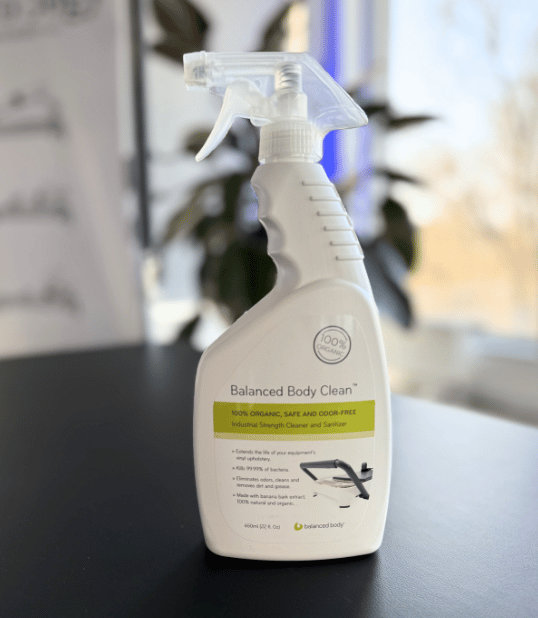
The quiet and smooth operation of the reformer depends on keeping the equipment in good condition. To this end, clean the rails once or twice a month. You can do this with a microfiber cloth — paper towels leave fine fibers that are hard to remove. For safe cleaning, use the Balanced Body Clean, but if you don’t have it on hand, mild soap with demineralized water or a gentle cleaning agent can be used. Absolutely do not use solutions containing alcohol! Follow the steps below, divided into two stages:
Stage 1:
- With the springs attached to the collar pin, wipe the rails from the left and right sides, inside the frame. This is important because a common mistake is cleaning only the visible surface instead of the part that actually works inside.
Stage 2:
- Detach the springs.
- Slide the carriage all the way to the end and wipe the entire length of the rails.
- Clean the other side in the same way.
You may find that while moving the carriage, you feel unevenness — this means that dirt has adhered to the wheels or rails and requires more thorough cleaning. Hair tangled around the wheel axles can also be a cause, which you can effectively remove with tweezers.
Check Monthly
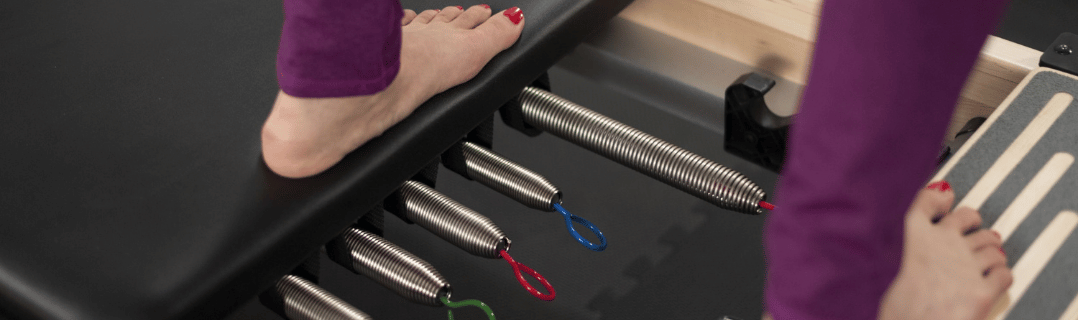
A month is sufficient time to check most elements of the reformer. Start the inspection with the springs — your attention should be drawn to visible cracks, bends, or chips on the spring body (this does not apply to minimal gaps at the ends of the springs — they may have occurred during the manufacturing process). Signs of rust and oxidation also shorten the lifespan of the component. If you notice any of these deficiencies, immediately replace the spring with a new one. Equipment used very intensively may require more frequent spring checks — even weekly.
Another element to check is the screw-lock carabiners. The nuts must always, without exception, be tightened — otherwise, the straps should not be used. If you notice a loose nut, tighten it by turning it to the right. If during subsequent checks the nut is always loose, use a wrench to tighten it and check this element more frequently, e.g., every two weeks.
The same applies to the carabiners (hooks). Check that each one opens and closes correctly, and ensure that the hook is not excessively worn. Any deviation from the correct appearance and function is a clear signal to replace the component with a new one.
Finally, check all eye bolts, nuts, and other screws. Pay special attention to the hinges and screws securing the headrest. Each of them should be tightly screwed.
Also, try to move the reformers at least once a month and clean the floor underneath them.
Springs are not only the components visible from the top but also those located under the carriage. Therefore, be sure to look underneath the carriage to assess their condition in full.
Check Quarterly
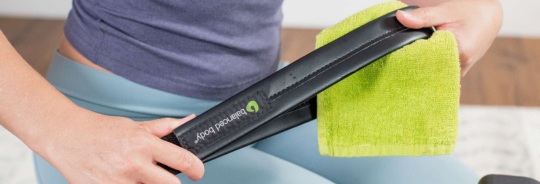
Every three months, check all cables and straps, especially at their attachment points and where they pass through pulleys. How can you tell if they need to be replaced? For cables, the signal is a visible core through the braid or flattening of their shape. For straps, you should replace them as soon as you notice they are starting to fray.
In reformers, it is important to check the spring hooks or eye bolts — depending on the fastening system you have. With the Revo Springbar, check that the spring hooks are tightly secured. In the Standard Springbar, the securing nuts should be maximally tightened.
To maintain the lifespan of springs with the same resistance level, try to change their position every quarter. How? Remove them from the hooks and place them in a different location in the spring fastening system.
Next, check the attachments of the handlebars with the brackets. The screws should not be too loose or too tightly screwed — they must allow for free adjustment of the handlebar position. In the case of older reformers, to secure the handlebar support, you must tighten the screw firmly.
Check every two years
It’s time to replace the most important component – the springs. This should be done at least every two years. However, if you use the reformer very intensively, you should probably do it more often. Neglecting to replace them can be very risky and dangerous. A significantly worn spring, not replaced in time, not only leads to inadequate resistance and reduced exercise effectiveness but, more importantly, is a straightforward path to it breaking during use, which can cause serious bodily harm.
Other components to check – before each workout
Some components must be checked before starting any exercises. This is related to the use of the reformer, especially by different people. Each user has their own “default” settings for the reformer, so prepare the machine accordingly before each session. Attach the appropriate number of springs, leave them in a neutral position, set the handrails to a specified height, and adjust the length of the straps. This way, the reformer will be ready for the next user and properly secured.
Before starting exercises using the foot strap and box, check that the straps are properly attached to the eye bolts. You can do this by pulling the strap firmly upward and tightening it.
Both before and after exercises, take care of the upholstery. Maintaining cleanliness and hygiene is a very important aspect of daily use of the reformer. This process includes cleaning the upholstery, which will extend its lifespan, as well as keeping it looking beautiful and disinfecting it.
After each use, clean the upholstery with water and mild soap, then wipe it with water and dry it with a soft cloth or towel. Although the upholstery of the machines is covered with an innovative antibacterial coating, BeautyGard, it is still good to disinfect it from time to time.
You can do this using gentle cleaning agents, such as: Balanced Body Clean. This versatile disinfectant spray is designed for equipment and surfaces in the Pilates studio – including vinyl upholstery, plastic, wood, metal, and glass. It effectively removes dirt, dust, sweat, grease stains, and other contaminants, as well as tackling unpleasant odors. Made only from natural ingredients – water and plant extract from banana tree bark, it kills 99.99% of bacteria, is odorless, and leaves no streaks. You can also purchase it in the form of a convenient and efficient concentrate → BB Clean concentrate.
To check as needed
Not all machine components need to be checked at a strictly defined time – some should be looked at periodically, depending on wear. The first such component is the posts that hold the straps, which may loosen over time – they need to be tightened securely. The same goes for the spring attachments – before starting your next training session, ensure that the spring hooks under the carriage are facing down.
Do you have a wooden reformer? Additionally, remember to check the bumpers on the solid surface of the foot platform (those small plastic elements). Cracked or otherwise damaged ones should be replaced.
Over time, the pulleys of the reformer, on which the straps move, may require lubrication to eliminate squeaking and ensure smooth operation. However, remember to never use silicone spray or WD40 for this – their use attracts dust and dirt that stick to the sprayed components. To avoid this, use dry silicone or Teflon lubricant for lubricating the pulleys. But before you do that, remove the straps to avoid getting them dirty.
Do not spray silicone products on the wheels and their interiors – they can remove the grease from the bearings and cause damage!
Do not lubricate the rails on the Allegro 2 reformer!
If you do not use the reformer for an extended period, ensure that at least two springs are attached to the carriage and to the spring attachment system. This way, you will properly secure the carriage.
What to Clean Pilates Equipment With?
A schedule for maintaining Pilates equipment is one thing. The cleaning agents you can use are equally important. All to ensure that your studio is always impeccably clean, inviting, safe, and comfortable for every user. We recommend the following solutions:
Water
Sometimes the simplest solutions are also the best. This is true for cleaning most elements of Pilates studio equipment. You can rely on water and a microfiber cloth for cleaning:
- rails on reformers,
- frames of reformers (wooden or metal),
- wooden RBB bars,
- metal and wooden PTB bars,
- reformer wheels,
- pedals on chairs and other dusty/dirty spots.
The main problem you may encounter while cleaning is greasy stains – caused by a combination of various products with sweat, oil, or body lotion. This sticky layer can be difficult to remove, so you need to arm yourself with patience while cleaning. It’s worth spending a little more time cleaning with water before reaching for stronger agents.
Remember to use only soft microfiber cloths for cleaning!
Water + Dish Soap
To give your cleaning an extra boost (besides scrubbing 🙂), it’s worth adding a teaspoon of dish soap to 0.5 liters of water. This prepared solution is perfect for:
- regular cleaning of vinyl upholstery (after each user),
- making cleaning easier, especially when dealing with very stubborn dirt on metal and wooden surfaces.
Cleaning the rails of the reformer is often not the easiest task – especially if they have been forgotten for a long time. To make your job easier in case of tough stains, use a bit of water and… crumpled aluminum foil. The same one you use in the kitchen. Spray the rail with water and scrub until the water becomes dirty. Then wipe it with a dry, soft cloth. Repeat the process until you remove all accumulated residue. Once you manage to clean the rails, remember to wipe them down every week. Frequent scrubbing with aluminum foil can negatively affect the metal coating of the rails.
Silicone Spray
Next, we have a slightly heavier solution, which is silicone spray. Some treat this solution almost like a magic wand, but that’s not entirely a good idea. You can use it, but under two conditions. First, use small amounts of spray, and second, apply it only to the parts listed below:
- the connector for the vertical tubes of the trapeze with PTB,
- springs, which will help silence buzzing noises,
- knobs on chair handles – it will silence squeaking,
- squeaky axles of pulley wheels.
Never use silicone spray on wheels and rails of reformers, and completely forget about any attempts to use popular WD40! This way, you can seriously damage the equipment!
Water + Tea Tree and Lemongrass Oils
Disinfection of equipment should occur after every workout. In this case, you can also reach for natural and health-safe agents. Water with a few drops of tea tree oil and lemongrass oil works great as a disinfectant. Moreover, the mixture will leave a pleasant scent behind.
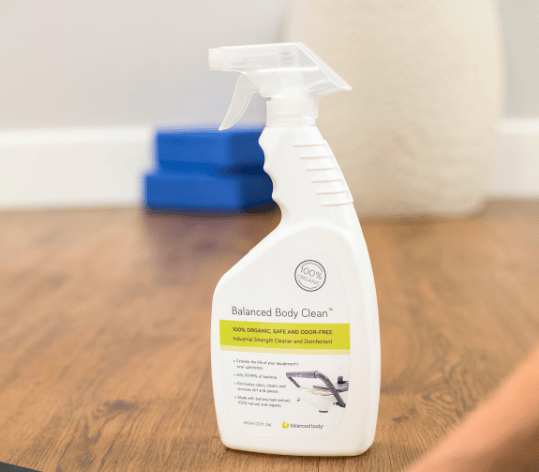
Balanced Body Clean – Cleaning and Disinfecting Spray
We’ve mentioned BB Clean before, but it’s worth spending a few extra moments on it. This natural disinfectant can be used instead of water and soapy water, allowing you to clean and disinfect machines naturally. It’s a quick solution in the form of a convenient spray that you can always have on hand.
When it comes to maintaining Pilates equipment, consistency is key. If you keep this in mind, regular and effective cleaning will only require water and a microfiber cloth. This way, you can easily remove scratches, dirt, and hair, thus eliminating the need for aggressive chemical agents. Their impact on the equipment is particularly detrimental – even universal cleaning agents can cause the finish of wooden frames or aluminum rails to deteriorate over time. And no one would want that.
Well-maintained equipment can easily last a minimum of 20 years in impeccable condition – along with wooden finishes and metal coatings. These few minutes of effort will result in a pleasant and long-lasting collaboration.