


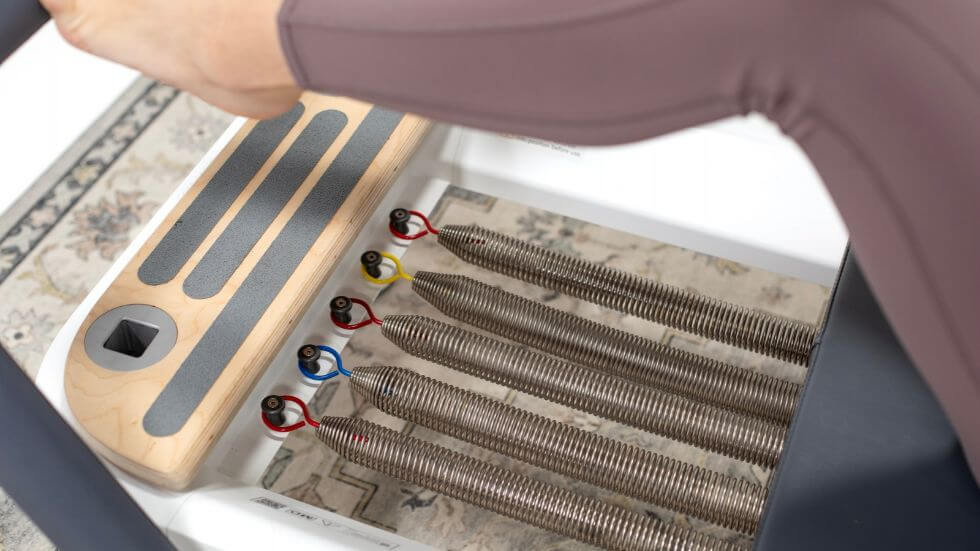
Springs for Pilates machines: technical differences, social media myths, and professional maintenance guidelines.
Springs are, without a doubt, the heart of every reformer and every other Pilates machine. They’re what guarantees the effectiveness, smoothness, and safety of every movement during training. It’s an important yet often overlooked topic, which is why we’ve put together a comprehensive, in-depth compendium of knowledge about springs.
You’ll learn how the different product lines differ (Signature Springs, the new DURO, and the classic Contrology line), how to debunk popular but misleading theories circulating on social media, and how to take care of these fundamental components so they last as long as possible in your studio.
Debunking TikTok and Instagram myths: why constant spring resistance and body-weight effects are fiction
In recent months, the Pilates community has been buzzing about TikTok and Instagram videos where creators try to simplify spring resistance down to one fixed number, or claim that a practitioner’s body weight changes the spring’s tension. One well-respected Pilates instructor and expert decided to challenge these information shortcuts and ran a series of rigorous tests debunking these common myths.
Myth 1: “The red spring has X kilograms of resistance” (dynamic resistance vs. Hooke’s Law)
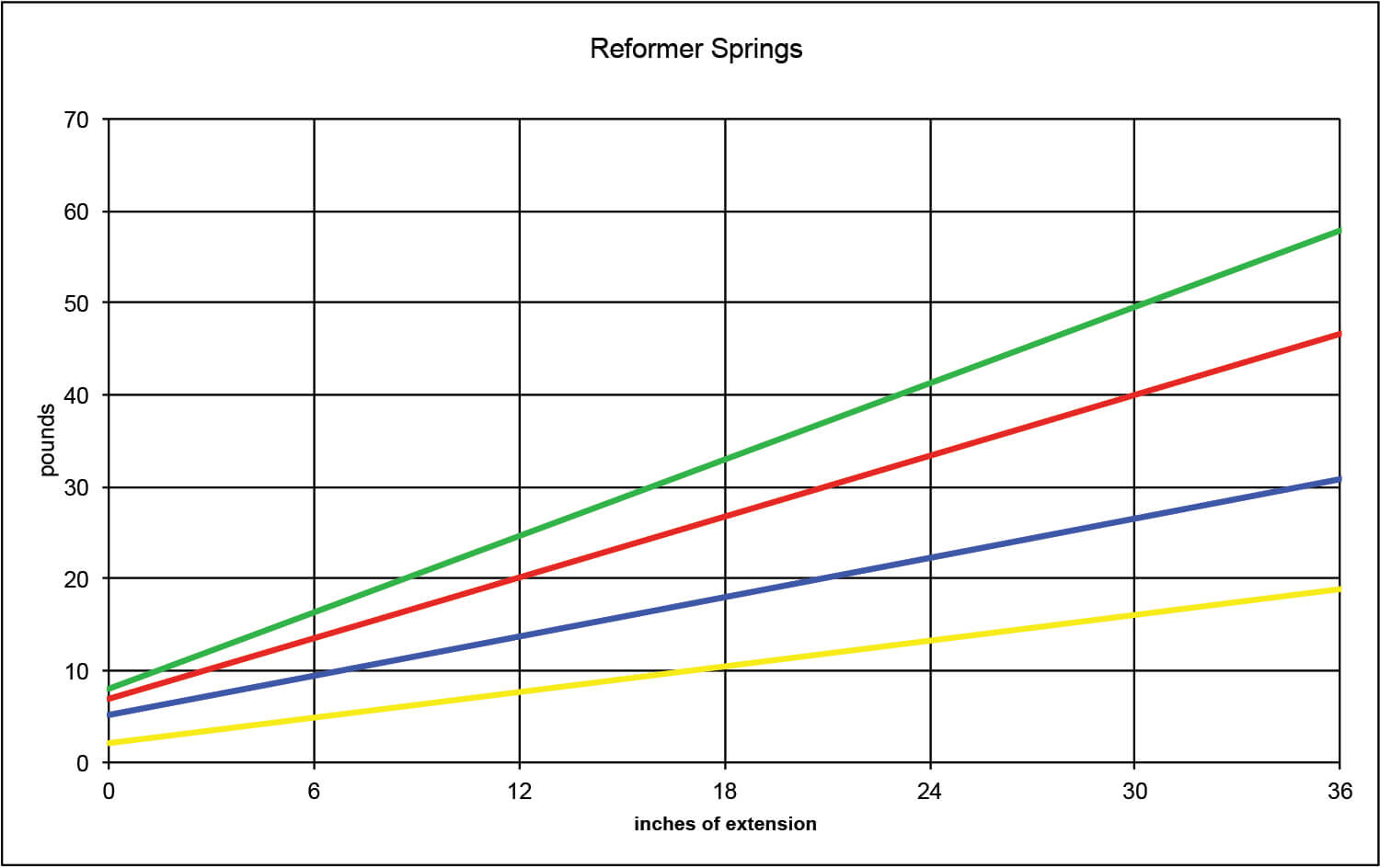
Simplifying a resistance chart down to one fixed weight value is deeply misleading. In reality, spring resistance is dynamic in nature: the more you stretch the spring, the more resistance it offers.
Let’s look at Balanced Body’s official data for the classic red spring (Signature Spring – Medium):
- At 6 inches of stretch (about 15.2 cm): resistance is about 16 lb (about 7.3 kg).
- At 12 inches of stretch (about 30.5 cm): resistance rises to about 21 lb (about 9.5 kg).
- At 18 inches of stretch (about 45.7 cm): resistance is now about 26 lb (about 11.8 kg).
What does this mean in practice for an instructor?
If a short person and a tall person perform the same exercise (e.g. footwork) with exactly the same springs, the taller person will be working against more resistance, because their body proportions mean they’ll stretch the springs further. Understanding this dynamic is fundamental to correctly programming training sessions and progressing the load for clients.
Myth 2: A practitioner’s body weight changes spring resistance
Some online creators have tried to prove that body weight directly affects the resistance of the springs attached to the carriage. To verify this, a precise experiment was carried out using a luggage scale clipped between the practitioner and the reformer’s cable:
- Pulling the carriage out 6 inches (about 15.2 cm) with two heavy springs attached, the scale showed 18 lb (about 8.16 kg) of resistance.
- Then a second person, significantly heavier, sat on the carriage. With the exact same 6-inch pull, the luggage scale again showed exactly 18 lb!
Why does this happen?
The reformer carriage moves on wheels fitted with high-quality bushings or bearings, which means horizontal friction accounts for an absolutely minimal, essentially negligible fraction of the whole system. In the physics of Pilates, body weight doesn’t change the tension of the spring itself.
How does body weight affect exercises done in a supported position (e.g. plank)?
Even though body weight doesn’t change the physical properties of the steel, it drastically changes how a client experiences a given exercise biomechanically and gravitationally:
- Gravity and force vector
In the plank position, the practitioner’s body is angled. Gravity acts straight down, which means the body’s weight generates a horizontal force that actively “pushes” the carriage backward (away from the footbar).
- Weight dependency
The heavier the person exercising, the greater the horizontal force pushing the carriage open.
- Stabilization demands
A heavier person has to generate significantly more force from their stabilizing and deep muscles to counteract that push and keep the carriage in place.
- The role of springs as assistance
In this case, increasing spring resistance (e.g. adding a blue or red spring) makes the plank easier, because the springs help keep the carriage closed, taking over part of the stabilizing work. Conversely, very light resistance (e.g. just one yellow spring) makes the exercise extremely difficult, forcing the deep muscles to work incredibly hard to stabilize against the body’s own weight.
Myth 3: The simple “1 spring from another manufacturer = 1 Balanced Body spring” conversion
It’s common to hear the claim that one classic spring from another manufacturer corresponds exactly to one green Balanced Body spring. That’s another oversimplification.
Rigorous physical measurements show that classic, unplated springs (used by other manufacturers) have a completely different resistance profile. Although they may offer less resistance at the very start of the stretch, their resistance curve is steeper — meaning that with further stretching they build resistance much faster, ultimately landing somewhere between a Balanced Body red and green spring. Comparing springs always has to take into account the full range of motion, the machine’s geometry, the starting height, and the pre-tension of the whole system.
Technical comparison of Balanced Body springs: Signature, DURO, and Contrology
Balanced Body offers three main types of reformer springs, each addressing different needs and training philosophies:
| Feature / Parameter | Signature Springs | DURO Springs (New) | Contrology Springs |
| Material | Nickel-plated carbon steel, protecting against corrosion and cracking. | Thicker steel wire, larger coil diameter. | Unplated (raw) carbon steel with a traditional finish. |
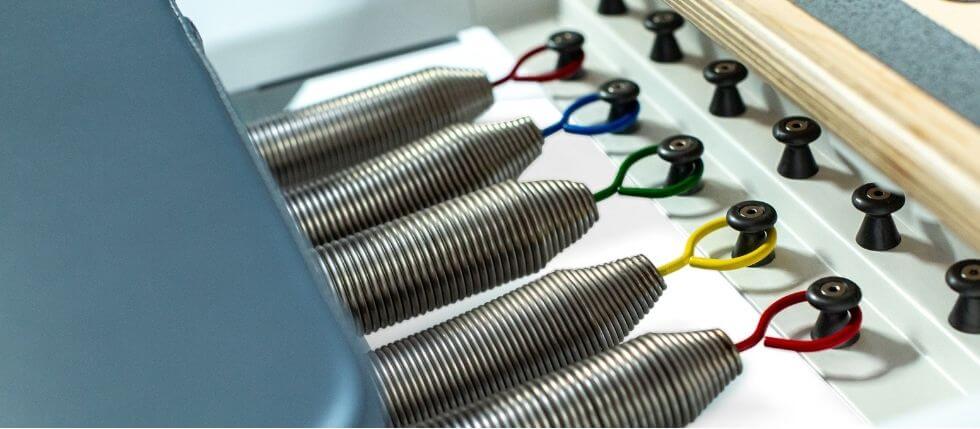
| Resistance profile | Gradable, multi-colored (yellow, blue, red, green). | Identical to Signature Springs (same resistance and feel). | A single, constant heavy resistance (close to the green Signature spring). |
| Manufacturer’s warranty | 2 years or 3,000 hours (reduced to 1 year with 5+ reformers). | 3 years or 3,000 hours (reduced to 2 years with 5+ reformers). | 2 years or 3,000 hours. |
| Key innovations | Patented tapered ends with rotating ball elements. | Increased resistance to wire fatigue under intensive use. | Long hooks providing the original, classic working angle. |
| Recommended use | Standard studios, varied personal and group training. | Intensive group classes, long hours of commercial use. | Classical Pilates, faithful to Joseph Pilates’ original method. |
| Compatibility | Universal for Balanced Body machines. | BB reformers (requires a KIT for Allegro 1/NextGen/Rialto). | Dedicated solely to machines from the Contrology Reformer line. |
Balanced Body Signature Springs: the reliable standard
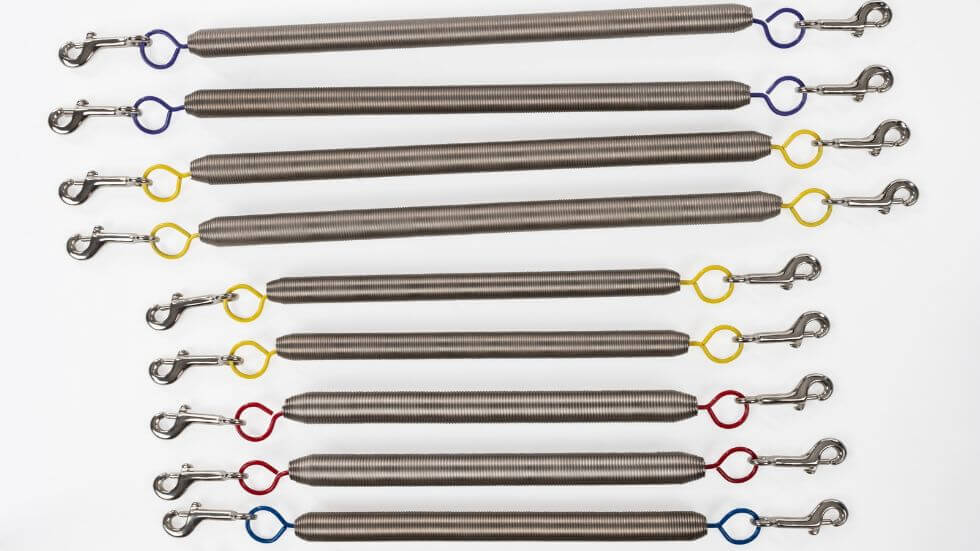
These are the legendary springs, the result of many years of Balanced Body’s design experience. Made from high-quality nickel-plated carbon steel, which protects them exceptionally well against corrosion and microscopic cracks. Their unique feature is a patented tapered end with freely rotating ball elements (bearings) inside, which drastically reduces torsional stress on the hooks and extends the spring’s lifespan. They offer 4 precise resistance levels, making it easy to fully personalize training.
New: Balanced Body DURO Springs – maximum durability for demanding use
DURO Springs are the newest innovation, designed for modern Pilates studios and fitness clubs running intensive group classes, where the equipment works nonstop for many hours a day.
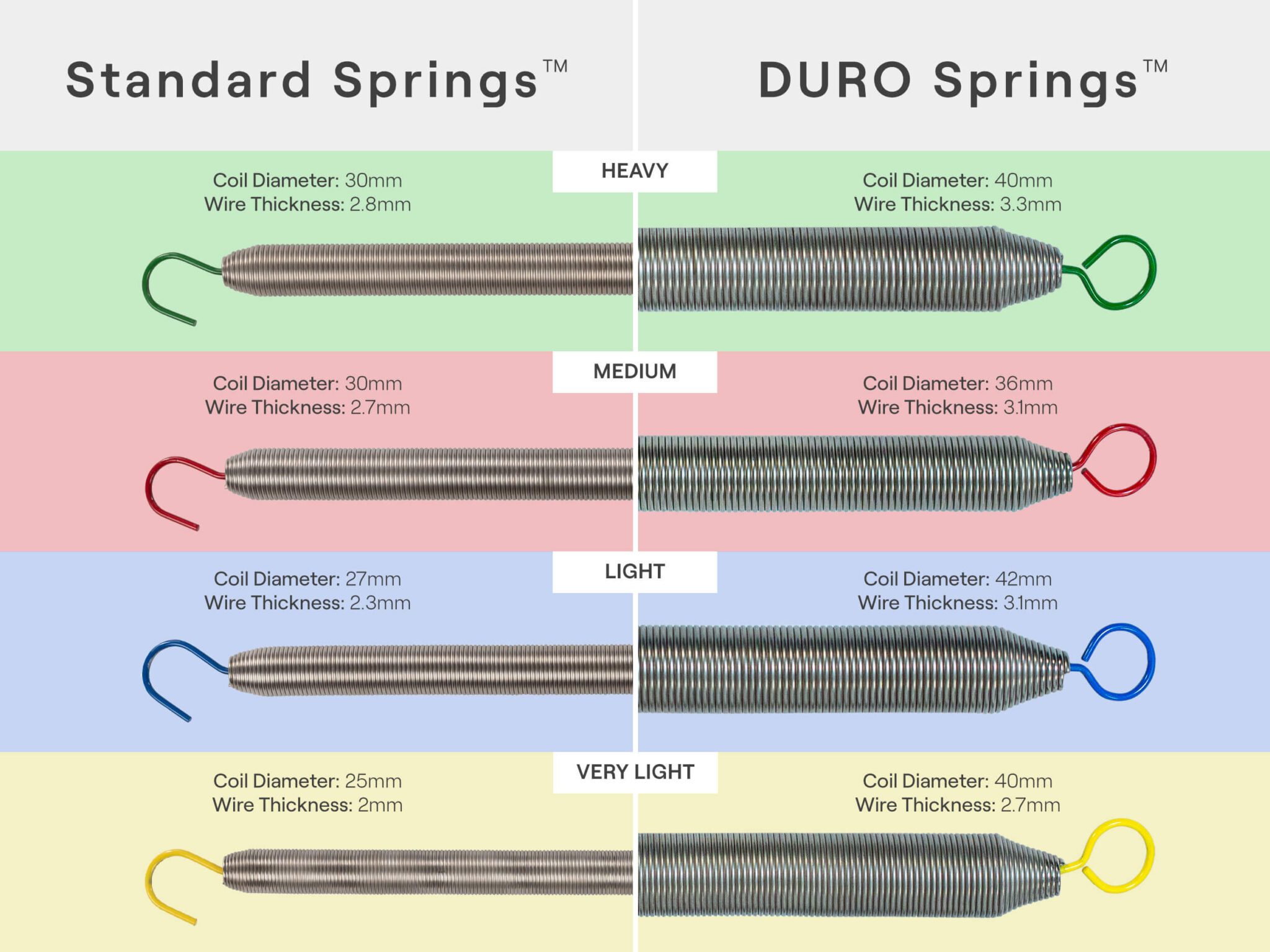
How did the engineers manage to combine greater durability with an identical resistance feel?
A brilliant engineering trick was used here: both the wire thickness and the coil diameter of the spring were increased. These two factors work in opposite directions — a thicker wire increases resistance, while a larger coil diameter decreases it. By precisely balancing these parameters, DURO Springs offer exactly the same resistance curves and movement feel as the classic Signature Springs.
Increasing the coil diameter, however, resulted in a significant expansion of the safe elastic deformation range (safe stretch range). This means that during everyday, deep stretches, the spring uses up a smaller percentage of its maximum elasticity limit, which directly translates into significantly slower metal fatigue (spring fatigue) and a longer lifespan. This durability is confirmed by the manufacturer’s extended 3-year warranty.
💡 Usage tip
DURO Springs cannot be used together (on the same carriage) with Signature Springs — when replacing them, you need to replace the entire set on the machine. Additionally, installation on Allegro, Allegro Nextgen, and Rialto reformers requires purchasing a dedicated Spring Support Kit.
Contrology Reformer Springs: back to the roots, classic character
For fans of Joseph Pilates’ classical method, the Contrology line is a true piece of functional art. These springs were flawlessly recreated based on the original springs from Joe Pilates’ own studio (including a pair of legendary heavy springs given to Jay Grimes by Clara Pilates in the 1960s).
They’re made from unplated (raw) carbon steel, which gives them a distinctive, firmer resistance feel and a characteristic sound during use — a sound that, for many instructors, is an inseparable part of the authentic Pilates experience. They feature long hooks that provide the classic working angle, and come in only one, traditional level of resistance.
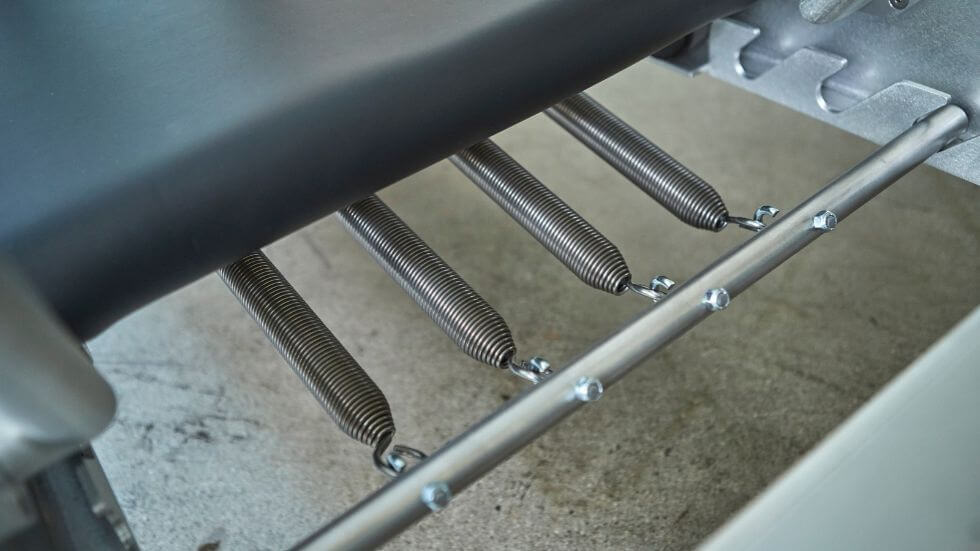
Standard and recommended spring configurations for Balanced Body equipment
To help studio owners and instructors verify their equipment is configured correctly, below we’ve compiled the official factory and recommended spring configurations.
1. Reformers
| Reformer model | Factory configuration (Signature) | DURO configuration (recommended) | Usage notes |
| Studio Reformer | 3 red, 1 blue, 1 green | 3 red, 1 blue, 1 green | DURO version installs directly. |
| Allegro 2 Reformer | 3 red, 1 blue, 1 yellow | 3 red, 1 blue, 1 yellow | Built-in mounting point for DURO. Ideal for dynamic group classes. |
| Rialto Reformer | 3 red, 1 blue, 1 green | 3 red, 1 blue, 1 green | Requires a Spring Support Kit for DURO. |
| Allegro Reformer | 3 red, 1 blue, 1 yellow | 3 red, 1 blue, 1 yellow | Requires a Spring Support Kit for DURO. |
| Allegro Nextgen | 3 red, 1 blue, 1 yellow | 3 red, 1 blue, 1 yellow | Requires a Spring Support Kit for DURO. |
| Clinical Reformer | 3 red, 1 yellow, 1 blue, 1 green | Not applicable | Maximum range of resistance customization for medical use. |
| CenterLine Reformer | 4 green (special uncoated) | Not applicable | Also recommended for classical-style work. |
| Contrology Reformer | 4 Contrology springs (identical) | Not applicable | Raw carbon steel, unique angular geometry. A reformer for classical Pilates. |
2. Chairs
Getting the right level of resistance on chairs is very important because of the asymmetrical work of the pedals:
- Combo Chair: 2 white (very light resistance) and 2 black (heavy resistance).
- EXO Chair: 2 black (heavy resistance).
- Wunda Chair: 2 modified black springs (heavy resistance for the classic Wunda Chair).
- CenterLine Chair: 2 black (heavy resistance).
3. Cadillac, towers, and other equipment
Working on the Cadillac and towers requires springs of various lengths, fitted with safe carabiners:
- Trapeze Table (Cadillac) & Reformer-Trapeze Combo: the full set includes 12 springs: 2 yellow, 2 blue, 2 red, 2 black (short), 2 yellow (long), 2 purple (long).
- Tower for Allegro/Allegro 2/Studio/Wall Tower: 2 yellow, 2 blue (short), 2 yellow (long), 2 purple (long).
- Pilates Springboard: 2 yellow (short), 2 purple (long).
- CenterLine Cadillac: Basic set: 1 red, 1 green, 2 blue, 2 gray, 2 white (short), 2 red (long).
How to choose springs wisely for your exercises? Practical tips for instructors
Choosing the right springs in Pilates is a balancing act. The official rule of thumb for every instructor is based on a simple feeling-based principle:
💬 “If you feel excessive compression in your joints or spine — the resistance is too heavy. If you’re losing control of the movement and the carriage ‘runs away’ — the resistance is too light.”
Below is how the number and color of springs translate into training goals:
- Very heavy resistance (e.g. 4 springs: 1 green + 2 red / 3 red + 1 blue)Used for exercises engaging large lower-body muscle groups (e.g. Footwork), for building muscular strength.
- Medium-heavy resistance (e.g. 3 springs: 2 red / 1 red + 1 blue + 1 yellow)Dynamic exercises, e.g. The Hundred, Leg Circles. Requires limb strength along with active core stabilization.
- Light/medium resistance (e.g. 2 springs: 1 red + 1 blue)Arm exercises in a standing or seated position (e.g. Serve a Tray), and mobilization exercises (e.g. Short Spine). Working on coordination without overloading the muscles.
- Very light resistance (e.g. 1 spring: 1 blue or 1 yellow)Advanced exercises, e.g. Long Stretch, Kneeling Cat. Since the spring doesn’t help bring the carriage back, the practitioner has to do all the stabilizing work themselves.
“Spring resistance can either make an exercise harder or help you perform it. There isn’t one single resistance level for each exercise. You always have to try to adapt as well as possible to the client’s needs and progress the difficulty level by adding or removing resistance.”
– Patrycja Brodek, physiotherapist, Balanced Body Educator
Safety and inspection rules for springs on the Cadillac and towers
Unlike reformers, where springs work horizontally and their movement is limited by the frame’s geometry, springs on the Cadillac and towers are stretched in three-dimensional space — often vertically or at a steep angle. This creates additional challenges around their wear and safety.
The golden 3x length rule (maximum stretch limit)
To prevent permanent elastic deformation of the wire, stress corrosion, and the risk of the spring suddenly snapping, it’s essential to follow one basic engineering rule: never stretch a spring to more than three times its resting length!
Ken, the founder and owner of the Balanced Body brand, explains this with a concrete example:
- A standard short tower spring is about 15 inches long (about 38 cm) at rest. That means its safe maximum length when stretched is 45 inches (about 114 cm).
- Exceeding this limit means the metal loses its elastic properties (permanent, plastic deformation occurs), the coils permanently spread apart, and the spring is fit only for disposal.
Carabiners and safety
All springs in the Trapeze Signature Springs line are fitted at their ends with professional, closed carabiners (rather than open hooks). This guarantees the spring won’t unhook itself during exercises done in suspension or under heavy dynamic load, which is an absolute cornerstone of safety in every professional Pilates studio.
A professional crash course: how do you care for springs and when should you replace them?
Want to learn how to properly install, use, and maintain your springs, to maximize their lifespan and ensure 100% safety for your clients?
We’re handing the floor to the expert! Below you’ll find the complete transcript of a talk prepared by Ken Endelman from Balanced Body, engineer and owner of the brand. This is an absolute must-read for every studio owner and instructor:
“Hey everyone, Ken here from Balanced Body. Today I’ll be talking about a really interesting topic: springs, which I love, right? And also, it’s spring — as in the season — so all the more reason to talk about springs.
I think we’ll start by going over the anatomy of a spring. The naming conventions around springs are kind of like flag terminology, just for springs, okay? But I’ll go through this part really quickly.
This full, compact part of the spring here is called the spring body. This part, which tapers toward the end, is the taper. And these pieces at the ends are… the hooks. This hook is a regular hook, and this one here, because it’s round, is called an eyelet. This is a reformer spring. Simple, right?
The length from here to here is called the resting length of the spring, that is, its compact length.
The next thing I want to talk about is the signs of a worn or damaged spring, and when it’s time to replace it. Because you know what? This is one of those reformer components that’s eventually going to need replacing — and it really will need to be replaced.
To show you, we have a visual aid here. This is our beat-up spring. We’ve got a spring here that’s been overstretched and has a few problems.
- First, you can see deformation here. The spring does this “boop, boop, boop” thing, okay? If you notice something like that on a spring, it’s time to get rid of it.
- Another thing to watch for is the coils spreading apart. This spring has a slight gap, but what I mean is a situation where the spring’s coils spread apart sideways like this, in a V shape. If you see this, it’s also a sign the spring is worn out and needs to be replaced.
- One more thing: if you take the spring off and you’re able to squeeze it together with your hands, that means it’s damaged. That means it’s been overstretched, which means there’s a greater risk of it snapping. Time to throw it out.
- You can also identify overstretching by looking between the coils. If you start seeing light showing through between the coils, that’s a warning sign. Similarly, if when squeezing the spring the coils can be pushed closer together. When you squeeze a properly functioning spring, it should feel like a tightly packed stack of coins.
Those are the key things to look out for. Can you squeeze the spring even though you shouldn’t be able to? Are the coils spreading apart? Is there any deformation? Are there any kinks? That’s exactly what you need to check. If you notice any of these things, just replace the spring. It’s really that simple.
Another thing worth knowing is how to care for your springs and what to do to make them last as long as possible:
- Rotate the springs on the reformer. It’s really easy. You can move the red springs from the outer positions to the inner ones, and move the ones from the inner positions out to the outside. It’s also worth noting down when you do this rotation. It’s exactly like rotating tires on a car! Rotate your springs every three to six months. This will make the springs more reliable and help them last longer.
- When you’re not using the reformer, hook a few springs onto it and just let them hang freely. That’s a good practice. You shouldn’t leave a spring permanently stretched out. That’s not good for the spring, and it also allows moisture to get into it.
- Watch out for moisture. Moisture is the enemy of almost every metal. If moisture builds up on the reformer or on the springs (e.g. from air conditioning), buy a dehumidifier, dry out the room, and change the conditions. If you’re working in an environment where condensation happens regularly, you’ll probably need to replace your springs much more often. As soon as you start noticing rust or corrosion, that’s a sign the conditions aren’t good.
Replacement frequency:
We tell our users that roughly two years is a reasonable period. However, if the reformer is used in a fitness setting, very intensively, practically nonstop (commercial use) — springs should be replaced every year. For safety, one year is the best replacement period under intensive use conditions. On the other hand, if you have a regular Pilates studio where sessions happen at a more controlled, calmer pace, you can probably use the same springs for about two years.
Noise:
People often ask about the sounds springs make. Springs just make various noises (e.g. a “boing,” a light rattling). 99% of the time, it means nothing at all. It’s usually just the sound of the spring sliding along the reformer’s hook, or a slight twist as it stretches. As long as these noises don’t get really loud, there’s nothing to worry about. What you should pay attention to, though, is loud clanking or banging.
Very important installation note!
I’ve noticed that very often, when installing reformer springs onto the carriage, the reformer is flipped upside down. Then people hook the springs on from underneath. As a result, when the spring later hangs beneath the carriage, the hook ends up positioned in a way that, during forward and backward movement, it can slip off. So make sure the springs are hooked onto the carriage in such a way that, once the machine is set up in its normal position, the hook faces downward. Otherwise the spring could fall onto the floor.
Why are our springs so good?
Our springs are manufactured by a company that specializes exclusively in spring production and holds ISO certification. Balanced Body has more than 40 years of experience. One result of that expertise was creating a patented spring end with a small ball element inside, which allows the hook to rotate freely and reduces stress. All springs go through rigorous cycle-stretching and resistance-repeatability testing.
Follow these guidelines, and your springs will last you significantly longer. Happy Pilates training!”
Springs for reformers and other machines — take care of them and take action!
The springs in Balanced Body equipment are more than just simple coils of wire. They’re the result of precision engineering, rigorous laboratory testing (ISO 9000), and decades of gathered experience from the world’s best Pilates teachers.
- Choosing Signature Springs gets you unmatched flexibility and smoothness for everyday training.
- Choosing the new DURO Springs means investing in a longer warranty and extreme resistance to material fatigue during heavy group class use.
- Meanwhile, choosing the Contrology line means embracing pure, unplated, historical resistance and acoustics straight from Joseph Pilates’ own New York studio.
Remember to rotate and replace your springs regularly (every year under intensive commercial use, every two years in calmer studios) and to follow the 3x length rule on the Cadillac, and your equipment will always deliver the safe, smooth, and repeatable training your clients deserve.

I am a graduate in Managerial Economics as well as Finance and Accounting, with a specialization in Marketing. Since 2018, I have been working as a Copywriter at Balanced Body, where I create marketing content for the fitness and Pilates industries. One of my particular strengths is translating complex topics into accessible language and accurately analyzing the needs of target audiences. Outside of work, I am passionate about fire shows and volleyball, which helps me better understand the needs of physically active people.