


The Etiology of Rehabilitation Based on Pilates Exercises PART I
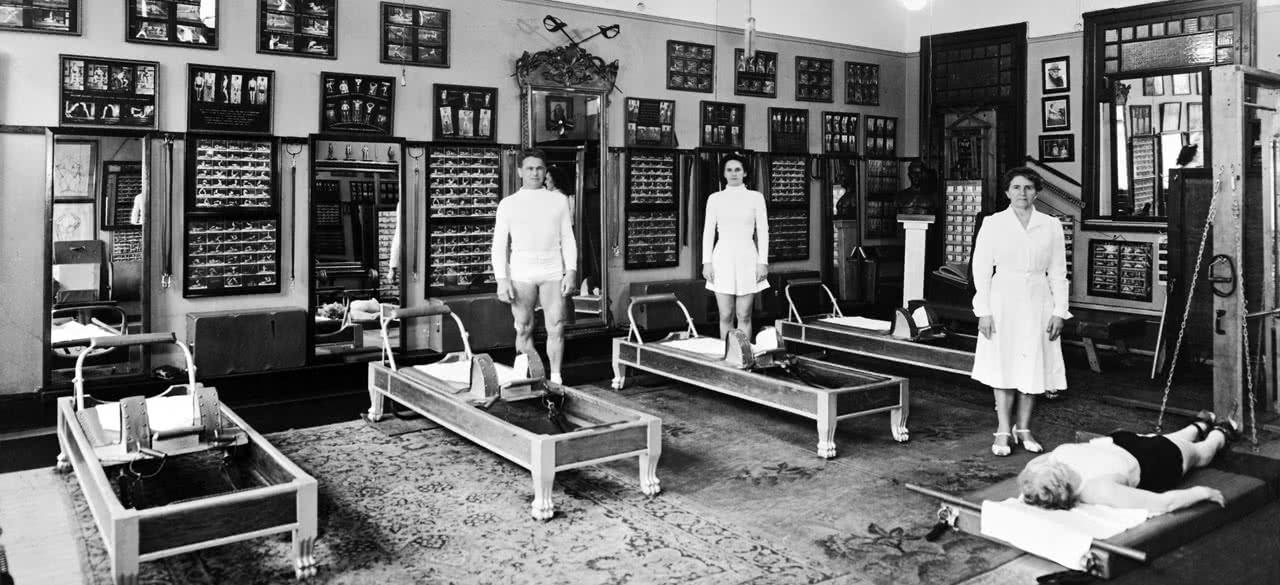
As a child, German Joseph H. Pilates suffered from many ailments resulting from weak muscles. Determined to overcome his weaknesses, he dedicated his life to becoming physically stronger. He studied yoga, martial arts, Zen meditation, and Greek and Roman exercises. He collaborated with doctors and his wife Clara – a nurse.

His experiences led to the development of a unique method of physical and mental conditioning, which he presented in the United States in 1923. In the early 1930s and 1940s, popular dance instructors and choreographers such as Martha Graham, George Balanchine, and Jerome Robbins adopted the Pilates exercise method. Dancers often suffered from various injuries, resulting in long recovery periods and an inability to achieve the peak condition necessary to perform their work. The unique Pilates method at that time allowed and encouraged movement at an early stage of the rehabilitation process under the guidance of qualified instructors. It was found that restoring mobility using non-destructive forces at an early stage of the rehabilitation process accelerated the healing process. Very quickly, this method entered the dance industry. More than 70 years later, Pilates exercise techniques began to gain popularity in the rehabilitation industry. In the 1990s, many physiotherapists used the method in various fields of rehabilitation, including orthopedic, geriatric, chronic pain management, neurological rehabilitation, etc.

In rehabilitation, most exercises are performed with the help of specialized equipment. The equipment evolved from the original set of Pilates exercises that were performed on mats. However, for individuals with orthopedic conditions, exercising without equipment posed a difficulty due to the relationship of gravity to the body’s capabilities. The equipment combines the action of springs and gravitational forces to enable the exerciser to perform full movements. The tension of the springs can be adjusted or the weight of the gravitational forces increased for gradual improvement of movement functionality. Today, despite the increasing number of physiotherapists using Pilates in rehabilitation, there is still little literature exploring phenomena related to the use of Pilates techniques in rehabilitation. This article discusses the theoretical foundations of the results experienced by specialists practicing Pilates in rehabilitation. We will analyze contemporary theories regarding movement motor skills and biomechanics in light of their application in movement re-education.
Pilates promotes exercise programs focused on achieving specific rehabilitation tasks. With the application of Pilates, we can precisely analyze improper movement, and based on that, we can adjust the therapy. Through appropriate analysis of the patient’s needs and by establishing the target movement, e.g., proper jumping, sitting, reaching, rotation, or walking, the therapist can create exercises aimed at achieving the target movement by regulating the load level on the limb or torso during the rehabilitation process. Pilates adjusts environmental factors such as gravity or base, thereby reducing the degree of freedom that must be controlled by the nervous system. Influencing these factors can significantly accelerate the healing process. As movements begin to improve, the patient may rely less on support, and the exercises can transition to more gravitational ones until the desired effect is achieved. The main desired effect of rehabilitation is proper torso control, which is crucial concerning movement functionality, and exercising it requires an integrated approach. Researchers from Australia – Richardson and Hodges conducted studies on the importance of torso control. Their research focused on defining the activities of torso muscles in healthy individuals and those suffering from chronic pain in…
dolnym odcinku pleców podczas ruchów górnych kończyn. Rezultaty badań potwierdzają wagę odpowiedniej sztywności mięśni tułowia prowadzących do poruszania kończynami. W usztywnieniu core (tułowia) nie chodzi o ograniczenie ruchów kręgosłupa, ale o ułatwienie kontroli ruchu. To właśnie leży u podstawy ćwiczeń pilatesu.
Pilates believed that core control is key to controlling human movement as such. Richardson and Hodges proved that the transverse abdominal muscles play the most important role in postural control. There is a hypothesis that the transverse abdominal muscles activate subconsciously and submaximally to ensure appropriate core stiffness during dynamic movements. This hypothesis would confirm the movement theory promoted by Pilates practitioners in rehabilitation, that Pilates-based exercises are more effective than traditional exercises. The term “Pilates-derived exercises” is used to distinguish rehabilitators who utilize and develop Pilates in physical therapy from specialists who only use traditional Pilates techniques. The goal and foundation of Pilates-derived exercises is to achieve correct movement during therapy and return to full functionality. Pilates-derived exercises are designed to facilitate movement for patients while minimizing unwanted muscle work, often responsible for incorrect movement patterns, rapid fatigue, which in turn can lead to injuries.
When the desired movement is weakened by a decrease in proprioception, muscles often overcompensate to achieve postural stabilization. Although there is a lack of evidence, it is assumed that excessive or incorrect stabilization often limits movement effectiveness. For example, a patient can flex a passive leg to 90 degrees, but when asked to lie on their side with a reduced base of support, the range of hip motion will definitely narrow. When the base of support and balance are reduced, the effectiveness of the range of motion may suffer. Pilates-derived exercises allow for an increased base of support and provide optimal conditions for shaping correct movement mechanics. The sequence of movements during the exercise can change, ensuring constant progress while maintaining high movement quality. The physical therapist can continue therapy towards even better functionality and the reduction of equipment support. The traditional method of movement facilitation teaches that at the cognitive level, one must first become aware of movement based on internal and external feedback. Once this occurs, the patient continues therapy and develops movement sequences in an automatic way. And it is this automation of new movements that reduces the risk of re-injury and enhances the effectiveness of therapy.

Another important factor in achieving automatic movement is neurological feedback from the deep core muscles or multifidus muscles. The multifidus muscles have six times more muscle spindle fibers than any other core muscle. This significant source of kinetic feedback plays an important role in core muscle awareness. Patients suffering from chronic lower back pain activated their multifidus muscles at different frequencies and contraction ranges compared to healthy patients. Healthy patients exhibited bilaterally symmetrical mobilization of the multifidus muscles, while patients with lower back pain showed asymmetry of the multifidus muscles towards the affected side. Another study using ultrasound showed discrepancies at the segmental level in the circumference of the multifidus muscle, correlating with the site of lumbar change.
Theoretically,jeśli mięsień wielodzielny i inne głębokie mięśnie przykręgosłupowe hamowane jako wtórne do bólu i hamowania bólu, można wysunąć hipotezę, że ten sam proces hamowałby propriocepcyjny mechanizm sprzężenia zwrotnego tego mięśnia (tj. włókna wrzecionka nerwowo-mięśniowego). Utrata propriocepcyjnego sprzężenia zwrotnego prowadzi do zmniejszenia świadomości i kontroli tułowia. Hamowanie propriocepcji rdzenia może być odpowiedzialne za wadliwe schematy kompensacyjne, które mogą skutkować pojawieniem się sił niszczących, które przedłużają proces gojenia. Praca nad pokonaniem wadliwych kompensacyjnych wzorców ruchów jest podstawowym celem metody ćwiczeń wywodzących się od pilatesu.
Leczenie i terapia mają na celu poprawę propriocepcji tułowia oraz minimalizację sił niszczących według opisu Porterfield i De Rosy, w ich pracy, na temat porad rehabilitacji biomechanicznej faza II. Po osiągnięciu przez pacjenta ruchu bez bólu, ćwiczenia są kontynuowane przez zmniejszenie wspomagania oraz podstawy wsparcia. Ten proces odpowiada fazie trzeciej dynamicznej stabilizacji Porterfielda i DeRosy.

I am a graduate in Managerial Economics as well as Finance and Accounting, with a specialization in Marketing. Since 2018, I have been working as a Copywriter at Balanced Body, where I create marketing content for the fitness and Pilates industries. One of my particular strengths is translating complex topics into accessible language and accurately analyzing the needs of target audiences. Outside of work, I am passionate about fire shows and volleyball, which helps me better understand the needs of physically active people.