


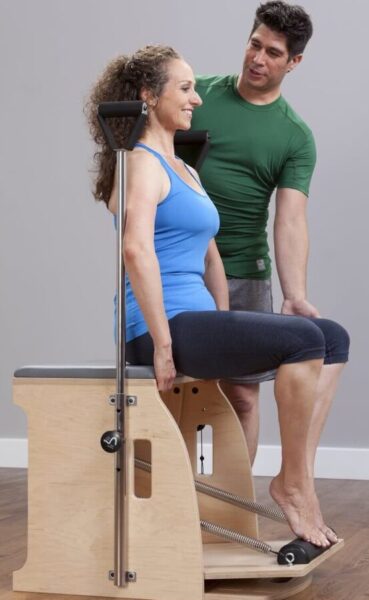
How the Pilates Chair Works – Wunda Chair
The chair is one of the simplest yet most mysterious devices created by Pilates. It is not as obvious as the mat or reformers, but it is truly worth your attention. It may turn out to be a greater challenge for you than you initially thought.
The Chair as a Traditional Pilates Equipment
Known as the Wunda Chair or low chair – it is another piece of strength equipment created by Pilates, following the reformer. Initially made of wood, with an upholstered seat and pedal, it served two functions – besides being exercise equipment, when turned over, it became a comfortable and appropriately shaped chair. The principle of the chair’s operation has remained the same to this day – the pedal has springs with several levels of resistance, which are pressed during exercises. In some versions, the pedal is divided into two parts, allowing them to operate independently – this enables a greater variety of exercise variations.
The Evolution of the Chair
While the principle of operation has remained the same, the materials used to create chairs have changed somewhat. Chairs have become lighter and more streamlined. All of this is to ensure that these sportier versions elevate the chair from being a special piece of equipment in Pilates studios to mainstream use. The refreshed versions are also more mobile – easy to transport and store – both at home and in the studio.
Exercises on the Pilates Chair
Pilates’ original design was very simple to use – and it remains so. However, the versatility of this equipment can come as quite a surprise. It is particularly recommended for intermediate and advanced individuals. It primarily serves to strengthen the core muscles, back, as well as arms and legs. You can exercise while standing, lying down, sitting, and from the sides of the chair. The chair requires a great deal of stability and flexibility. Even the first workout on the chair will reveal to you the ingenuity of Pilates – the number of exercises you can perform on it is very large. Less advanced individuals can also use the chair – it is advisable for them to do so under the watchful eye of instructors. This is thanks to the fact that chairs can also be used for simple strength exercises and balance maintenance. Another advantage of the chair is that once you learn the basics, you can successfully use it for exercises in the comfort of your own home. The chair is also an invaluable aid in post-injury rehabilitation. It excels at rebuilding the condition of damaged muscle groups.

I am a graduate in Managerial Economics as well as Finance and Accounting, with a specialization in Marketing. Since 2018, I have been working as a Copywriter at Balanced Body, where I create marketing content for the fitness and Pilates industries. One of my particular strengths is translating complex topics into accessible language and accurately analyzing the needs of target audiences. Outside of work, I am passionate about fire shows and volleyball, which helps me better understand the needs of physically active people.