


Advanced Pilates
Beginner, intermediate, or advanced? The creator of Pilates, Joseph Pilates, did not use a strict classification – when he looked at a person, he knew what their body needed and established exercises specifically for them.
Today, however, a wide range of exercises requires appropriate classification. The stages are not strictly defined by time frames – the transition from beginner exercises, through intermediate, to advanced can take a decade or more. It is not about time, but about continuous development and pushing one’s own boundaries.
PILATES FOR INTERMEDIATE LEVEL
Intermediate exercises constitute quite a large group. What characterizes them?
- They include skills acquired during the performance of basic exercises
Focus, repetition, and consistency during the execution of the simplest exercises in Pilates will serve you as you progress in your training.
- They utilize potentially unfamiliar body positions
That is, positions that you do not use in your daily life, e.g., twisting and straightening the back or more complicated rolling.
- They require significant coordination and balance
At the intermediate level, your balance will be tested in several body positions and equipment settings.
How to recognize that it is time to transition from basic exercises to intermediate ones in Pilates training? You need to examine your skills – are you stiff or flexible? What does not pose a problem for you, and what skills do you struggle with? And – most importantly – do you have the right motivation and willpower to take on more challenging exercises?
As you walk through the well-tended paths of basic exercises, at some point you will feel the need to take on a challenge and step onto yet untraveled roads. This is the moment when you will start adding more complex exercises until you are finally able to perform them all.
This transfer of skills to a higher level occurs through both reformer exercises and mat work. Intermediate exercises on the reformer include Pull Straps, Long Stretch, Down Stretch, Teaser, Side Splits, or Front Splits. When practicing on the mat, try, for example, Single Straight Leg Stretch, Double Straight Leg Stretch, Criss Cross, Saw, Swan, Seal, Teaser. Demonstrations of these exercises can be easily found by entering their names into a search engine.
PILATES FOR ADVANCED
Pilates helps to discover strengths, but also to recognize difficulties that are a challenge for you. Regular, long-term practice forces the body to submit on all levels. However, remember that some effects require perseverance and time.
What characterizes advanced exercises?
- They usually involve 2 or 3 body positions in the same exercise
This requires concentration, high awareness, and body fitness.
- They assume minimal connection with the equipment
For example, based only on hands and feet. That’s why your core must be strong enough to support its weight while performing the exercise.
- They utilize unfamiliar and difficult positions
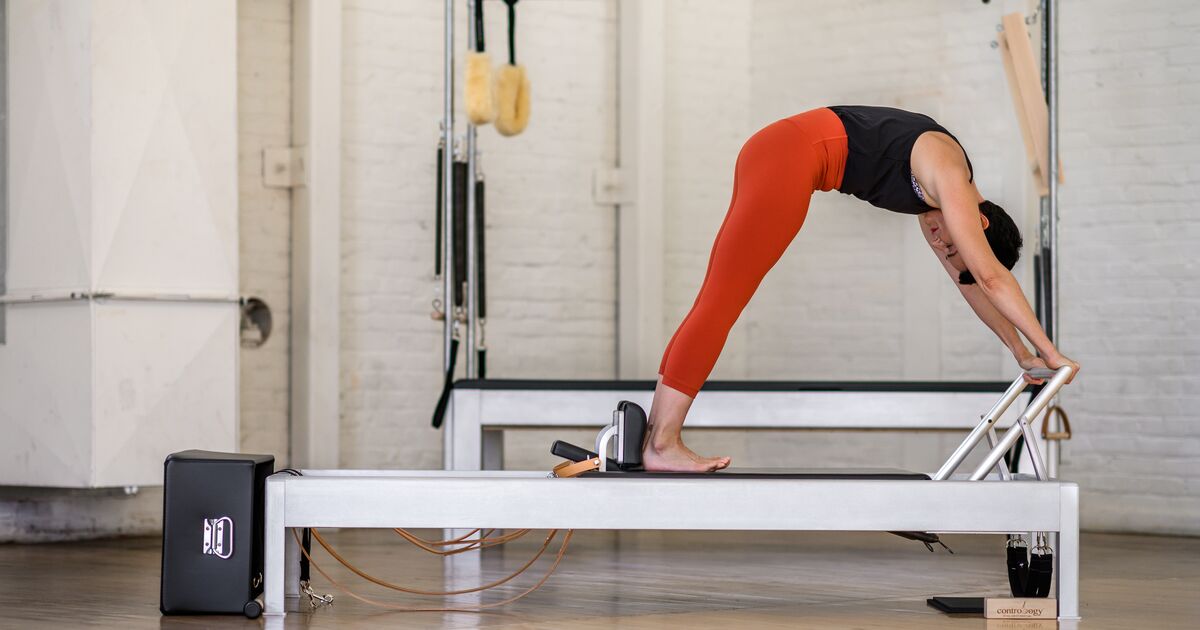
For instance, during many exercises, you will be positioned upside down.
- They require full focus on the exercise
These exercises are no joke – if the mind is not focused on controlling the body, they can be dangerous. You must be mentally prepared for this.
To meet the demands of advanced exercises, it is worth reaching for the appropriate equipment. At some point in your development, you will feel that the reformer alone is not enough. When you decide to take on advanced exercises, the Cadillac (e.g., during Chest Expansion or Thigh Stretch exercises), Arm Chair (which works great, for example, during the 4 exercises from the Rowing series), or the Spine Corrector (ideal for exercises like High Scissors and High Bicycle) will be very useful.
Of course, most advanced exercises can be performed on just the reformer and mat, but additional equipment significantly increases your comfort, safety, and possibilities.
Remember that many advanced exercises depend on strength, control, and endurance – and these should be nurtured from the very beginning. That’s why it is so important not only to “complete” the exercise but also to focus on the technique and precision of its execution. Exercises from this group will not happen on their own. They require discipline – often for many years – and taking on the challenge.

I am a graduate in Managerial Economics as well as Finance and Accounting, with a specialization in Marketing. Since 2018, I have been working as a Copywriter at Balanced Body, where I create marketing content for the fitness and Pilates industries. One of my particular strengths is translating complex topics into accessible language and accurately analyzing the needs of target audiences. Outside of work, I am passionate about fire shows and volleyball, which helps me better understand the needs of physically active people.