


Classic and Modern Pilates Machines – What Sets Them Apart?
Currently, endless versions of Pilates are offered in studios and gyms. Mat Pilates, Pilates for pregnant women, Pilates on machines… Not everyone knows that it is the latter that is most in line with what the creator of Pilates, Joseph Pilates, envisioned when he developed his disciplined physical system in the early 20th century.
What is classical Pilates on machines? What distinguishes classical Pilates machines from modern ones? What style should you choose? We provide some guidance.
CLASSICAL PILATES
Creating his method, Joseph Pilates aimed to develop a system that, through a series of precise, controlled movements, works on all muscle groups in the body while also addressing posture, functionality, and flexibility. Classical Pilates is also one of the best practices for mindful training, helping to alleviate stress and anxiety through breathing exercises, which is one of its key principles. Specially designed machines, such as the Reformer, Cadillac, Tower, Barrel, or Wunda Chair, are intended to achieve these goals.
In classical Pilates, instructors strive to stay as close as possible to how Joseph Pilates worked. This includes all of his original training procedures, exercises, and the order in which they are performed. Some instructions in classical Pilates may vary, but for the most part, many remain true to their original roots.
One of the fundamental differences between classical and modern Pilates is the positioning of the pelvis – in the classical approach, foundational exercises are performed in a backward tilt (the pelvis is tucked).
EXAMPLES OF CLASSIC PILATES EQUIPMENT
Classic Pilates equipment primarily consists of machines marked with the word “Contrology.” Interestingly, Pilates himself initially referred to the method of exercises he developed in this way. Studios opened in the classic spirit most often choose:
- Contrology Reformer – inspired by the original design of Joseph Pilates, created in collaboration with his student – Jay Grimes and his protégé, one of the most respected Pilates mentors – Karen Frischmann. The device features an elegant, durable frame made of sturdy aluminum, ensuring smooth movement of the platform. Finished in a satin style, it has traditional leather straps and unique Contrology Springs that faithfully replicate the work of the original. The innovatively designed rail with an altered angle of inclination emphasizes the uniqueness of this classic equipment, which, despite its demanding nature, allows for quick and effective achievement of desired training results.

- Contrology Reformer with Tower and Mat – this versatile training device faithfully reflects the principles of J. Pilates. It combines the functions of a reformer, tower, and mat, saving valuable space in a studio or home. The solid frame made of extruded aluminum and elegant satin finish ensure durability and aesthetics. The mechanism of the moving platform guarantees smooth exercises, while traditional straps and handles made of natural leather highlight the authenticity of the experience. The tower made of durable steel and the mat made of dense foam provide comfort and support during training.

- Contrology Cadillac – a classic device that provides maximum stability, ease of adjustment, and safety. All thanks to specially designed springs that faithfully reflect the character of the original machine by Joseph Pilates and allow one to experience those times firsthand. The solid frame made of extruded aluminum and the rigid trapeze made of galvanized steel tubes ensure durability and stability. The dense foam mat provides comfort, and the moving elements are easy to adjust. Vintage-style details and an optional “toybox” for accessories add functionality and aesthetics. The device comes with a lifetime limited warranty, confirming its reliability.

CONTEMPORARY PILATES
Contemporary Pilates encompasses everything that has emerged after the classic. Essentially, much still relies on the fundamental work of Joseph Pilates, but certain changes have occurred.
For example, thanks to modern scientific research, various exercise variations have been added or modified to include rehabilitation after injuries. Exercises are performed in a slightly different order than recommended by Joseph Pilates. The evolution of contemporary Pilates has also been significantly influenced by physiotherapy.
As mentioned, in contemporary Pilates, practitioners position the pelvis differently – exercises are conducted in a neutral pelvis (with a normal curve of the lumbar spine).
EXAMPLES OF MODERN PILATES MACHINES
Just like the exercises, the machines have been somewhat updated and modified in the modern version of Pilates. They are significantly easier to master and differ slightly in the materials used. Some of the most popular machines for contemporary Pilates are:
- Allegro 2 Reformer – stands out with its innovative design and construction that ensures easy and intuitive operation. It features a comfortable EasySet rail that can be precisely adjusted with 4 vertical positions and 9 horizontal positions. The sturdy frame made of painted aluminum, with maple wood elements, is equipped with optional wheels that facilitate the movement of the device. The Reformer is characterized by quiet and smooth operation, as well as the ability to be stored in a vertical position – making it an ideal solution even for small spaces.

- Studio Reformer – made of maple wood, has been trusted by professionals for many years. It offers the widest configuration possibilities, allowing for perfect adaptation to the individual needs of users. Its elegant frame with a satin finish is not only durable but also robust, ensuring long-lasting use. Users can choose from three types of rails and spring attachment systems, allowing for full customization of the device for different types of exercises. The Reformer is equipped with a unique 8-wheel system that ensures quiet and smooth operation. The device is also available in a Stretch version, which is 15cm longer, thus increasing the comfort of exercises for taller users.
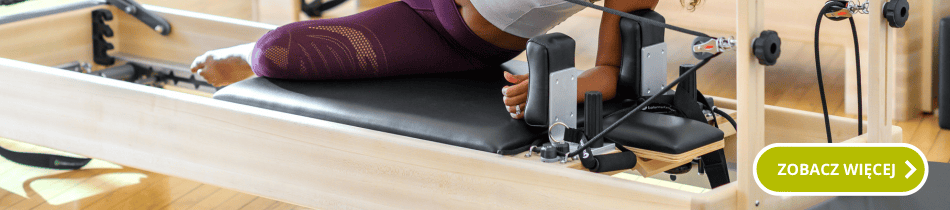
- Rialto Reformer – this unique device features an attractive design that combines a stylish wooden frame with metal anthracite legs. It is ideal for modern Pilates studios, especially during group classes. The Reformer is characterized by a solid, stable frame, handcrafted from maple wood, and legs made of painted aluminum. Its carriage operates silently and smoothly, enhancing the comfort of exercises. Additionally, the adjustable rail allows for quick height adjustment to suit each user’s height.

CLASSIC REFORMER AND MODERN REFORMER – COMPARISON
The classic Pilates reformer is a machine consisting of a sturdy frame made of hot-rolled aluminum, movable pulleys attached to it with straps made of natural leather, a movable platform, and springs with long hooks made of carbon steel. It resembles a bed in appearance.
In the classic reformer, it is essential to accurately reproduce all details so that the device perfectly reflects the original design, in accordance with the ideas and intentions of Joseph Pilates. The springs, the way they are attached, the angle of the handrails, the shaped armrests – all of these factors matter to ensure that the course of the training and its results align with the creator’s assumptions. An example of such a reformer is the Contrology Reformer from Balanced Body. It was created as a result of several months of collaboration with a direct student of Joseph Pilates – Jay Grimes – and his protégé and long-time collaborator – Karen Frischmann.
Modern reformers are largely based on their classic predecessors; however, there are several differences that make them deviate in appearance and some functions.
In modern reformers, the frame is no longer made solely of aluminum. It is created, for example, from wide boards (as in the Studio Reformer from Balanced Body) or a combination of aluminum and wood (as in the Allegro 2 Reformer from Balanced Body). The straps are made not from leather but from flexible cords with adjustments, allowing for quick and precise length adjustments to suit users and the exercises being performed.
In modern reformers, the springs also differ – they have slightly shorter hooks and are marked with different colors, allowing for greater resistance adjustment. In classic reformers, the springs require more force to move the platform. Modern reformers may also have different spring attachment systems: Revo Springbar (integrated with the movable platform) or No-Roll Springbar (in which the oval shape of the rod prevents it from rotating and the springs from slipping out).
Modern reformers also utilize an innovative handrail adjustment system. This allows for an ergonomic body posture for each user during exercises, regardless of their body structure, height, or physical capabilities. For example, the Revo Footbar allows for 4 position settings, while the Infinity Footbar – the most innovative – enables smooth horizontal movement of the handrail along the entire length of the reformer.
CLASSIC OR MODERN – WHICH STYLE TO CHOOSE?
There is no definitive answer here – neither approach to Pilates is wrong. However, if you are dealing with a limited range of motion or injuries, modern Pilates may be better for you. For those seeking a style much closer to the original work of Joseph Pilates, we recommend the classic approach.

I am a graduate in Managerial Economics as well as Finance and Accounting, with a specialization in Marketing. Since 2018, I have been working as a Copywriter at Balanced Body, where I create marketing content for the fitness and Pilates industries. One of my particular strengths is translating complex topics into accessible language and accurately analyzing the needs of target audiences. Outside of work, I am passionate about fire shows and volleyball, which helps me better understand the needs of physically active people.