


Classical Pilates
What is classical Pilates?
If you are wondering whether it is worth engaging in Pilates or you have just caught the enthusiasm for this form of taking care of your health – you must discover what classical Pilates is. It is a school that has survived for over 100 years and gains its followers every day. This is all thanks to the perfect concept of Joseph Pilates – because what was brilliant from the beginning requires no corrections.
The principles and intentions of Joseph Pilates
Every exercise session according to Joseph Pilates was meant to be a very strong and intense workout for both the body and mind – simultaneously. The entire focus should concentrate around the strength of the abdominal muscles. All of this contributes to endurance, strength, flexibility, and stability. It is these aspects that are maximally stimulated to action during training. The teacher must adjust the level of training to the student’s capabilities in order to utilize their full potential during each session. There is no problem if dealing with a healthy person. Special attention should be given to those who are ill and for whom such training will be a significant challenge. There are many exercises, and the possibilities of adapting them to individual needs are also vast – this is why Pilates is such a versatile field of health care.
Reach for the roots – rely on proven methods
As is commonly known, knowledge tends to evolve when passed from mouth to mouth. A similar pattern affects anyone who wants to learn the original secrets of Pilates, which were conceived by the master himself. These discrepancies, referred to by many teachers of this technique as a “virus,” have appeared quite naturally and often simply help in performing the original, classical exercises. However, it all depends on the teacher you encounter. Many people are even unaware that some of the exercises they perform or teach are not a faithful representation of the original. So how can we simply define what classical Pilates is?
Classical Pilates is nothing more than the most faithful reproduction of the exercises and the order of their execution created by Joseph Pilates.
However, a dispute arises over which of the currently available schools is the most faithful, that is, the true and classical one. There are slight differences in the order and in the ways of performing the exercises, making it difficult to determine with 100% accuracy which variant is unequivocally true.
Another way to distinguish classical Pilates from its modernized forms is the positioning of the pelvis on the mat during exercises. Classically, abdominal exercises should be performed in a “posterior pelvic tilt” – meaning when lying on your back, the lower back should be completely pressed into the floor, creating a “pelvis tuck.” However, nowadays, it all depends on the classical Pilates teacher as well as the exercise being performed.
Classical Pilates is a demanding and appropriate sequence
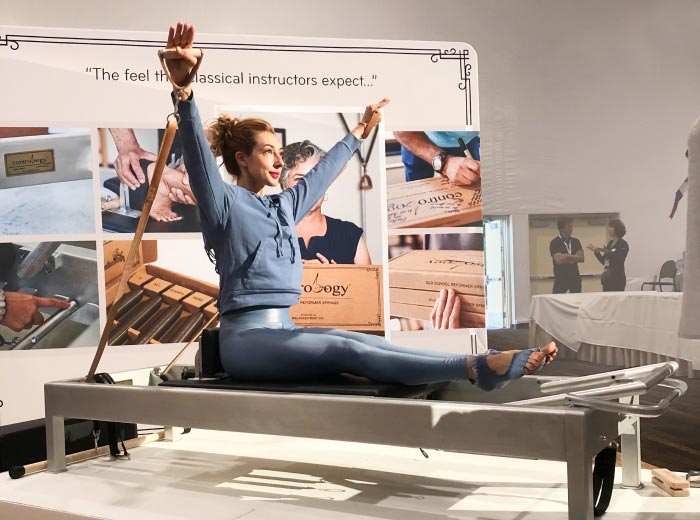
Those teaching Pilates in its classical version teach the sequence created by Joseph Pilates, mainly for exercises on the reformer and mat. The reason is very simple – the order established by Pilates properly warms up the body, presents challenges, and then allows it to cool down. This order strengthens and stretches the arms, legs, and torso in all planes of movement. The sequence he established creates challenges for practitioners with the appropriate pace of systematic development and achieving increasingly difficult goals. It also allows working against gravity, which is related to lying down, sitting, kneeling, and standing up.
Regardless of whether you are exercising or plan to exercise, you must remember that the main idea is to create a training session that develops in accordance with the principle related to gravity and the theory behind the appropriate order of performing exercises. The training must be balanced, but at the same time demanding effort and work. Such a structured session will be the most effective and will allow you to achieve the best results in a relatively short time.

I am a graduate in Managerial Economics as well as Finance and Accounting, with a specialization in Marketing. Since 2018, I have been working as a Copywriter at Balanced Body, where I create marketing content for the fitness and Pilates industries. One of my particular strengths is translating complex topics into accessible language and accurately analyzing the needs of target audiences. Outside of work, I am passionate about fire shows and volleyball, which helps me better understand the needs of physically active people.