


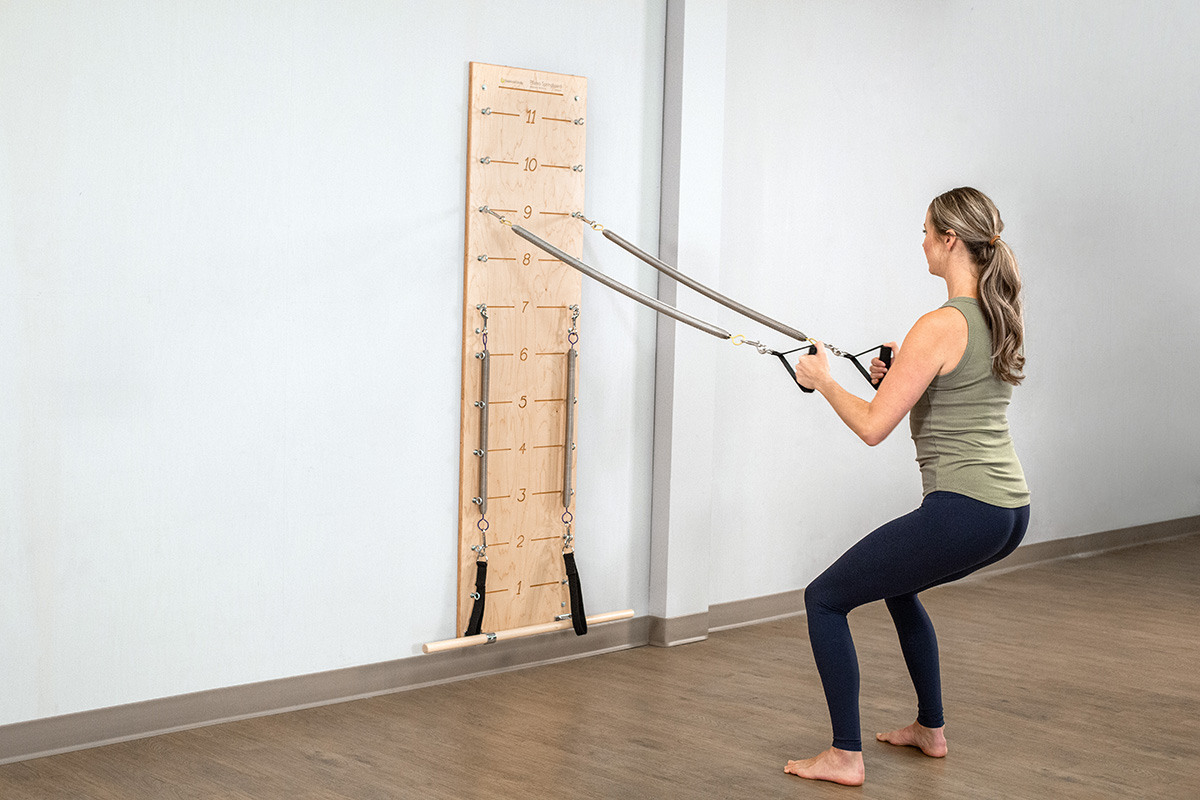
Pilates by the Wall – A Way to an Effective and Enjoyable Workout
Do you want to relieve your spine after a long day of sitting? Or perhaps you are looking for a way to improve pelvic and spinal stabilization, as well as strengthen your smooth muscles? Try Pilates at the wall – exercises based on the classical Pilates method that will give you the opportunity to take a break from sitting.
A list of Pilates studios with machines can be found here. Check if you can schedule a training session in your city.
BODY POSITIONS – HOW DO THEY AFFECT EXERCISES?
Body positions – sitting, lying, and standing – greatly influence your functioning. They are particularly important for the spine, which is indeed resistant to loads, but only when the entire musculoskeletal system is functioning properly and the loads are not too great.
Theoretically, when you compare the three body positions – lying, sitting, and standing, you might conclude that the spine is most heavily loaded while standing, and least while lying down. Your intuition suggests this – it is much easier to relax while sitting than while standing. Usually, you can also sit longer than stand. Does this mean that sitting is better for your spine than standing?
It turns out that sitting is not as good for the spine as is commonly believed. To understand this, it is worth first realizing one fact – the shock absorbers of loads in the spine are the intervertebral discs, which are subjected to pressure due to movement and while maintaining a position. This happens because different body positions generate different compressive forces, causing pressure on the intervertebral disc. Excessive compensatory forces can even lead to the destruction of the entire intervertebral disc.
Research has shown that the sitting position loads the intervertebral disc by 30% to even 40% more than the standing position. While sitting allows the back extensor muscles to rest, this position causes greater strain on the disc. Interestingly, the way you sit also plays a significant role. Sitting on a classic chair, with the backrest at a 90-degree angle, is much more burdensome than sitting with the backrest at a 120-degree angle. The greatest strain occurs when bending the spine forward while performing rotation.
It is no wonder that exercises in a standing position can be a salvation for a spine condemned to hours of sitting. However, the spine is not the only part of the body that feels strongly about the position in which you perform various activities. Body position also affects the circulatory system and exercise capacity. Studies have shown that body position during training is linked to the speed of return to normal heart rate after exercise. A higher heart rate lasts longer if you train in a standing position, which means that standing engages your forces for a longer time. This way, you will achieve the results you are working for more quickly.
The heart rate also significantly increases if you frequently change positions during training – for example, from sitting to standing or from standing to sitting. Workouts that involve frequent changes in body position can have a greater impact on heart rate than exercises requiring a constant body posture.
WHAT IS THE DIFFERENCE BETWEEN WALL PILATES AND MAT PILATES
Wall Pilates and mat Pilates exercises have a lot in common – after all, they are based on the same classic method. However, there are several significant differences between them.
Mat exercises are certainly the least stressful for the spine – this is due to the fact that when lying on your back, the intervertebral discs are under the least pressure. In the lying position, small compressive forces act on the discs, and the weight of the upper body is not transferred according to gravity to the lower parts of the body, as it is when standing.
However, standing exercises have several undeniable advantages. First, when you stand during exercises, you have a much greater influence on shaping and correcting your posture. Standing exercises are therefore a great way to develop good body posture habits.
Using the wall for training is also a clever way to gain feedback on your alignment. Anchoring your feet, hands, or back on a stable, immobile surface is called a closed-chain environment and is the most helpful way to increase proprioception in the body, which in turn helps you understand the exercise better and perform it more correctly. As a result, you will gain more benefits from the exercises.
Using the wall as a training prop improves posture and balance. With the wall, you will better realize where your body is in space, and after the workout… you will feel taller.
It is also worth remembering that using the wall during exercises does not mean that you will perform all exercises in a standing position. You can also use the wall for lying exercises, for example, for leg training. Using the wall in this case strengthens the hamstrings and glutes and allows for alternating abdominal muscle exercises.
WALL PILATES – TOOLS – WALL TOWER AND PILATES SPRINGBOARD
Although you will find many proposals for training sessions using a regular wall online, you will achieve even better results by using Pilates equipment designed for this purpose – the Wall Tower and Pilates Springboard.
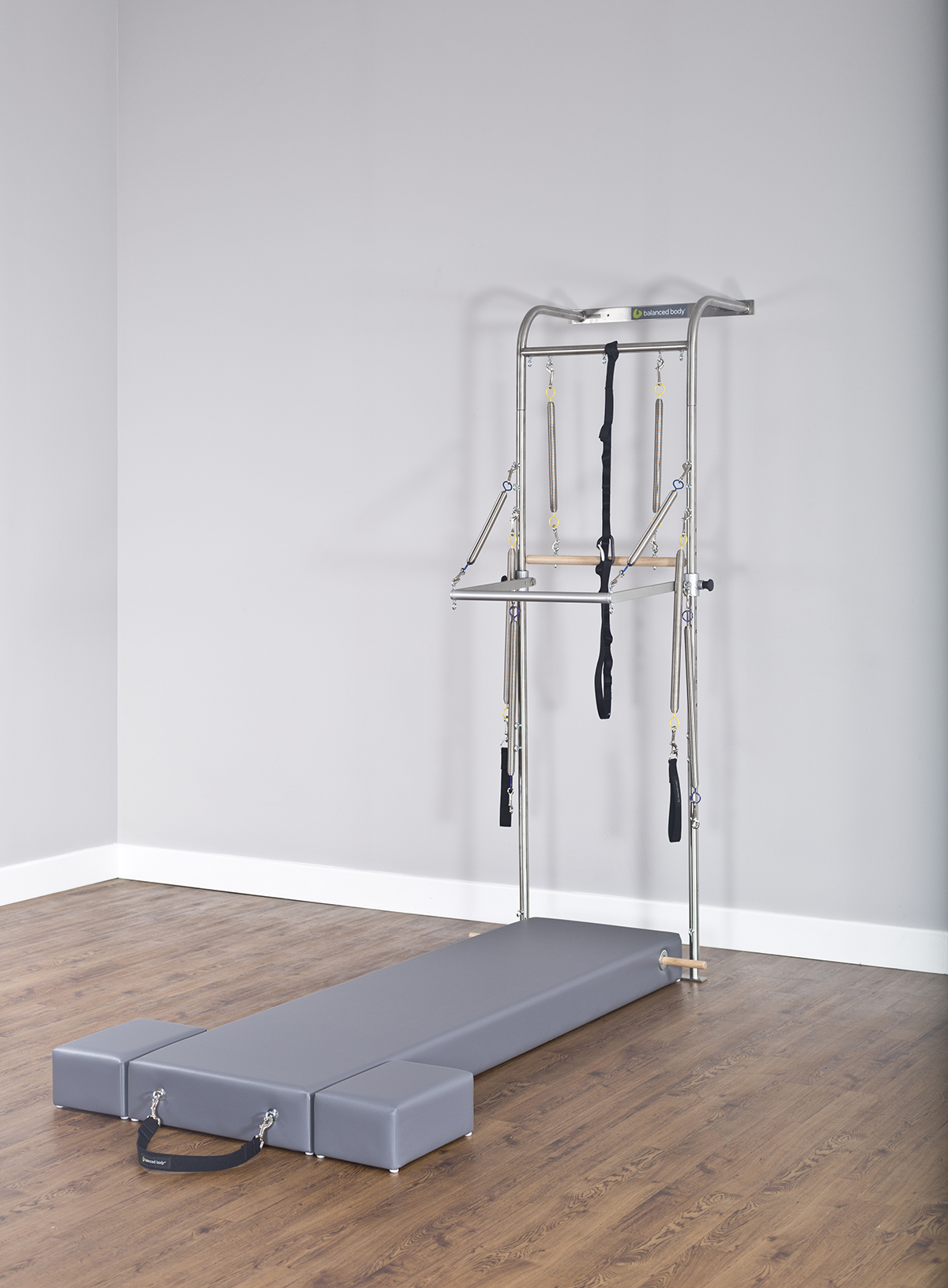
The Wall Tower is the ideal tool for training sessions and group classes. It can be used for various exercises with a traditional or high mat placed on the floor, as well as a reformer of any height. This allows for an expanded and enriched Pilates training.
The Wall Tower consists of a tall, stable frame securely mounted to the wall and floor, as well as a set of loops, springs, and bars that can be attached at selected points on the frame. They allow for varied training and customization to individual requirements. The Wall Tower is also equipped with a side movable bar that you can set in 8 positions at different heights on the tower. This way, you can adjust it to the needs of users and the height of the mat or reformer of any dimensions.
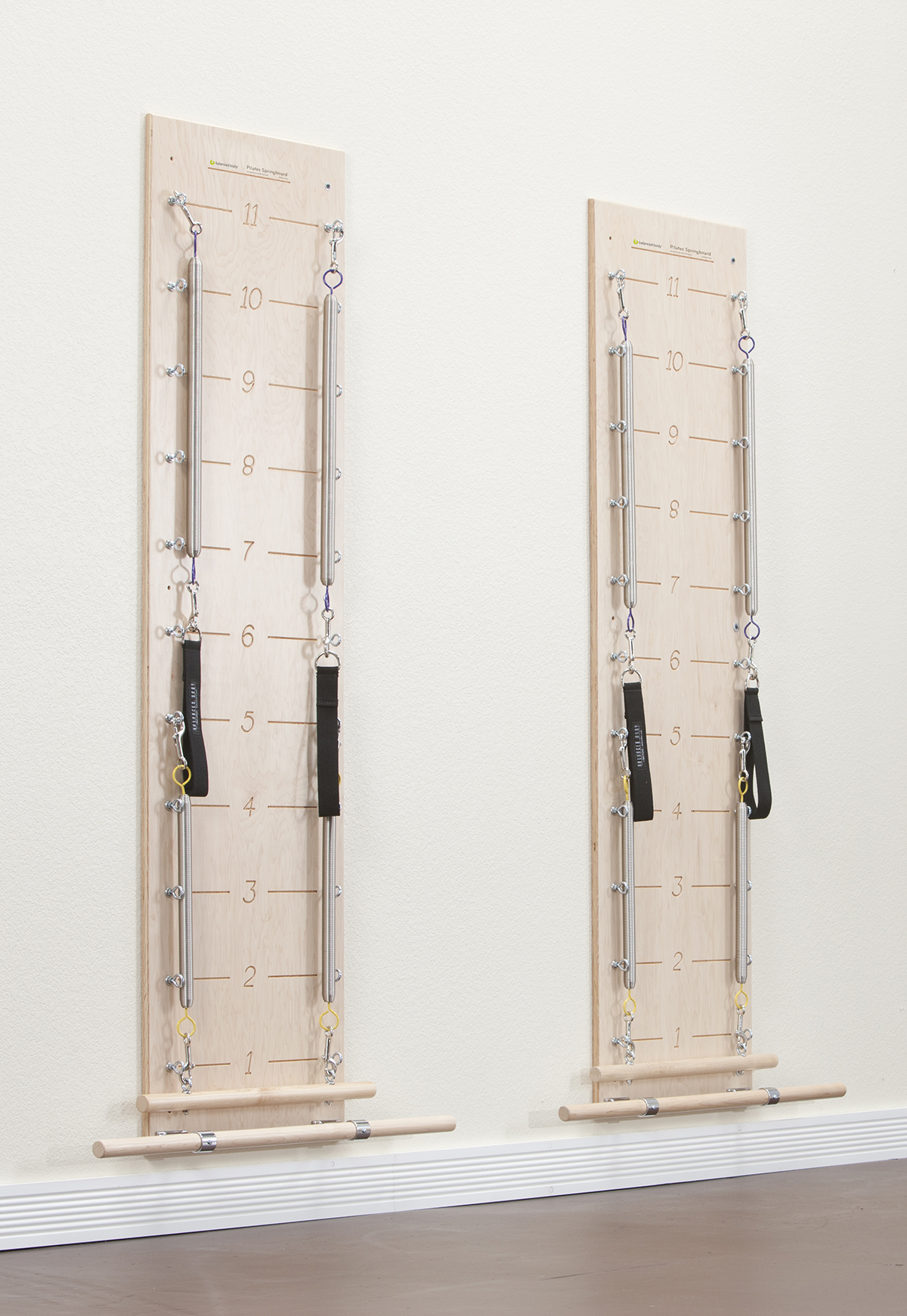
An alternative to the traditional Pilates tower is the Pilates Springboard – a stable, wall-mounted exercise device, ideal for conducting dynamic full-body training. This modern device was created by master Pilates trainer – Ellie Herman.
The Pilates Springboard is suitable for both Pilates studios or rehabilitation offices, as well as home gyms. Using the Pilates Springboard, you can exercise in various positions – standing, sitting, and lying on the mat.
The Pilates Springboard is equipped with a set of accessories that enable comprehensive training, including two wooden bars intended for upper body and leg exercises, as well as springs. Exercises can be tailored to each user thanks to 22 spring attachment points, allowing for wide adjustment and modification of exercises.
IS WALL PILATES THE SAME AS PILATES ON THE TOWER ON A REFORMER OR CADILLAC?
Wall Pilates uses a regular wall or door to perform exercises. It is a good way to conduct an effective workout if you do not have access to professional equipment. Exercises against a regular wall help relieve the spine, especially after long periods of sitting, improve pelvic and spinal stabilization, as well as strengthen deep muscles and enhance proprioception.
The advantage of Wall Pilates is that you can do it practically anywhere, in any room. All you need is a piece of wall. Such exercises are a great way to take a break from sitting, for example, during an office work break.
Pilates exercises on the tower on a reformer or on a Cadillac have a lot in common with Wall Pilates, but they offer you many more training possibilities. When you first see such equipment, you may feel intimidated by it. However, you will soon realize that they are not instruments of torture, but huge helpers in the pursuit of a healthy and beautiful body.
Exercises on equipment are actually much easier than without it – all thanks to the supportive springs and other accessories. Using Pilates equipment ensures precise training – whether standing, sitting, lying down, or kneeling. It allows you to strengthen your body safely, achieve balance, correct posture, and even identify weak spots to strengthen them. Using Pilates equipment with the resistance of the spring mechanism will also make you feel more stretched.
Using the tower on a reformer or Cadillac allows for many more types of exercises than with regular Wall Pilates. Training with this equipment offers virtually unlimited possibilities – you will work your entire body, from head to toe.
Wall Pilates is a great option for dynamic group training and as a complement to personal training. It can be conducted using a piece of regular wall, but you will achieve much better results using professional Pilates equipment, such as the Wall Tower and Pilates Springboard.
The advantage of Wall Pilates is its positive impact on the spine, especially for those who spend long hours sitting. With Wall Pilates, you will relieve your spine and gain other benefits, such as posture correction, improved pelvic and spinal stabilization, strengthened deep muscles, and enhanced proprioception.
It is worth trying this variation of Pilates to support your spine and diversify your regular training.

I am a graduate in Managerial Economics as well as Finance and Accounting, with a specialization in Marketing. Since 2018, I have been working as a Copywriter at Balanced Body, where I create marketing content for the fitness and Pilates industries. One of my particular strengths is translating complex topics into accessible language and accurately analyzing the needs of target audiences. Outside of work, I am passionate about fire shows and volleyball, which helps me better understand the needs of physically active people.