


Dynamic Stabilization: Rehabilitation in Pilates Part 2
Phase II: Dynamic Stabilization
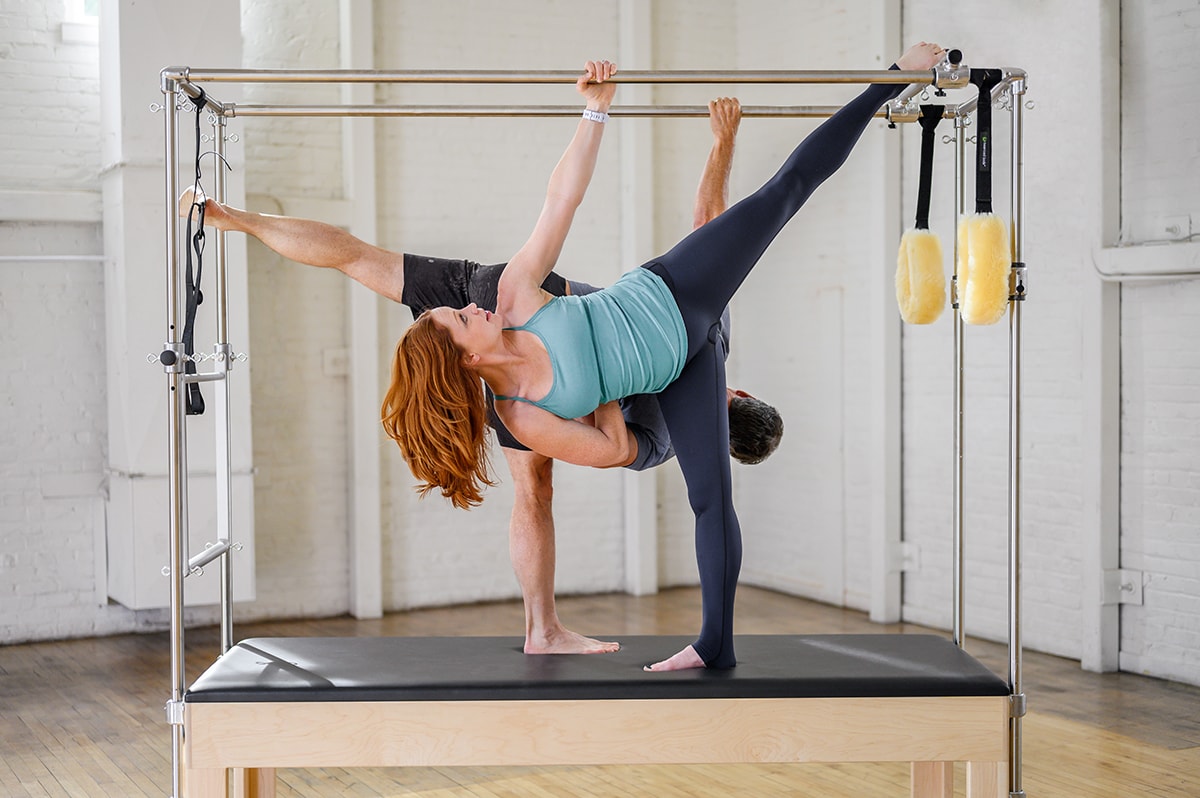
The next phase – the second – is called dynamic stabilization. Its initiation involves challenging the newly acquired – in the previous phase – mobility or stability. However, this occurs in more functional conditions and already dependent on gravity. It is easy to notice that this phase is a continuation of the disconnection, stabilization, and mobilization achieved during Phase I.
How does it work?
The entire process of the second phase requires additional effort. By reducing support and the base of support or by increasing the length of the lever, the range of motion or the difficulty of the exercise increases. Once the desired movement is restored or the intended range of motion is achieved, it may turn out that the newly acquired skill is inadequate for the goals and expected results.
Advanced athletes – amateurs or professional competitors often require greater movement challenges concerning gravity and resistance than is necessary for patients leading a more sedentary lifestyle. Efficiency, effectiveness, and movement performance are the primary goals of the exercises.
Emphasis on Control
By incorporating specific breathing and movement principles and appropriately engaging these elements during training already at an early stage in Phase I, the patient’s ability to activate secondary stabilizers (i.e., the erector spinae, internal and external oblique muscles, latissimus dorsi, or pelvic floor muscles) improves. The rectus abdominis should be trained in a more ballistic manner, as it consists mainly of type II muscle fibers that perform quick contractions.
This phase focuses primarily on controlling movement.
Part III “Functional Reeducation”

I am a graduate in Managerial Economics as well as Finance and Accounting, with a specialization in Marketing. Since 2018, I have been working as a Copywriter at Balanced Body, where I create marketing content for the fitness and Pilates industries. One of my particular strengths is translating complex topics into accessible language and accurately analyzing the needs of target audiences. Outside of work, I am passionate about fire shows and volleyball, which helps me better understand the needs of physically active people.