


Can Pilates be effective in treating lumbar degenerative disc disease?
Are you looking for a way to relieve lower back pain? You are not alone – this condition is one of the most common ailments among adults and the elderly. Statistics show that degenerative spine disease affects more than half of the population over the age of 40.
Back pain is not just a matter of discomfort – it hinders normal functioning and is one of the most common causes of absenteeism at work. When your back suffers, your wallet suffers too. It’s no wonder that patients often seek shortcuts to relieve their pain. They turn to painkillers and take them for years on end. As a result, the problem is pushed aside and worsens. In many cases, degenerations increase to the point where surgical procedures become the only option, or even a necessity.
Don’t make this mistake! Pharmacology and surgical procedures are not the only ways to combat spinal degenerations. Massages and other therapies in which you are a passive participant also bring moderate benefits. The best thing you can do to prevent and fight spinal diseases is to move! However, not every form of movement is beneficial for the spine. So which one should you choose to help with your ailments?
Here comes Pilates – a method created by Joseph Pilates, which has so far been appreciated mainly in fitness clubs and gyms, and is now gaining recognition among doctors, researchers, physiotherapists, and orthopedists.
How does Pilates affect the improvement of health in cases of degenerative disease of the lumbar spine? Why is it worth choosing these exercises? How to start Pilates training? Read on to find out more!
WHAT IS LUMBAR SPINE DEGENERATIVE DISEASE?
Lumbar spine degenerative disease is a degenerative condition of the spinal structures in the area connecting the thoracic segment with the sacrum. It causes irreversible changes in this area. Although the lumbar segment consists of only 5 vertebrae, numerous conditions related to a sedentary lifestyle, injuries, osteoporosis, and other issues develop in this area.
Degenerative disease involves the premature wear of tissues that make up the discs, vertebrae, and other components of the spine. As the disease progresses, the articular cartilage is damaged, bones undergo remodeling along with the formation of so-called “bone spurs,” and subchondral cysts also develop.
The consequences of lumbar spine degenerative disease are not optimistic – overall damage to spinal structures, the formation of instability in its parts, spinal deformity, and above all, pain – of varying intensity, often preventing normal functioning. Although initially, patients experience slight limitations in spinal mobility and moderate pain, over time, the condition leads to increasingly severe symptoms. Therefore, it is not worth ignoring even the first symptoms of the disease and downplaying them by taking doses of painkillers.
Although it is commonly believed that degenerative spine disease affects older individuals, in reality, the problem begins much earlier. The first signs can appear in adults over the age of 25. However, young people often do not acknowledge the problem and do not take any steps to prevent the disease from progressing, which reflects later in life.
What are the causes of degenerative disease? Doctors list many, but the main ones include:
- overweight and obesity,
- lack of movement,
- occupation – e.g., sedentary work or excessively heavy physical labor,
- hormone levels,
- high bone mass,
- congenital factors.
WHY PILATES?
To understand why the Pilates method has a particularly beneficial effect on the spine, it is worth looking back at its roots. The creator of the exercises – Joseph Pilates – did not enjoy good health as a child. He suffered from rickets, asthma, and rheumatic fever. He could have ended up as a cripple in a wheelchair, but he did not give up.
Since all types of physical activity at that time could not be practiced due to his ailments, as a growing boy, he created a set of exercises to help him overcome his physical weaknesses. The result was incredible – Pilates transformed from a frail child into a young man with such a beautifully sculpted body that at the age of 14, he became a model for anatomical drawings!
It is no wonder that his system quickly gained numerous followers among people with various ailments and pains. Pilates approached each case individually and constructed sets that helped with specific issues. The exercises proved to have a particularly beneficial effect on the spine – strengthening the muscles around its core, nurturing its physiological curves, and improving core stabilization.
Pilates is not just an ordinary method of exercise. It is rightly called intelligent gymnastics because it involves the conscious and purposeful execution of movements. The combination of all elements, such as breath, precision, centering, and fluidity of movement, requires great concentration and focus. Pilates exercises will allow you to delve into your body and teach you to control every, even the smallest, muscle, which will give you greater body awareness and help prevent injuries in daily functioning.
It is worth noting that Pilates is perfectly suited for older adults and those suffering from various ailments, as the proposed movement combines effectiveness and gentleness. It can be practiced after injuries and serious injuries, during pregnancy, at any age, and regardless of body weight.
HOW DOES PILATES SUPPORT THE TREATMENT OF LOW BACK PAIN DUE TO SPINAL DEGENERATION?
The positive effects of regular Pilates exercises are numerous – strengthening muscles, including deep muscles, relaxing shoulders, arms, and neck, and maintaining proper posture. Pilates has a beneficial impact especially on the skeleton, including the spine in all its sections. This is why this method has increasingly interested physiotherapists who are looking for optimal and effective training and rehabilitation programs for their patients.
One of the most important tasks of today’s rehabilitation is to reduce pain symptoms. It is pain that significantly lowers the quality of life, leading to disability. Regular Pilates exercises greatly contribute to reducing low back pain by improving overall physical fitness, muscle and joint mobility.
The beneficial impact of Pilates on the spine has been confirmed by scientific research.
Physiotherapists collaborating with the Faculty of Physiotherapy and Health Sciences at the University of Management in Gdańsk – Przemysław Karasiński, Katarzyna Pawłowska, and Jakub Pawłowski studied 30 women aged 50-65 who participated in weekly, hour-long Pilates classes for a period of 10 weeks. After this period, the patients were subjected to tests using tools such as the Roland-Morris Disability Questionnaire (RMDQ), the World Health Organization Quality of Life Questionnaire (WHOQOL-BREF), and tests for mobility and stabilization of the lumbar spine.
The research showed that regular Pilates training significantly improved the quality of life of patients suffering from degenerative lumbar spine disease. Positive changes observed included:
- significantly increased mobility, especially in terms of rotation and lateral bending of the torso as well as extension in the lumbar region,
- improvement in overall joint mobility,
- increased spinal mobility,
- significant improvement in conscious stabilization of the spine – both flexion and extension,
- significant reduction in pain symptoms,
- minimization and control of abnormal stresses in the studied women,
- proper posture control.
The conducted research clearly shows that Pilates training improves the health of individuals with degenerative lumbar spine disease, increasing their range of motion and relieving them from pain.
HOW TO START PILATES TRAINING?
You already know that Pilates training is a great way to prevent and treat degenerative lumbar spine disease. Do you want to transform your body with this method? We have good news for you – compared to other exercise systems, Pilates in its basic version does not require significant financial investment and can be practiced both in a fitness club and at home.
How to get started? You can use ready-made exercise sets available online, but initially, the best and safest way is to sign up for classes under the watchful eye of a qualified instructor. This way, the exercises will be tailored exactly to your conditions and capabilities. Working with a trainer will also help you avoid mistakes and instill healthy habits during exercises.
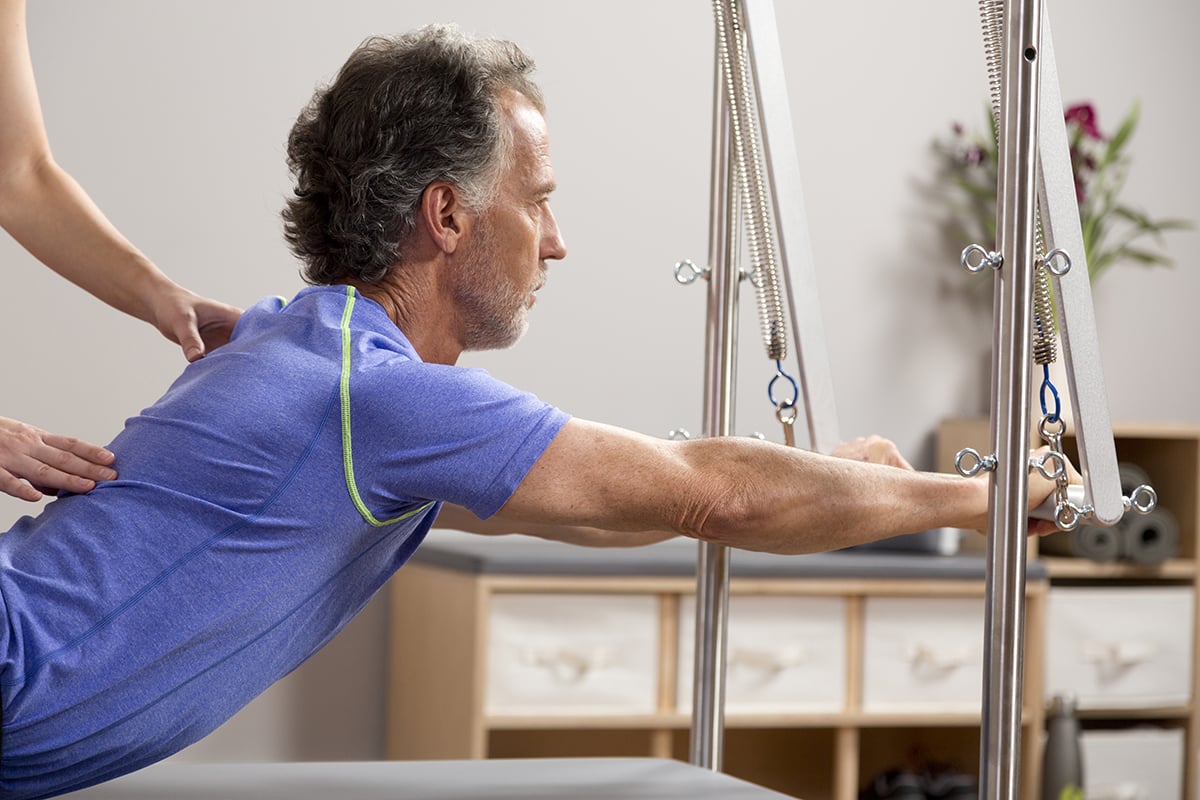
Later, depending on your needs and expectations, you can continue training at home or start advanced classes at the club. The latter option gives you the opportunity to use specialized Pilates machines, such as the Reformer or Cadillac. They are equipped with springs and straps that allow for greater control over the body and achieving better results.
Your body is your home – you should feel good in it. Don’t wait and transform it with regular Pilates exercises!

I am a graduate in Managerial Economics as well as Finance and Accounting, with a specialization in Marketing. Since 2018, I have been working as a Copywriter at Balanced Body, where I create marketing content for the fitness and Pilates industries. One of my particular strengths is translating complex topics into accessible language and accurately analyzing the needs of target audiences. Outside of work, I am passionate about fire shows and volleyball, which helps me better understand the needs of physically active people.