


Classical Pilates and Breathing
Do you know how significant breathing is during exercises? Even if you don’t spend much time on it, you are probably aware that it must be synchronized with the exercises being performed. Joseph Pilates, the creator of classical Pilates, was a pioneer in this regard – he emphasized the importance of the connection between exercise and breathing.
Romana Kryzanowska, an instructor who closely collaborated with Pilates and served as the director of the American Pilates studio after the death of its creator, continued the breathing practices of her master. Over time, certain modifications were added to the original principles based on the rhythm of the exercise and the level of the student, which we will discuss in this article. For example, some exercises – the so-called “Breathing Exercises” – follow the breath. Others require a more “naturally flowing” breath.
BREATHING ACCORDING TO JOSEPH PILATES
Pilates had a somewhat different perspective on breathing than that of previously existing disciplines. He believed that inhalation should occur during exertion – muscle contraction, and exhalation during rest – muscle relaxation. This way of breathing allows for the maximum amount of oxygen to be delivered to the working tissues during their contraction and to make full use of it.
Romana Kryzanowska told her students: “If you are doing something that strongly compresses your body, use that movement to squeeze the air out of your lungs and inhale when you straighten up.” A similar concept is used during rolling exercises, where the rolling movement pushes air in and out of the torso. As Pilates described in “Your Health,” the movement during rolling is “like a wheel rolling forward and backward, pushing air out, which effectively clears the lungs.”
In his books “Return to Life” and “Your Health,” Joseph Pilates promoted “long, deep breaths aimed at expanding the upper part of the chest to maximum capacity while pulling in the belly. One should hold the breath for a short time and then exhale, trying to squeeze every atom of air out of the lungs very hard.”
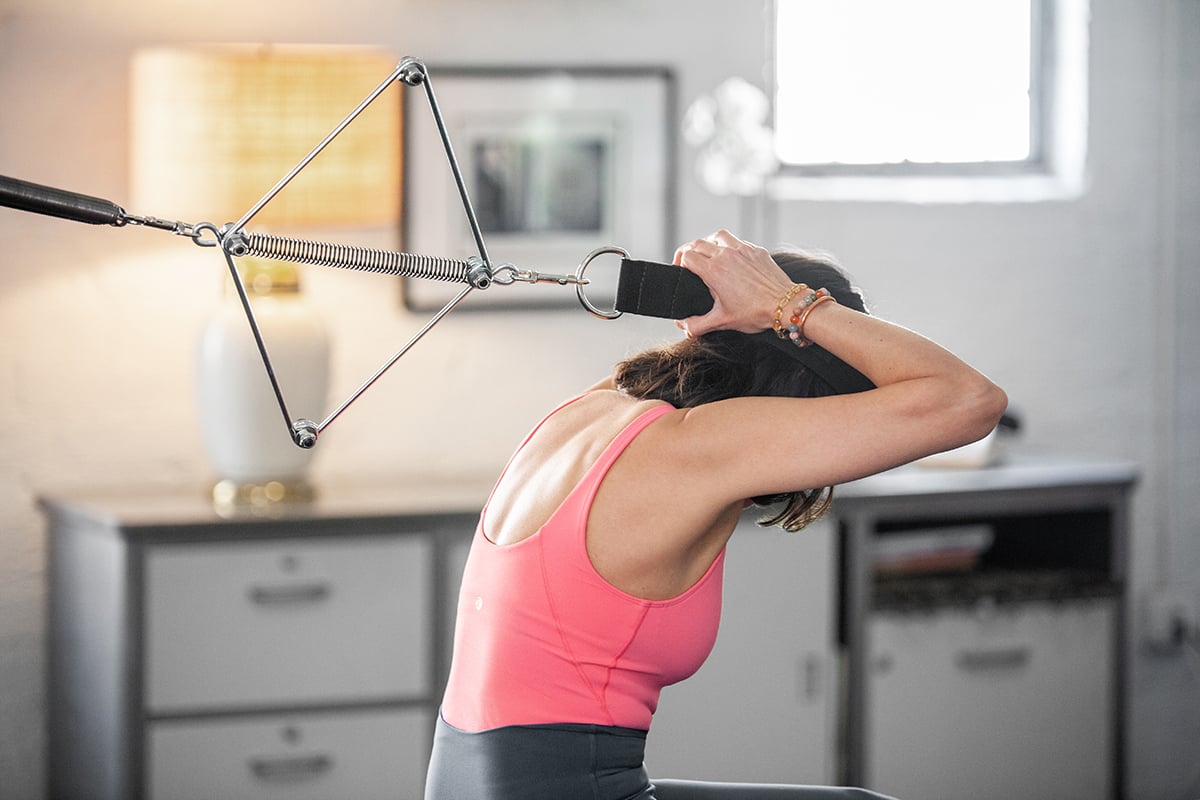
Joseph Pilates further explained his exhalation technique in an article in “Cosmopolitan” magazine from February 1941, authored by Kenneth Wilson. He advised that at the moment when it seems you have no breath left, pull in your belly again, round your shoulders, and lean your head forward until your chin rests firmly on your chest. At this moment, you should blow out the air as hard as you can – first through your nose, then through your mouth. You will find that you still have plenty of air to exhale!
LEARNING TO BREATHE IN PILATES
Learning to breathe deeply is difficult, which is why beginner students in classical Pilates are introduced to breathing using the “double breath.” This slows down the movement, allowing the student to better focus on cues, muscle actions, and coordination. For example, when performing the Spine Stretch Forward exercise, breathing should proceed as follows:
- inhale to sit taller,
- exhale while bending forward,
- inhale while rising up,
- exhale after returning to the starting position.
Once the student masters the double breath, a more advanced “single breath” is applied: inhale to begin the exercise and a deep exhale for the rest of its duration.
As you can see, the most important element of breathing in classical Pilates is a deep, intense exhale. There are two reasons for this: a deep exhale prepares the muscles for the next inhale. Secondly, the larger the exhale, the more emptied the lungs are, thus increasing the capacity to inhale new air. As Romana Kryzanowska used to say: “Your inhale is as good as your exhale!”
Joseph Pilates knew that posture also affects breathing. He was one of the first to promote chest breathing with engaged abdominal muscles. As described above, spinal flexion facilitates a deeper exhale, so when you actively inhale in such a position, “the lungs will completely fill with fresh air.” This cleansing physiological effect, maximized by muscle action, was the most important outcome of proper breathing for Joseph Pilates.
Breathing is one of the most important elements of Pilates exercises. As the creator of the method said, properly performed breathing “supplies the blood with life-giving oxygen that expands to the fingertips of the hands and feet, just like a heating system properly distributing heat in every room of the house.” Therefore, it is worth dedicating an appropriate amount of time to breathing exercises to make your training more effective and efficient!
Breathing During Machine Exercises
Many people associate Pilates with slow mat exercises – however, this is just a small part of the method. Classical Pilates is based on working with special Pilates machines, such as the Reformer, Cadillac, or Wunda Chair.
Their operation utilizes the potential of springs with varying degrees of resistance, allowing for greater results in a shorter time. The machines also help develop proper movement patterns, which allows you to continue exercising on the mat, for example, at home.
Learning to breathe in Pilates is just as important during mat exercises as it is on the machines. Everything starts with the breath. In daily life, no one controls their breathing – it is an unconscious process. However, in Pilates, you work on lengthening the exhale and adapting it to the exercises being performed. This way, you utilize the full capacity of your lungs. By breathing correctly during machine exercises, you achieve dynamic stabilization and also protect your spine from potential injuries.

I am a graduate in Managerial Economics as well as Finance and Accounting, with a specialization in Marketing. Since 2018, I have been working as a Copywriter at Balanced Body, where I create marketing content for the fitness and Pilates industries. One of my particular strengths is translating complex topics into accessible language and accurately analyzing the needs of target audiences. Outside of work, I am passionate about fire shows and volleyball, which helps me better understand the needs of physically active people.