


Supportive Movement: Rehabilitation in Pilates Part 1
The Pilates method has a wide application in musculoskeletal dysfunctions, both those caused by primary or secondary muscle tension distribution disorders, as well as in postural defects. It prevents back pain, improves joint mobility, strengthens the deep muscles of the back, abdomen, and pelvic floor, thereby allowing for the stabilization of the spine, shoulder girdle, and hip girdle.
Many physiotherapists value Pilates for providing proven methods to support patient therapy. The method offers the possibility of effectively correcting patients’ faulty movement patterns, proposing various exercises both on the mat and using advanced Pilates equipment and machines.
The Pilates method aims to achieve musculoskeletal fitness, which consists of achieving and maintaining local and general static balance, as well as muscle coordination – especially of the spine and respiratory muscles. It places great emphasis on central stabilization (so-called core stability), allowing for the patient to go through the process of building deep muscle strength. This is precisely why Pilates is so often used in rehabilitation – both the entire method and its elements.
Polestar Education
One example of a well-understood art of motor teaching is Polestar, a training organization that bases its practices on Pilates while also focusing on rehabilitation. It has defined the process of motor re-education of the spine using the Pilates method, dividing it into three phases.
Phase I: Supportive Movement
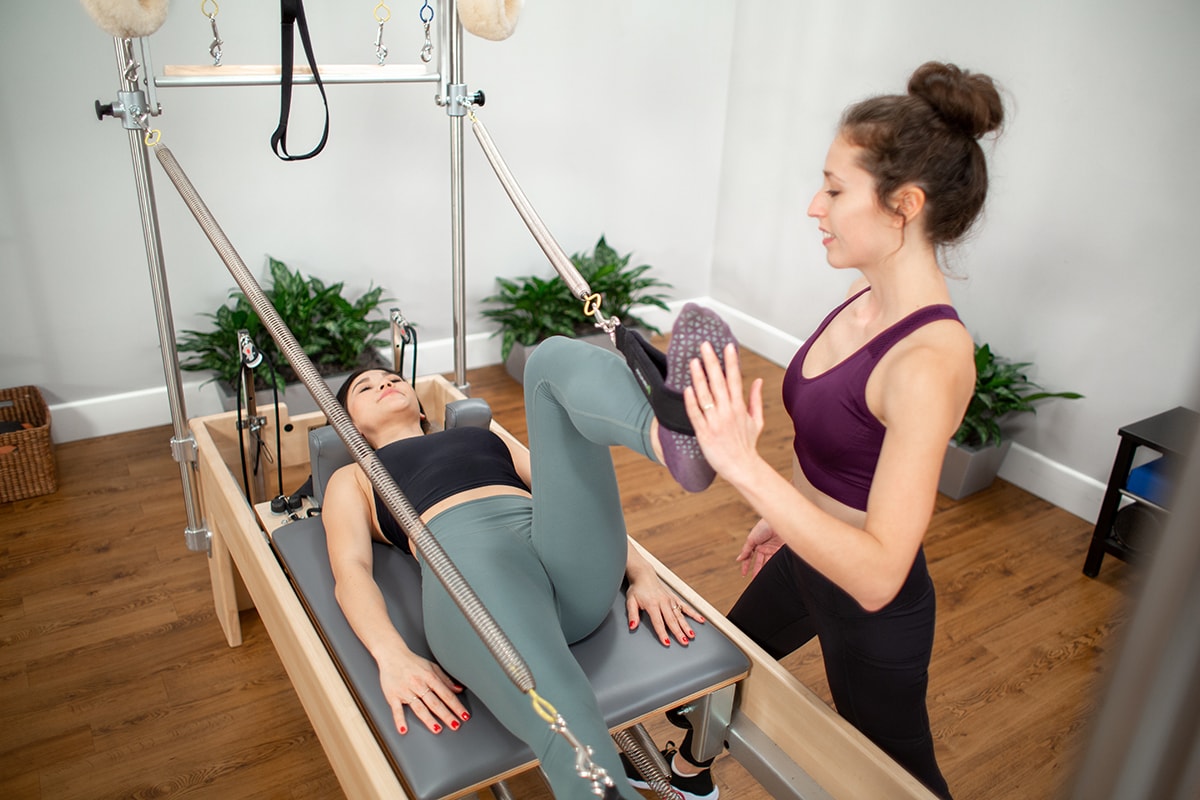
Supporting movement using springs can help reduce undesirable muscle activity in the healing process or protect against pain and muscle weakness. Phase I, according to Polestar, can be divided into three stages. These three stages can exist simultaneously.
Disconnection
Disconnection involves isolated movement in the hip or shoulder joint, independent of pelvic or spinal movement. Such isolation can be achieved by creating a large support surface. Disconnection, combined with stabilization, provides a beneficial environment that protects against future injuries to the spine. Large muscles that are often responsible for undesirable stiffness (i.e., the quadratus lumborum, gluteus maximus, or erector spinae) can be trained to lengthen eccentrically, allowing the hip joint to effectively absorb and distribute potentially harmful bending forces to the spine.
Stabilization
In the initial phase, deep stabilizers (i.e., the transverse abdominis, internal and external obliques, and multifidus) are responsible for this. Stabilizers are primarily composed of type I fibers and are designed to work at a submaximal level, which is 30% – 40% less than the maximum active contraction. This submaximal contraction occurs simultaneously with the separation of the limb or segments above or below the pathological change. When the limb is isolated from the torso and the pelvis remains in a neutral position, deep stabilizers function much more effectively in maintaining control over the body.
Mobilization
Mobilization is the restoration of mobility to joints and muscles affected by injury or other pathology. The therapist must be attentive, as inappropriate exercise selection, overly aggressive, or premature mobilization can contribute to the development or worsening of pathology. Conversely, the condition may worsen if mobility has not been restored. Therefore, utilizing the assistance of a specialist is very important to correctly restore the desired physiological movement. Pilates therapists can also use appropriate feedback and aids to facilitate achieving physiological movement. When the therapist restores mobility in the target joint and surrounding joints, forces are evenly distributed, minimizing destructive forces.
Part II “Dynamic Stabilization”
Part III “Functional Re-education”

I am a graduate in Managerial Economics as well as Finance and Accounting, with a specialization in Marketing. Since 2018, I have been working as a Copywriter at Balanced Body, where I create marketing content for the fitness and Pilates industries. One of my particular strengths is translating complex topics into accessible language and accurately analyzing the needs of target audiences. Outside of work, I am passionate about fire shows and volleyball, which helps me better understand the needs of physically active people.