


Pilates for Back Pain
Are back pains making your daily life difficult? Your spine is calling for help. You are not alone – up to 80% of the population experiences lower back pain at least once in their lifetime. Unfortunately, it often does not end with a one-time problem – 60% of people experience a recurrence within a year, and for 15%, the issue becomes a permanent disability. How can this be addressed?
Back problems do not arise out of nowhere – a sedentary lifestyle, lack of movement, and an improper diet take their toll. Many people believe that a good way to get rid of back pain is to rest. Unfortunately, mere inactivity will not help your spine.
Even the often-recommended massages do not provide the desired relief. Why? Research shows that the role of the patient should shift from being a passive recipient of therapeutic actions to one where they actively strive to regain their fitness.
When looking for an effective way to eliminate pain, choose exercises. Performing them daily guarantees significant improvement and pain relief without relying on medication. Physiotherapists especially recommend Pilates – a method that allows you to master and maintain active spinal stabilization, helping you to get rid of pain once and for all.
How does Pilates affect the spine?
Pilates exercises are an ideal remedy for back pain and stiffness. By practicing regularly, expect the following results:
- strengthening key muscles responsible for proper posture: abdominal, gluteal, and back muscles,
- relaxation of tense back muscles,
- stabilization of the torso,
- increased flexibility of the back,
- relief for the most vulnerable sections of the spine,
- improvement of body posture,
- increased balance and coordination.
When suffering from back pain, a very important, yet often overlooked element is maintaining active spinal stabilization. Pilates exercises lead to increased postural control, helping you avoid exposing tissues to increased loads, and consequently – pain.
In many traditional exercise programs, the goal is merely to increase the strength of muscle groups. Meanwhile, individual muscle groups must complement each other – some are responsible for performing movement, while others stabilize and support the spine. Therefore, the core muscles must tighten statically when necessary. This prevents unwanted additional movements that can lead to back pain.
Pilates, as one of the few exercise methods, combines exercises that increase the strength of muscle groups with those that stabilize muscles. Thanks to this, your body will learn to consciously and subconsciously coordinate muscle activity.
Exercises for a healthy spine – a sample workout you can do at home
Looking for something for your spine as a beginner? You’ve come to the right place. Pilates is a method for everyone. To start your workout, you only need a mat, a bit of space, and comfortable clothing.
- Start with a warm-up
Stand comfortably with your feet slightly apart. First, you need to activate parts of your body – head, pelvis, shoulders, spine. To do this, perform head circles, hip circles, arm swings, and gradual bends, “rolling” your spine. - Exercise in a kneeling position
Make sure your wrists are in a straight line under your shoulders, and your knees are under your hips. The position of your spine and head should be neutral. With an inhale, extend your right arm forward and your left leg back. Hold for a second, return to the starting position, and repeat the movement for the other arm and leg. Perform the exercise 10 times. - Exercise in a side-lying position
Lying on your side, support yourself on your right arm so that it is directly above your elbow. Bend your legs at the knees and in this position, lift your hips and your left straightened arm upwards while inhaling. During the exhale, twist your torso and place your hand under your right shoulder without lowering your hips. On the next inhale, lift your arm back up, following your hand with your gaze. Repeat the exercise 10 times. - Exercise in a supine position
Lying down, bend… - Stand with your knees and feet hip-width apart and place your arms along your body. Gradually lift your torso until you reach shoulder level. Extend your arms and bring them overhead. Hold for a second and slowly, vertebra by vertebra, return to the starting position. Perform 5 repetitions.
Between the above exercises, add relaxing exercises that will help you loosen and stretch your spine, such as calm inhalations and exhalations or gentle swaying. To achieve the desired effect, train at least 2-3 times a week, and preferably daily.
When you experience how easy and effective these exercises are, you will likely reach for additional equipment that will help you achieve even better results. To start, try the arcs. These specialized and versatile tools are recommended for back pain because they increase back flexibility and improve posture, balance, and coordination. Light, small, and practical, they are great for home workouts.
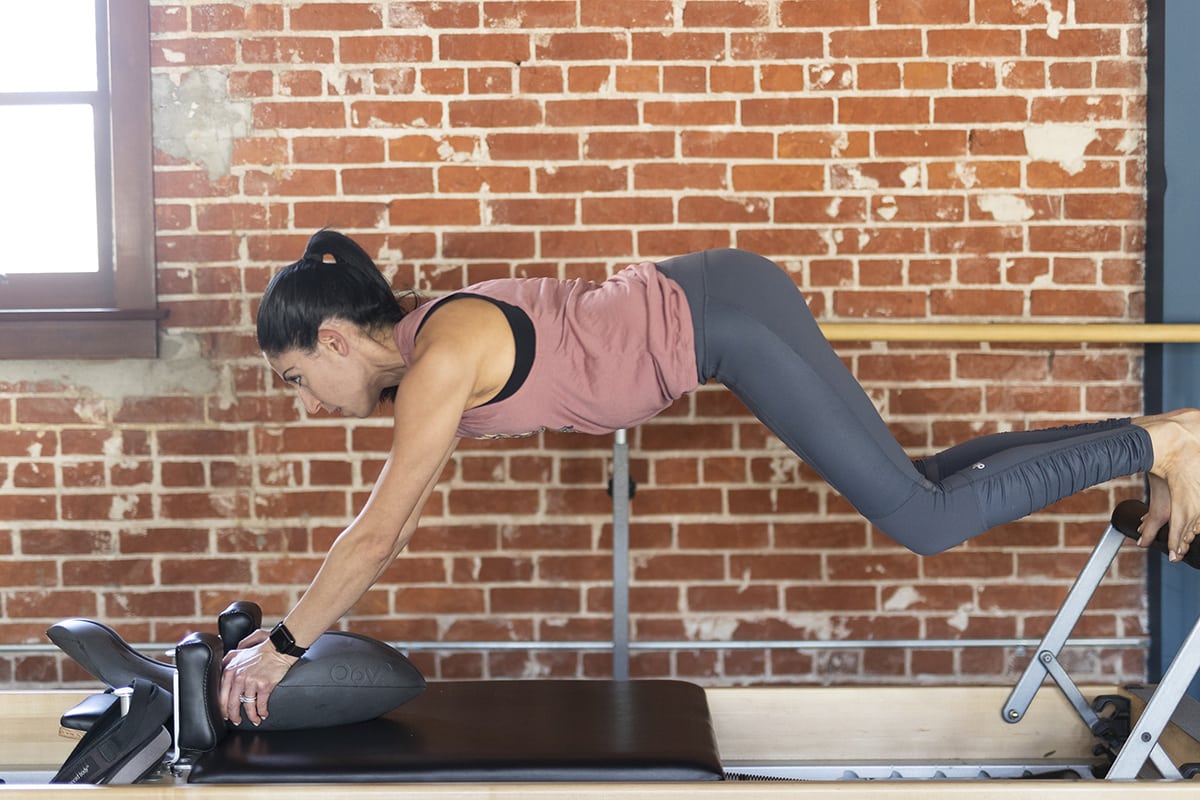
Another tool that will help relieve and relax your spine is the Oov. This device promotes body balancing and is shaped to fit the contours of your back and the natural curvature of your spine. Its unique design encourages proper back alignment and mobilizes deep and stabilizing muscles.
When practicing Pilates, don’t forget about prevention. Avoid bending, lifting heavy weights, sitting in one position for long periods, and make sure to incorporate additional movement, such as walking, swimming, etc.

I am a graduate in Managerial Economics as well as Finance and Accounting, with a specialization in Marketing. Since 2018, I have been working as a Copywriter at Balanced Body, where I create marketing content for the fitness and Pilates industries. One of my particular strengths is translating complex topics into accessible language and accurately analyzing the needs of target audiences. Outside of work, I am passionate about fire shows and volleyball, which helps me better understand the needs of physically active people.