


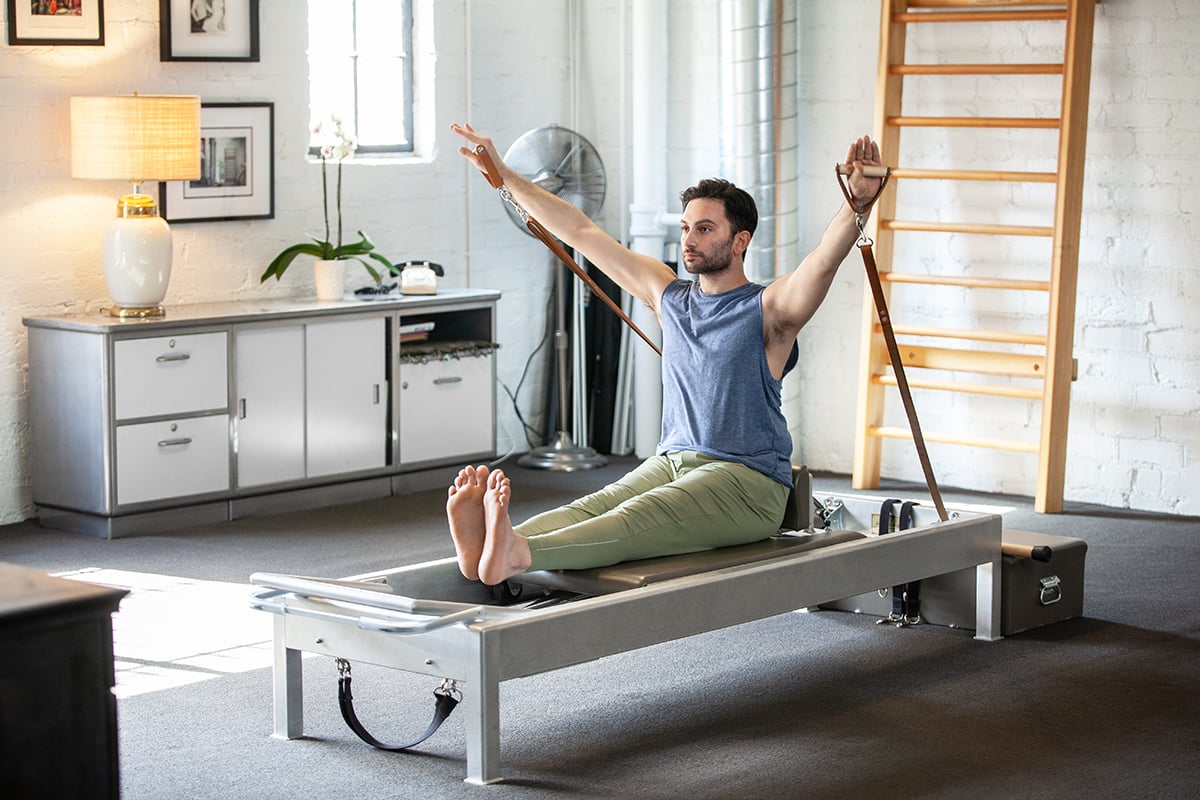
Building Muscle Strength with Pilates
Po co ćwiczysz pilates? Większość osób zaczyna przygodę z tą dyscypliną z zamiarem stania się silniejszym. Aby osiągnąć oczekiwane rezultaty, kluczowy jest wybór instruktora – to on odpowiada za poznanie mechanizmów skurczów mięśni, sprawdzonych strategii generowania hipertrofii (wzrostu masy mięśniowej) oraz zasad ruchu człowieka. Tylko doświadczony instruktor sprawi, że uzyskasz upragniony cel.
Czego potrzebuje organizm, aby stać się silniejszym? Jak budować swoją siłę dzięki ćwiczeniom pilates? Czytaj dalej i dowiedz się, jak kształtować ciało z pilatesem!
STRENGTHENING THE BODY IN PILATES
Basically, to become stronger, the body needs two things: stimuli (stimulation) and rest (i.e., sleep, proper nutrition, etc.). In this article, we will focus on providing the right stimuli and proven strategies to strengthen the body.
To start with, it is important to be aware that there are three types of muscle contractions:
- Concentric contractions – muscles shorten
- Eccentric contractions – muscles lengthen
- Isometric contractions – muscles remain the same length
It is also essential to realize that each phase of contraction can generate different amounts of force. Eccentric contractions generate more force than isometric contractions, and isometric contractions generate more force than concentric contractions. This can be illustrated by a simple relationship:
eccentric contraction > isometric contraction > concentric contraction
Moreover, it is crucial to understand how muscles actually become stronger. To generate a hypertrophic response (i.e., to achieve an increase in muscle mass), you need to gradually load the tissues with mechanical tension. This means that over time, you add greater resistance to a given exercise. Pilates equipment exercises, such as reformers or cadillacs, work perfectly here, allowing you to adjust the difficulty level of exercises using springs of varying resistance. If you want to become stronger, it is also important to respect how your body adapts to the imposed demands.
What should you do to actually increase muscle strength through exercises? According to the Henneman size principle, which describes the relationships between the properties of motor neurons and muscle fibers, muscle fibers contract in a sequential order. If you do not provide sufficient load, some muscle fibers will not be stimulated, inhibiting the hypertrophic response. In this way, muscle mass will not develop.
To stimulate these fibers, you need to force them to work. You have two ways to do this:
- Increase the load (e.g., by using greater spring resistance)
- Increase the number of repetitions
Contrary to appearances, a greater number of repetitions with the same load usually turns out to be more exhausting and tedious. That is why trainers usually recommend adding an extra spring to enjoy the increase in Pilates strength.
HOW TO INCREASE YOUR STRENGTH ON THE REFORMER?
Muscles become stronger by gradually increasing mechanical tension over time. How can you achieve this while practicing Pilates? The classic Pilates machine – reformer – comes to the rescue.
The reformer allows for the gradual increase of resistance during exercises. It works similarly to a gym – at first, you take a 0.5 kg dumbbell, then a 0.7 kg one, and when the time comes, you move on to a 1 kg dumbbell. Similarly, on the reformer – at first, you work with one spring, then with two full ones, 2.5… In this way, over time, you apply more mechanical tension to your body to adapt to the adaptations you have achieved and continue to increase strength.
The second way, besides increasing resistance, is to increase the intensity of the exercises – for example, by performing them twice during one session. This way, in the same time frame, you will perform twice as many exercises, which is strongly correlated with strength gains.
Another technique is the so-called “dropset.” It causes fatigue in a muscle group at a certain load. When
When fatigue sets in, you reduce the load and continue working. But how do you do this on the reformer?
To apply this method on the reformer, use a higher spring resistance and then decrease it when you are unable to perform another repetition. For example, when performing arm circles on the reformer, start with 1.5 springs until you bring your muscles to fatigue. When you can no longer perform another repetition, reduce the resistance to 1 spring, and when you weaken again – to 0.5 springs.
Although this may seem like an innovative, non-traditional approach to Pilates, it is worth following new strategies to become stronger.
As you can see, the notion that Pilates cannot influence muscle growth can be put to rest! Proper work with the reformer will allow you to achieve the desired results through the correct use of spring resistance. Give it a try and see for yourself!

I am a graduate in Managerial Economics as well as Finance and Accounting, with a specialization in Marketing. Since 2018, I have been working as a Copywriter at Balanced Body, where I create marketing content for the fitness and Pilates industries. One of my particular strengths is translating complex topics into accessible language and accurately analyzing the needs of target audiences. Outside of work, I am passionate about fire shows and volleyball, which helps me better understand the needs of physically active people.