


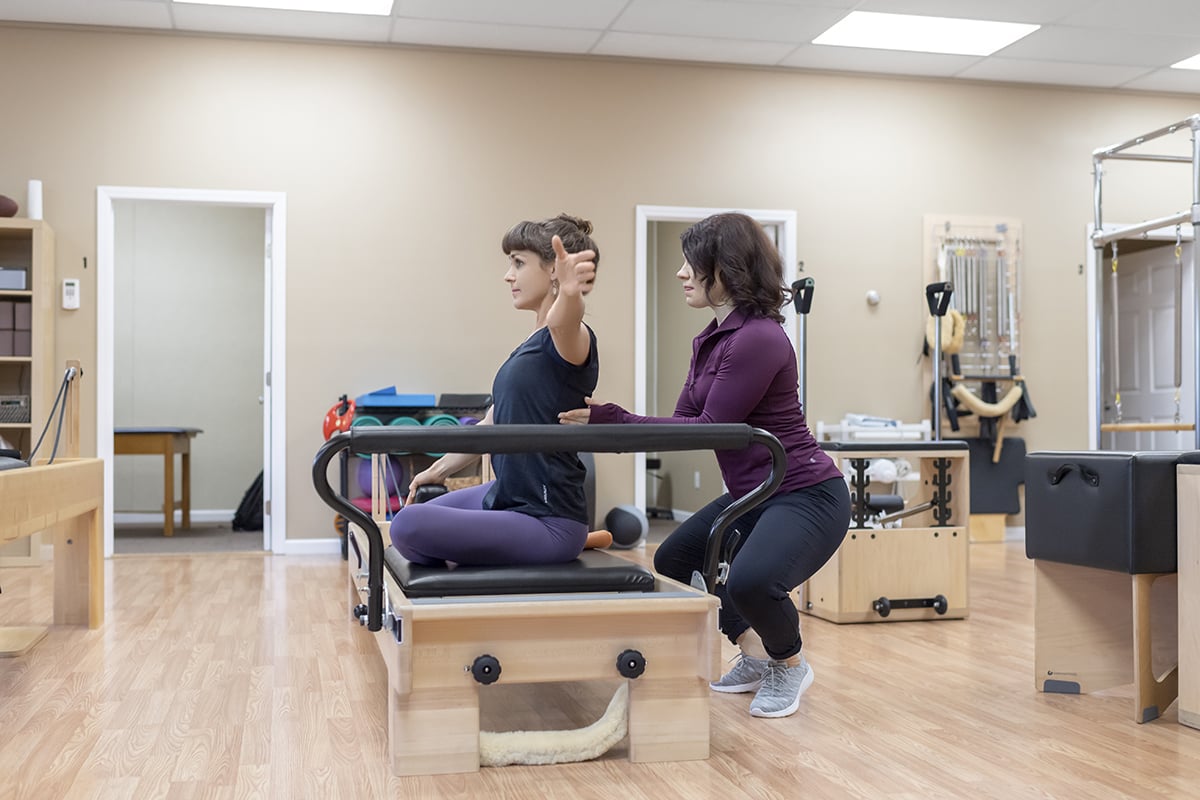
Therapeutic Pilates
Pilates is an exceptionally versatile method that works well in both rehabilitation and acrobatics. Some advanced versions of exercises indeed resemble complicated acrobatic routines. It is no coincidence that Pilates serves largely as a supplementary training for dancers and athletes.
However, performing advanced versions of exercises is not possible without knowledge and skills in applying modern, therapeutic modifications of these exercises. Therapeutic Pilates is an excellent way to improve posture and adopt the correct technique during exercises. It is also a great method for individuals who have difficulties executing exercises correctly and often suffer from injuries and strains.
Learn about the most common mistakes made during exercises, what therapeutic Pilates involves, and what distinguishes it from classical Pilates.
THE MOST COMMON MISTAKES MADE DURING EXERCISES
Many people participating in sessions and functional training complain of pain in the musculoskeletal system after attending classes. Unfortunately, this is often the fault of their trainers, who do not sufficiently ensure the use of thoughtful and safe training methods, nor do they educate their clients on how to perform basic positions and movements.
Unfortunately, many individuals, even those who exercise regularly, make numerous technical mistakes during exercises. They do not have established correct movement patterns. The most common mistakes include:
- incorrect foot positioning,
- incorrect alignment of the knee, hip, and lumbopelvic complex joints,
- incorrect chest positioning,
- incorrect head and neck positioning,
- incorrect sitting and standing posture,
- incorrect walking,
- incorrect bending,
- incorrect breathing,
- incorrect execution of the front support,
- incorrect execution of push-ups,
- incorrect execution of cat stretches.
The above mistakes hinder the realization of the first of the five basic principles of safe movement, which is adopting the correct starting position for exercises. This leads to the reinforcement of poor posture and incorrect movement patterns.
Unfortunately, poorly performed and improperly selected functional exercises not only do not bring the desired effect but can even lead to micro-injuries, overloads, or injuries. This is why pain occurs after exercises. And long-term incorrectly performed exercises affect the reduction of the efficiency of the musculoskeletal-fascial system.
It happens that individuals exercising under a trainer who does not treat their client with due diligence only discover after many years that they have a problem, for example, with body asymmetry. Therapeutic Pilates comes to the rescue, teaching techniques for working with the body and allowing one to find the cause of existing overloads.
CLASSICAL AND THERAPEUTIC PILATES – WHAT ARE THE DIFFERENCES?
Today, the Pilates method can be divided into two streams – classical and modern, which includes the therapeutic approach. They have much in common, but there are several significant differences between them.
CLASSICAL PILATES
Classical Pilates is a technique that faithfully imitates the principles of the method’s creator, Joseph Pilates, who developed it in the 20th century, during the post-war period. The method, although innovative for its time, was created with all the conditions of that era in mind. It was based on the goals of body work at that time. It was also designed for a specific group – mainly for dancers and athletes. For this reason, classical Pilates exercises assume that the person starting the exercises already has a well-developed basic technique.
THERAPEUTIC PILATES
Therapeutic Pilates is based on classical Pilates, but it also incorporates the latest discoveries in the fields of anatomy, biomechanics, and physiology. It represents a gentle adaptation of the original classical Pilates exercises based on contemporary scientific findings. It assumes that Pilates exercises can be tailored to the individual patient, selecting only those that are appropriate for them. It also includes modifications of Pilates exercises, for example, by using different versions of a given exercise depending on the individual’s capabilities, endurance, and flexibility.
In therapeutic Pilates, you have the option of preparatory exercises, easier versions, and more challenging ones. This allows for the design of exercise sequences more freely, focusing on the patient’s progress and goals.
Therapeutic Pilates is based on many fields – anatomy, primarily biomechanics, knowledge of injuries, and pain conditions. It involves selecting exercises for a specific patient. Initially, diagnostics are always necessary – the trainer must understand the patient, their problems, and what they came in with. Diagnostics can be conducted, for example, through interviews or questionnaires, as well as based on the patient’s test results, clinical analysis through observation, and analysis of simple physiotherapeutic tests.
Diagnostics allows for determining what to work on with a given person, which exercises to choose, and how to teach the body to work correctly. Pilates understood in this way is a logical, almost mathematical, and very effective method.

I am a graduate in Managerial Economics as well as Finance and Accounting, with a specialization in Marketing. Since 2018, I have been working as a Copywriter at Balanced Body, where I create marketing content for the fitness and Pilates industries. One of my particular strengths is translating complex topics into accessible language and accurately analyzing the needs of target audiences. Outside of work, I am passionate about fire shows and volleyball, which helps me better understand the needs of physically active people.