


Improving Spine Health Through Pilates Exercises
Does your back hurt and do you need to rest? Nothing could be further from the truth! Your spine needs movement to regenerate. For proper stability, it requires strong paravertebral muscles that will provide the necessary support. You won’t develop these muscles if you take on the role of a patient lying in bed, being a passive recipient of massages and other therapeutic interventions. Such rehabilitation is certainly useful, but a change in mindset and an attitude towards action are needed.
Movement is essential, but not every sport discipline is beneficial for the spine. Running, soccer, or basketball can lead to overloads and injuries to the spine. Fortunately, there are disciplines that have a healing effect on the spine. Among them, Pilates exercises reign supreme.
What is the Pilates method? What results will you achieve by exercising? How to support the lumbar, cervical, and sacral spine while practicing Pilates? Read on and discover new ways to cope with pain!
PILATES METHOD
Are there exercises that simultaneously increase movement awareness, improve performance, complement training in competitive sports, and heal injuries and pain? The Pilates method has such a wide range of applications that it can be utilized by professionals, individuals recovering from injuries, pregnant women, and those in postpartum recovery.
The creator of the method, Joseph Pilates, is known as an advanced gymnast, dancer, and boxer. However, his beginnings were not remarkable – in childhood, he suffered from asthma, rickets, and rheumatic fever. What a marvel it is that through the physical exercises he created, he not only mitigated the negative effects of these diseases but became such an outstanding specialist in developing the human body that he was hired as a self-defense instructor for detectives at Scotland Yard!
Today, anyone can benefit from the advantages of the Pilates method. To tailor the exercises to their expectations, one can choose the traditional form of Pilates, precisely according to the creator’s instructions, utilize the modern technique, expanded by the latest research findings, or opt for combined exercises, such as yoga-pilates.
PRINCIPLES AND GOALS
The goal of Pilates exercises is not just the development of the body. The creator of the method was inspired by the words of the German philosopher Friedrich Schiller, who believed that “the spirit builds the body.” This is why the Pilates method places such a strong emphasis on movement awareness, mastering precise technique, and the mental engagement of the practitioner.
The primary goal of the exercises is to correct muscle imbalances, which often stem from the weakening of deep muscles, as well as to restore flexibility to the muscles.
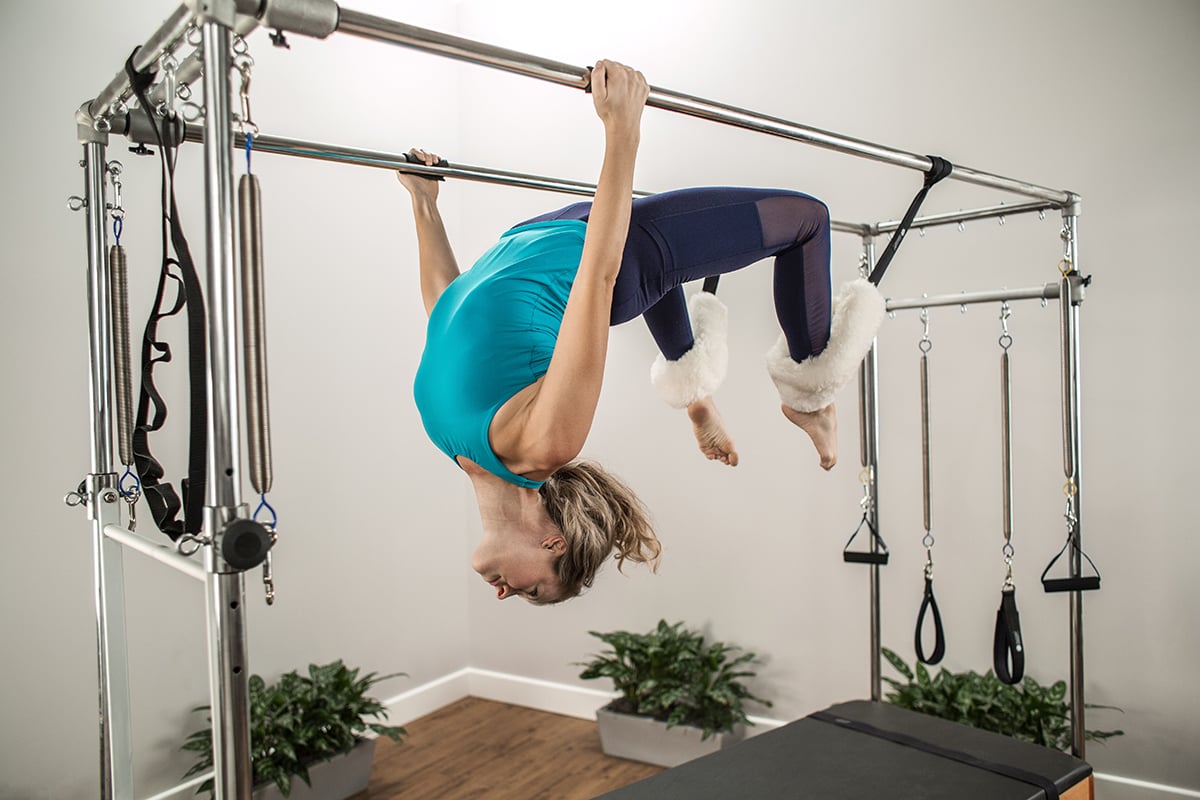
During the exercises, various gymnastic equipment is used – from small items like a bar, stick, elastic band, or ball, to large Pilates machines, such as the reformer or Cadillac, where springs are used for resistance exercises.
Pilates exercises are performed according to 8 fundamental principles, which show why this form of working with the body is so unique. These principles are concentration, relaxation, posture, breathing, centering, coordination, fluidity of movement, and endurance. What do they mean?
- concentration – the movement should be intentional, with attention focused on the work of the body,
- relaxation – the exercises allow for mental rest and physical relaxation,
- posture – it should be neutral to minimize the feeling of strain,
- breathing – one should focus on proper breathing through the thoracic-abdominal pathway,
- centering – meaning the stabilization of the center of the body,
- coordination – refers to both the coordination of body movements and the coordination of all fundamental Pilates principles (centering, breathing, posture, etc.),
- fluidity of movement – the movement should be smooth, gentle, yet controlled and coordinated,
- endurance – seemingly easy exercises performed repeatedly and with care for all principles become challenging and require endurance.
The basic principles of Pilates are strongly interconnected and intertwine with one another – there is no one without the other. Combining them all is not easy, but the result in the form of a healthy, strong body without pain is worth the effort.
THE IMPACT OF PILATES ON THE LUMBAR, CERVICAL, AND SACRAL SPINE
Pilates is a very effective way to prevent and treat back pain of various causes. It allows for mastering and maintaining active stabilization of its different sections. Why is stabilization so important?
If you do not control your posture, the spine becomes susceptible to injuries, as its tissues are exposed to increased loads. It is the muscles that protect it from injuries – if they are too weak, micro-injuries in the spine will occur, leading to pain. The muscles must work together – when some perform movement, others stabilize and support the structures of the spine. This prevents unwanted additional movements.
Pilates exercises actively stabilize the spine in the lumbar, cervical, and sacral regions. However, it is not just about increasing muscle strength, but primarily about consciously maintaining a coordinated posture and muscle activity. Below are a few examples of exercises that activate and strengthen these sections, making your spine healthy and strong.
Exercises for the lumbar and sacral region:
- Transition to a supported kneeling position. Set your knees hip-width apart, hands shoulder-width apart. Inhale and lift your rounded back up, exhale – your back should become concave. Repeat several times, according to your own rhythm and breath.
- Transition to a seated position. Straighten your legs at the knees, point your toes towards each other. Extend your arms up with an inhale and with an exhale relax, lowering your hands.
- Slowly lower yourself to lying on your back, legs slightly apart. Straighten your legs at the knees, move your feet wide to the sides. Firmly press your lumbar region to the ground. Relax and repeat several times.
- While lying on your back, bend your legs and set your knees hip-width apart, arms along your body, heels pressed to the ground. Inhale and slowly lift your hips up, vertebra by vertebra, and with an exhale lower them down, vertebra by vertebra, until your buttocks return to the mat.
Exercises for the cervical region:
- Sit cross-legged, straighten your back. Bring your arms behind you and clasp your hands. With an exhale, move your right elbow to the side, then shift your hands to one side. Inhale, and with an exhale slowly lower your head to the right side, as if you wanted to place your ear on your shoulder. Try to relax in this position, breathing freely. Slowly lower your head and lift it up. Repeat for the other side.
- In the same position, move your arms forward. Interlace your fingertips and extend your arms forward, tilting your head so that your back becomes rounded – vertebra by vertebra.
- Without changing position, place your hands on your knees. Move your head once to the right, once to the left. Your chin should always be directed forward – try not to look down. Repeat several times. Stop on the right side and place your right hand behind your left ear, and your left hand under your buttock. Hold this position for a moment, stretching the neck muscles. Perform the same exercise for the other side.
Finally, remember one very important thing – for the exercises to be effective, you must perform them regularly. As Joseph Pilates said: “After ten sessions you will feel the difference, after twenty sessions you will see the difference, after thirty sessions you will have a completely new body.”

I am a graduate in Managerial Economics as well as Finance and Accounting, with a specialization in Marketing. Since 2018, I have been working as a Copywriter at Balanced Body, where I create marketing content for the fitness and Pilates industries. One of my particular strengths is translating complex topics into accessible language and accurately analyzing the needs of target audiences. Outside of work, I am passionate about fire shows and volleyball, which helps me better understand the needs of physically active people.