


Classical Pilates – Why Don’t Everyone Practice It?
Classical Pilates offers many benefits – yet not everyone practices it. Although there has been a slight increase in the popularity of the classical version of the method recently, it is still much less popular than contemporary Pilates or other forms of fitness.
What makes classical Pilates less attractive? Can this be changed? Here are some thoughts on the subject.
WHAT IS CLASSICAL PILATES?
Classical Pilates is a school that has survived for over 100 years. It includes a series of exercises developed by Joseph Pilates.
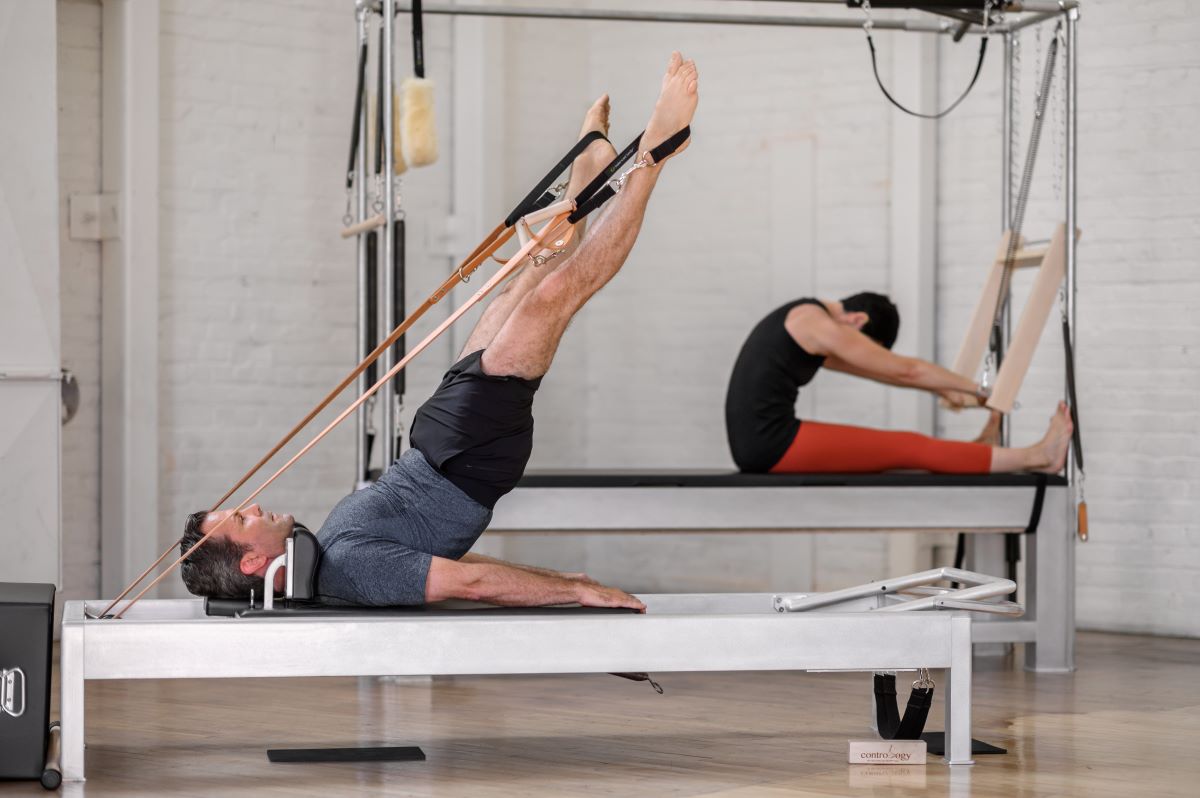
Classical Pilates involves faithfully reproducing the exercises and the order of their execution according to the creator’s intent. The order is very important here – Pilates designed his exercises to first warm up the body, then challenge it, and finally cool it down. This specific sequence allows practitioners to face challenges at a proper pace of systematic development and to achieve increasingly difficult goals.
As Pilates himself stated in his book “Return to Life through Contrology”:
“Contrology is the complete coordination of body, mind, and spirit.”
Currently, many available schools often use a “modernized” form of Pilates, which is not a faithful representation of the original. One way to distinguish classical Pilates from its contemporary forms is the positioning of the pelvis on the mat during exercises. Classically, exercises should be performed in a “posterior pelvic tilt” – meaning that when lying on the back, the lower back should be completely pressed into the floor.
In the book “Return to Life through Contrology,” there is also a statement by Frederick Rand Rogers – president of the North American Physical Institute, which perfectly illustrates the essence and demand for classical Pilates:
“…maintaining a higher standard of physical fitness is increasingly necessary for sustaining life and freedom in any complex civilization. This is particularly necessary in times of social struggle (…).
In my opinion, “Contrology” is the ideal system for transforming the body into a perfect instrument of will. It is proper kinesiology, physiologically correct, psychologically sound.
I have personal knowledge of its success in achieving astonishing results, not only in normal adults but also in those suffering from supposedly incurable physical defects and organic deficiencies.”
Classical Pilates is, however, more demanding, which is why many people choose to use its more modern form – which is also effective.
AT WHAT AGE CAN YOU PRACTICE CLASSICAL PILATES?
It is obvious that Pilates is for adults. No one really questions this. But what about the youngest? Can they also benefit from the advantages that this system of exercises offers?
To answer this question, we must return to the roots. Joseph Pilates developed his method of exercise over many years – and he started as a child. By his teenage years, he was so well-built that he even worked as a living anatomical model.
So the answer to the question of whether children can practice Pilates is: YES! With great benefits for the entire body, which will pay off in later years. The earlier one starts their journey with Pilates, the sooner the body will prepare for the challenges of today’s world – which often includes sedentary work, which over the years has a dreadful impact on health.
So, Pilates on machines for the youngest? Absolutely! As long as their height allows them to use a specific machine comfortably. And a qualified instructor will take care of that.
WHAT MAKES CLASSICAL PILATES LESS POPULAR?
Instructors teaching Pilates in its classical version point out several issues related to its teaching.
Appearance
Visuals surrounding the topic often capture the audience’s attention first and determine whether they want to learn more about it or not. In the case of classical Pilates, the photographs associated with it can be quite problematic. The dominant image is that of a white woman with very little body fat and some experience as a dancer. At least that’s the image suggested by Google and most organizations involved in classical Pilates that have social media pages.
There is an unhealthy obsession within the classical Pilates community with old images from the method that do not fully reflect the current reality. It’s not about discarding history, but the adoration of past images makes it difficult for classical Pilates to exist in the present.
The problem is that when people cannot find themselves or imagine themselves in a given space, they often conclude that this space is not for them, or that they are not needed there. Therefore, to make classical Pilates look appealing, it is worth showing people that their bodies are also suitable for classical Pilates by including various body types in images representing this method. Visuals are needed to show how classical Pilates can put anyone in a good, happy mood. This will encourage many more people to try it.
Knowledge and Skills
For a person to understand why they should do something, they must first grasp what that thing is. Unfortunately, most people (including many Pilates instructors) do not really know what classical Pilates is. On the other hand, those who possess knowledge in this area often seem to guard what they know like a closely guarded secret. And when they do share it, it usually sounds like a foreign language.
The consequences of this approach mean that those practicing classical Pilates, in trying to preserve the classical method, are slowly killing it. Therefore, it is important for the message about classical Pilates to be more understandable to people. For a new generation of classical Pilates practitioners to emerge, and for the community to be more inviting, efforts must be made to communicate with others in a way that attracts them to this method.
Price and Accessibility
It is obvious that when people understand how amazing classical Pilates is, they will find ways to afford it. Unfortunately, it often looks like this: many classes will be expensive and out of their reach.
It would be beneficial for the classical Pilates community to invite a larger number of people by providing more accessible and cheaper entry options. Unfortunately, very expensive classes discourage people with limited budgets (which is most people) from practicing Pilates. Attractive options for monthly passes, free videos on YouTube or social media can be encouraging here. All of these are great ways to attract more people to this space and highlight classical Pilates.

I am a graduate in Managerial Economics as well as Finance and Accounting, with a specialization in Marketing. Since 2018, I have been working as a Copywriter at Balanced Body, where I create marketing content for the fitness and Pilates industries. One of my particular strengths is translating complex topics into accessible language and accurately analyzing the needs of target audiences. Outside of work, I am passionate about fire shows and volleyball, which helps me better understand the needs of physically active people.