


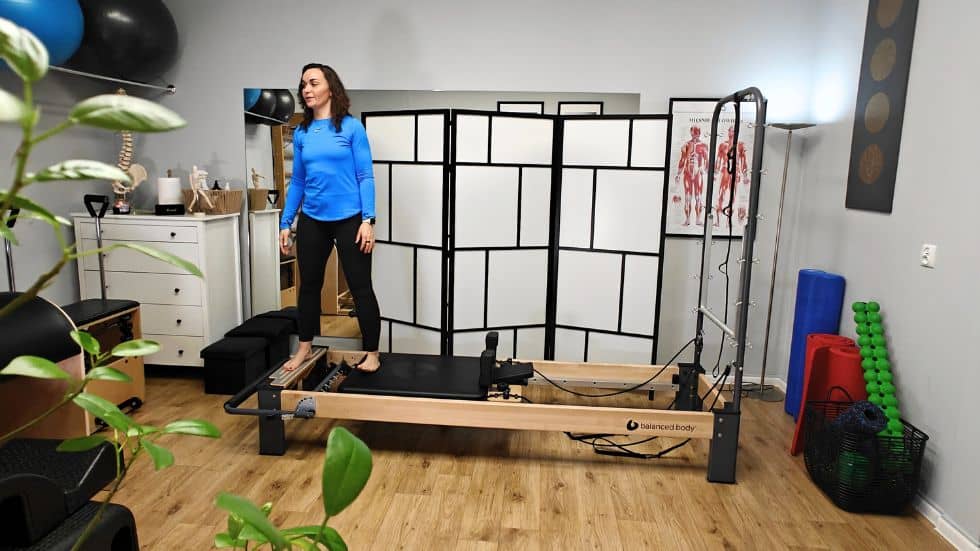
From a Passion for Physiotherapy and… Pilates – An Interview with Dr. Danuta Wiśniewska
Zapraszamy do inspirującej podróży na Śląsk, gdzie Iza Wiśniewska z Balanced Body Polska spotkała się z wyjątkową osobą – Danutą Wiśniewską, fizjoterapeutką i doktor nauk medycznych oraz nauk o zdrowiu. W sercu Chorzowa, w przestrzeni, gdzie pasja do fizjoterapii łączy się z miłością do pilatesu, rozmawialiśmy o tym, jak pilates wpisał się na stałe w życie Danusi i jak wygląda prowadzenie biznesu w tej dynamicznie rozwijającej się branży. Przygotujcie się na fascynującą opowieść o holistycznym podejściu do zdrowia, wyzwaniach i radościach płynących z pomagania innym w osiąganiu sprawności i harmonii ciała, a także o sposobie na prowadzenie biznesu właśnie w tej branży.
[Iza Wiśniewska from Balanced Body Polska] Today we are in Silesia, specifically in Chorzów – with Danuta Wiśniewska, a physiotherapist and doctor of medical and health sciences. However, as you might guess, something a little different brought us here, and I mean Pilates. We will talk about why Pilates has become a permanent part of Danuta’s daily life and what it is like to run a business in this rapidly developing industry. Alright, let’s start with a question that is completely relevant in your case: what came first, Pilates or physiotherapy?
[Dr. Danuta Wiśniewska] It depends. Pilates on the mat came before physiotherapy, but Pilates on the equipment came later than physiotherapy because I started learning Pilates on the mat when I was already studying physical education. But the market made it so that I didn’t have a job at school, so while also teaching Pilates classes, I really enjoyed it and you could say colloquially, I got really into it, so I started looking for alternatives and found Pilates on the equipment. Unfortunately, in my area, where I lived and started – in Rybnik or Wodzisław – there were no such equipment at all. So I was, let’s say, a precursor. So while browsing the internet, looking for different people in physiotherapy studies, I became interested in those pieces of equipment. And in my second year of physiotherapy, or maybe in the first, I don’t remember exactly, I got into Pilates equipment.
[Iza] And what, in your opinion, distinguishes this Pilates from other fitness methods?
[Dr. Danuta] I think it’s the holistic approach to training. So I think about all the principles of Pilates such as control, breath, fluidity, precision, engaging the center, and definitely breath. And I think that these principles from Pilates provide a lot of detail, such harmony of movement, and that makes it fit super well, so to speak, into physiotherapy for me and is an ideal combination for manual therapy. So when I check someone on the treatment table, if a patient comes in with pain or some long-standing problem, I can detailly activate that later on the Pilates equipment based on the manual examination.
[Iza] And from the perspective of a physiotherapist: why Pilates on machines, and not on mats?
[Dr. Danuta] I think it’s more about the closed chain. A closed chain means that when we exercise on the mat, we don’t have that point of reference. We can add some small equipment, like a magic circle or a ball, or some bands, but we can’t relate that resistance. And certainly, the springs in equipment like the chair or reformer or barrel or Arm Chair definitely help us in that we have better feedback. And we can also create a closed chain. Of course, it’s also known that we go methodically from low positions to high ones. And here we can very much, let’s say, activate a given muscle, depending on the position on a given piece of equipment. So that’s great, for example, after knee reconstruction, if we want to activate the knee, let’s say for flexion, extension, I don’t know, to 45° or whatever recommendations we have, we can control that here. And on the mat or on other equipment, it would be much harder.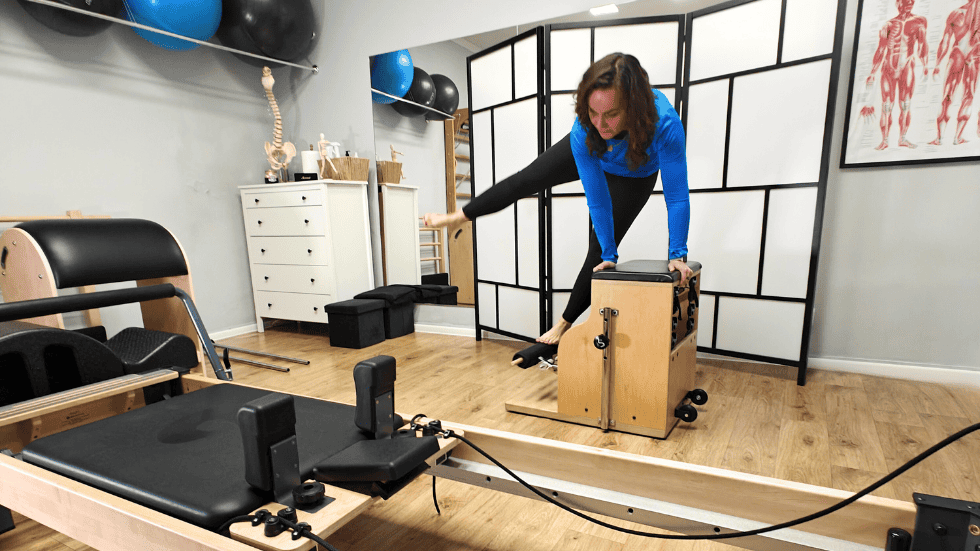
[Iza] And how do you see the development of Pilates in the coming years?
[Dr. Danuta] I think there is a huge boom right now. Many Pilates studios are opening, so I believe that it will become more accessible and that’s great. Many people will no longer have the problem I had 10 years ago, wondering: reformers? What’s that about? And no one knows, no one knows. Only because celebrities started exercising on it and it’s being showcased much more, or many sports stars, I think it will generally become more accessible. I definitely believe it is a professional product. Well, we know that training is very expensive and the equipment is also very expensive, so I think it won’t be accessible to everyone. But that’s just how life is, right?
[Iza] Exactly [laughs]. And in your opinion, what are the biggest challenges facing Pilates instructors today?
[Dr. Danuta] To be honest, I don’t have many beginner Pilates instructors, but from what a few people have asked me, I think it’s the choice of training. And I can relate this to physiotherapy because these trainings are more expensive, cheaper, and varied, but I think that if a given instructor wants to (train, editor’s note), wants to start training somewhere and wants to teach a specific method, because we have different approaches. We have the comprehensive ones that are more physiotherapeutic, maybe more fitness-oriented, although I’m not sure about that word. I think I would advise those instructors to first go to a specific teacher or to a specific student from a given school and see if it suits them at all. Because when I spend a lot of money, for example, on a specific manual therapy, I first went to that manual therapy to check if it would be okay for me. And I think that’s just the key, to ensure it aligns with their goals and also with the target group. Because if someone really wants to focus solely on training, they won’t be interested in a very detailed approach from rehabilitation, but if someone is a physiotherapist, they also need to choose a teacher who will match their knowledge and experience.
[Iza] Mhm. We are sitting in a place that serves people daily in improving their health and quality of life, and a place that you create every day. Where did the idea to open such a business come from? Why did you decide to pursue such studies and engage in physiotherapy?
[Dr. Danuta] I went into physiotherapy, also because of, let’s say, a market problem, because my first field of study was physical education. But since there were no vacancies available in schools at that time, I worked for a few years, but only as a substitute. I worked in the fitness industry, leading many fitness classes, and I also taught Pilates, healthy spine classes, and I was also dabbling in yoga. I taught yoga, and those are two poles [laughs], let’s say, distant, but still from the same trend. So I wanted to deepen that knowledge. And also, attending various Pilates trainings, I needed detailed knowledge because it really intrigued me: why does it have to be this way? Why differently? I also attended a great training once with Bogna Janik at Reha Pilates, and I think those trainings were the key, as I noticed that I was still lacking more precise biomechanical, physiological, or anatomical knowledge. And I decided that since I am somewhat organized in this movement [laughs], it would be nice to combine it with some good manual therapy, because I noticed that many of the problems clients came with, because I also refer to group classes and personal training, needed to be supplemented with manual therapy and some detailed things. And I noticed that…, that when I sent to some physiotherapist and that person came back, they were completely different, they improved a lot. That movement was great and simply what I needed, I don’t know, a number of lessons, a number of personal training sessions, suddenly it turned out that after one manual therapy the patient was able, I mean my client at that time, was able to do it right away. So, I think so and also my friend said that he saw that I had such aspirations that I was really good at understanding biomechanics and he said that I would be awesome at it, so I just have to go for that physiotherapy [laughs].
[Iza] And it’s great that it happened! By the way, what is the most difficult part of running your own practice, like you have now, and what brings you the most joy?
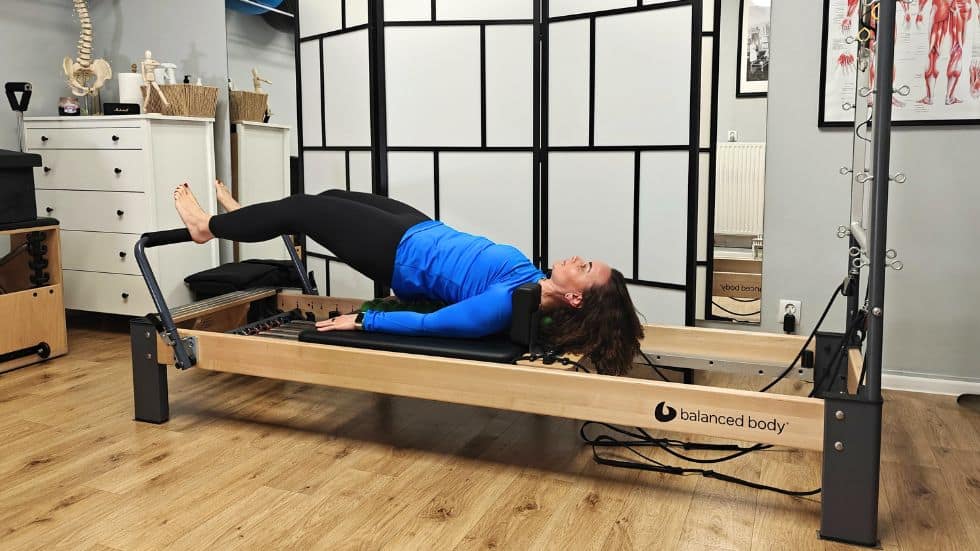
[dr Danuta] You know, these days, you have to manage social media. I think many of my colleagues in the industry would share the same impression, because I think that managing social media and the trends that are being introduced now, you know, posts don’t get clicks anymore, you have to make those reels. And to be honest, recently I even had to buy a course on training [making reels, ed. note], you know, reels, but to be honest, I would prefer to spend that time on, I don’t know, deepening my anatomical knowledge. But that’s the industry, you have to sell yourself a bit on the internet, so I think that definitely the paperwork is not fun either, some invoicing, contacts with the accountant, even though I have a great accountant. Shout out to Karolina! It’s difficult because we actually work in this office. And you know, it’s not like working at the reception, where, for example, there’s a client, but we have a 10-15 minute break. It’s really, if a patient comes to me at 2:00 PM and leaves at 2:55 PM, I am intensely focused for 55 minutes. And now if I have, I don’t know, a long day and I see 8 patients, well, to post that story or that reel, or something – I have to work extra hours. So now my working day sometimes extends to 10 or 12 hours. So I think that the paperwork is a challenge. And let’s not hide the costs either. The costs to purchase new equipment or to attend another training are very high, very, very high, so I think that’s a challenge, and of course, the more we run, the more we work, the more we crave knowledge. And it’s evident that for me, a frequent challenge is a particular patient, for example, if a difficult case comes to me, or I have neurological patients, for example, with MS, with SMA, I often have to consult, I have to think. I have to, for example, order some equipment or a spring because a given person is not even able to perform a certain exercise, so I think that’s the worst part of this job.
[Iza] And what is the best part?
[dr Danuta] The best part is that there are great results, you know, when a client or a patient comes to me, you can see that usually after 5 – 6 sessions, depending on whether the patient is in pain or a healthy patient who wants to work on their figure. So it’s spread out over the number of sessions, but it’s great when they say: “Danusia, I’m at work and my back doesn’t hurt anymore. I’m going for a walk – I can feel my glutes,” which we activated, you know, so I think that’s the best part. Such a reward and a nice flow. And it really makes me happy when people deepen their body awareness, that they come in just green. And then, in Pilates, they start to feel that they know this is the hip joint, this is the knee joint, that here is the glute. Aha, now I should feel, for example, the lower part of the trapezius, and for example, not the levator scapulae, meaning not the middle, not the upper part of the back, but for example the middle of the back. And it all comes together into a whole
that he simply does not feel tightness in his back or, for example, his hands stop going numb. And I think that is the biggest fan in this work.
[Iza] Great! And listen, you have been running this business for several years now, if you were to open such a practice again, would you do anything differently?
[Dr. Danuta] I think not, because I work well, my schedule is full in the sense that it is already completely booked, so if someone wants to sign up, they have to write privately and wait quite a long time for an appointment. I think I did everything as I should, because I also work a bit differently than top Pilates studios, as I work with manual therapy and Pilates. So we will see, I am also moving to a larger place in Rybnik, but that question will be answered in some time, we will see.
[Iza] We are keeping our fingers crossed for that place. Well, now, if you had a new Pilates instructor in front of you who is very eager to open their own studio, what advice would you give them? Before opening their own business.
[Dr. Danuta] You know what, it depends. It depends on their situation, their life situation, because obviously, I personally started more from physiotherapy and could invite my manual therapy patients to Pilates. Because when I started 8 years ago in Pilates, there wasn’t much of this. I think that now, thanks to the fact that it is trendy, these instructors have it much better. I would definitely advise them to research the market, create some social media presence. To attend a good training and maybe first work for someone, to be honest, unless someone can afford to spend a lot of money on equipment and purchases, then there is no problem. But I definitely think that at the very beginning, people will not be rushing to new places, because word of mouth is the best advertisement. So I think that simply working somewhere in a studio, gaining that experience, and also definitely having personal practice. Because the more they work with themselves, the more experience they will have and more feedback from – so to speak – from people, so that’s what I would say.
[Iza] We also came here to ask a bit about your impressions regarding the equipment you use. Why did you choose Balanced Body equipment?
[Dr. Danuta] To be honest, I knew right away that I would be working in physiotherapy, so asking, well, back then my older colleagues or Ilona Włodarczyk, with whom I trained, recommended this company due to the variety of springs. Because when we work on all those comprehensive ones, in those Gratz-like, let’s say original springs, they are very heavy and strong. I can allow myself in my work with my patients to use them in several or a dozen cases. I also have a few neurological patients, so for them, let’s say the original load would definitely be too much. So for me, I was convinced by the functionality, the adjustment of the distance or changing the straps on the reformer. And I think that the springs spoke to me the most, so to speak.
[Iza] We are sitting here, I see various equipment, because there is a reformer, a barrel, and a chair. What do you like about Balanced Body machines?
[Dr. Danuta] Well, such versatility, holistic training, that a given exercise or a given muscle, if I want to perform and need to activate it in a given movement, well, depending: I step onto the chair, or I step onto the reformer, or I step onto the barrel, or as I have in Rybnik – a Cadillac, I adjust it to the given moment and to the current state, whether it’s mine or that of a patient. So there is definitely a lot of versatility. So we have unlimited possibilities to adjust the exercise to the patient.
[Iza] Mhm, and which of these machines is your favorite?
[Dr. Danuta] It depends, if I want to get very tired, I think the chair, if I want to activate something and dig into my body, so to speak,to I think, it depends on whether it’s the Cadillac or the Reformer. And it depends on what I’m working on and how I’m feeling today.
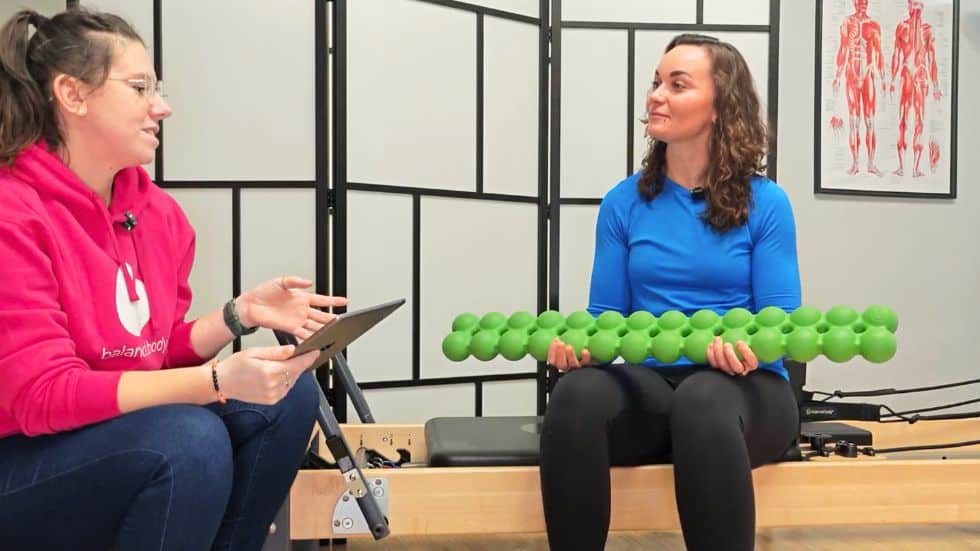
[Iza] Great. Here, I’m also glancing at the wall and I see a device like the SISSEL Spinefitter. Ada, could you pass it to me? [laughs] Thank you. It’s coming to us now, it’s nice and green. Tell me, from a physiotherapist’s perspective, what do you think about the SISSEL Spinefitter?
[Dr. Danuta] I bought it, to be honest, on the recommendation of my friend, because she first lent it to me for 2-3 days just to try it out, as I am always very skeptical about new things. But I must honestly say that it has worked very well for me when I work with a patient, especially a beginner, in terms of pelvic alignment. It works great for the footwork exercise on the Reformer, because people come in with muscle imbalances, and if I want to activate the glute, while trying to disengage the hip flexors, I place the Spinefitter down, and it provides ideal feedback for pelvic alignment. I also think it works well for scoliosis, as I work a lot with individuals who have postural defects and scoliosis. It works great because if we have, for example, a curvature in the thoracic region, depending on the arc of the curvature, I instruct them to press the opposite side, which helps to balance the muscle imbalance, and then the weakened muscles activate better during specific exercises. It definitely helps patients who have very tight backs. They say it’s great for them and they feel a lot of relief, especially those who have office jobs or even chefs; when they lie on the Spinefitter, they say it’s like a free massage and it’s wonderful for them. So I think those are the most important aspects.
[Iza] So generally, you just lie down and you can see the difference?
[Dr. Danuta] [laughs] Yes, definitely, that’s what they say!
[Iza] And how quickly are the effects of such therapy using the Spinefitter noticeable?
[Dr. Danuta] Are you asking about a specific exercise or about the entire therapy as a whole?
[Iza] Overall about the entire therapy.
[Dr. Danuta] The entire therapy? To be honest, I don’t have a comparison because we would need to take two people, one exercising on the Spinefitter and one not exercising. But of course, there are many variables, as we would need to take two similar individuals, just like in scientific studies. But I can say that in terms of a specific exercise, if someone, colloquially speaking, doesn’t get it, and I say, okay, let’s set it aside, let’s get on the Spinefitter, there is immediate feedback, and they say: “ahaaa, that’s what it’s about,” to ensure that the sacrum is actually positioned correctly, whether it’s in posterior or anterior pelvic tilt – it helps. So, I think, as we discussed earlier, exercising on the mat versus exercising on equipment. I think it’s also an advantage that it’s an additional stimulus for beginners who have very little awareness of their bodies, or those who have exercised before and had no idea that they could exercise like this, or that they need to specifically align certain muscles or joints or even segments of the spine or the pelvis. This is very helpful for them.
[Iza] Nice, nice, I’m glad to hear that it works. Overall, I admire you for what you do. You put a lot of heart and passion into it, and it shows. I don’t know if you can see the nice health-oriented atmosphere here.
[Dr. Danuta] Cozy and more family-like.Yes. I can confidently say that this is a space where you can come in peace and surrender to your hands, knowing that you will leave here healthier and full of life. Because you radiate such positive energy, it is simply amazing. You can take care of your health here, which is great. So if you are from Silesia, I warmly invite you here to Chorzów or to Rybnik to this new location that will open soon. Well, I thank you very much for welcoming us here, for allowing us to come and have a little chat, and I wish you continued success in running this business.
[Dr. Danuta Wiśniewska] Great, thank you very much.
[Iza from Balanced Body Polska] Thank you very much.
Our journey through the world of Pilates and physiotherapy is coming to an end, but the inspiration and energy that Dr. Danuta Wiśniewska shared with us will certainly stay with us for a long time. Her passion, commitment, and comprehensive approach to the client are proof of how important it is to love what you do. If you dream of your own Pilates studio or simply want to take care of your health, remember the advice and experience that our heroine shared with us. And if you are from Silesia, be sure to visit Danuta’s studio in Chorzów or the new location in Rybnik – these are places where health and well-being are always a priority.
You can find Dr. Danuta Wiśniewska online:
Chorzów:
https://www.facebook.com/DanusiaWisniewskaFizjoterapia
https://www.instagram.com/dr_danusia_wisniewska/
Rybnik:
https://www.facebook.com/people/Dobry-Wybór-Rybnik/61559332509746/
I am a graduate in Managerial Economics as well as Finance and Accounting, with a specialization in Marketing. Since 2018, I have been working as a Copywriter at Balanced Body, where I create marketing content for the fitness and Pilates industries. One of my particular strengths is translating complex topics into accessible language and accurately analyzing the needs of target audiences. Outside of work, I am passionate about fire shows and volleyball, which helps me better understand the needs of physically active people.
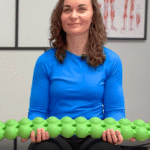
I graduated from the Academy of Physical Education in Katowice, where I gained knowledge in physical education, tourism, and recreation, and also completed my doctoral studies. I also completed a master’s degree in physiotherapy. Sport has accompanied me from an early age – from swimming to lifeguarding with the Volunteer Water Rescue Service (WOPR). I am the author of numerous scientific publications, and a healthy lifestyle and physical activity are an integral part of my daily life. Thanks to my comprehensive education, I specialize in physiotherapy, health-promoting and strengthening activities, functional and medical training, including the use of specialized Pilates equipment.