Budget and Financing
Opening Costs of a Pilates Studio
Opening your own Pilates studio, like starting any new business, involves expenses. The largest of these is the cost of renting or purchasing a premises and buying exercise equipment and furnishings (computer, bathroom and reception equipment). It is also essential to estimate monthly fixed costs, including rent or mortgage payments for the premises and utility bills such as electricity, internet access, etc. If you plan to work with a qualified Pilates instructor and hire additional studio staff (e.g., receptionist, cleaning crew), a significant expense will also be salaries and employment costs. If you plan to work independently, it is also important to consider mandatory social security contributions. However, if you are starting a business for the first time (or reopening after a long break from your previous one), there is a possibility to reduce these burdens and take advantage of a 6-month start-up relief (during this period, only health insurance contributions are required) or lower contributions for the first 2 years of operation.
Don’t forget about additional costs that are easy to overlook when planning to open a studio. If you plan to play music in the studio, you need to enter into and pay for a licensing agreement with a copyright collective management organization (ZAiKS and STOART) or purchase an appropriate music package offered by specialized companies. It is also crucial to obtain suitable insurance that will protect you and your business from the consequences of accidents, as well as your equipment and studio furnishings from the effects of unforeseen events.
Pilates Studio Business Plan
Before starting your business, it is worth creating a business plan (which is also necessary documentation when applying for a loan or funding) that will help establish assumptions and financial plans, including expected earnings. This is not easy, especially if you do not know what level of interest you can expect from clients and how to price your classes. However, remember that while traditional fitness clubs or gyms with large spaces usually offer the possibility of exercising independently (without a trainer) or in numerous groups, your specialized Pilates studio will offer individual exercises in an intimate atmosphere, on unique equipment, and under the guidance of a qualified Pilates instructor, building much more personal relationships with clients. As the owner of a boutique studio and a Pilates instructor, you will be able to set rates for classes that significantly differ from conventional sports facilities. Consider rates for individual sessions and small groups. Think about preparing promotional passes that allow for a specified number of classes within a certain period.
Also, don’t forget about the possibility of introducing an additional product sales offer in your new Pilates studio, which may interest your clients and provide an additional source of income – healthy snacks, coffee, studio-related merchandise (towels, t-shirts), etc.
How to Use the Class Planner?
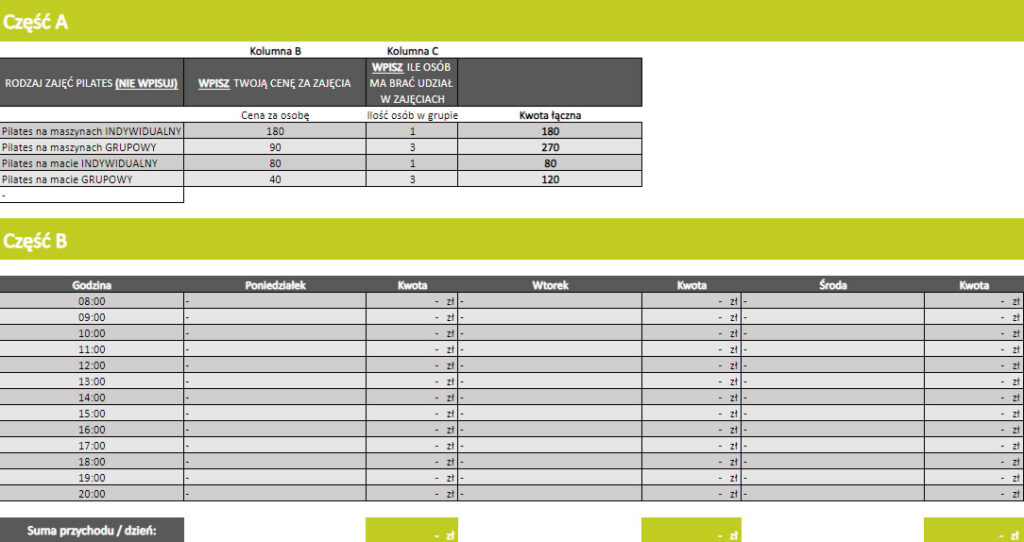
To facilitate the preparation of a business plan and determine potential revenues from the classes you conduct, we have created a simple-to-use Class Planner
All you need to do is enter the amount for individual and/or group classes that you want to include in your price list, and then select the planned number of classes of each type in the weekly schedule. The program will automatically sum the amounts and calculate the estimated revenue for the month.

How to Finance the Establishment of a Pilates Studio?
Your Pilates studio is an investment. To realize it, you will need the funds necessary to start working and to purchase Pilates equipment. In addition to using your own savings, loans from relatives, or obtaining a loan from your bank, you can apply for funding from the labor office and from EU funds.
Leasing Pilates Machines
For business owners operating for at least 6 months who are interested in creating a Pilates studio, we have prepared a unique offer that provides an easier way to equip the studio with Balanced Body Pilates equipment. Our leasing program, prepared in collaboration with the European Leasing Fund, allows for covering the costs of purchasing Pilates machines and adjusting installment payments. If you would like more information on this topic, contact us.
Equipment Rental
Renting Balanced Body Pilates equipment is a unique offer in the Polish market, which we provide exclusively. By using this form of financing, you can significantly reduce the initial financial outlay for equipping the studio. We offer flexible rental terms that can include a one-year, multi-year, or indefinite period. This makes it easier to manage the budget and immediately benefit from high-quality Pilates equipment. Additionally, after the contract ends, there is a possibility to purchase the used equipment and become its owner, without large expenses at the stage of establishing the studio.
Grants and Loans for Operating Businesses
Running your business, you can also apply for support from Regional Operational Programs, prepared for each province. If you want to expand your business by adding a Pilates studio and new services for your clients, you can receive a non-repayable grant and loan on preferential terms (you can find the list here https://pozyczkiunijne.bgk.pl/oferta-pozyczek-unijnych/). To learn the detailed rules for granting them, you should contact the provincial Information Point for European Funds.
Funding for Starting a Business
If you plan to start a business, you have access to various forms of financial support. All are described on the government website: Where to Look for Money to Start a Business. In short, we will describe the most important ones. You can apply for a non-repayable grant from the labor office to start a business, benefit from grants from European funds, as well as from low-interest loans from support programs for new entrepreneurs. These options will help you minimize initial costs and facilitate your start in business.
Grant from the Labor Office
Funding is a one-time non-repayable grant, received in advance (without the need to incur prior expenses from your own funds). This form of financial assistance is aimed at registered unemployed individuals (their experience may vary in different offices), who are not full-time students and who have not conducted business activities or rejected job offers in the last 12 months. Detailed requirements and rules for granting may also be specified by the regulations of the relevant county labor offices, available at their facilities or on their websites. The amount of funding also varies for each county – the grant cannot exceed 6 times the average salary, which is about 50,000 PLN. This grant is the easiest to obtain.
Grant from European Funds
Non-repayable grants for starting a business can also be obtained as part of projects implemented in specific provinces. They are mainly intended for individuals in difficult situations in the labor market or at risk of social exclusion (e.g., long-term unemployed, people over 50, or women). The rules for granting these funds and the amount of funding vary by region – you should familiarize yourself with those that apply in your province by using the assistance of the European Funds information points (a list can be found on the European Funds Portal).
Loan from the First Business – Support at Start Program
If the Pilates studio will be your first business and you are unemployed, you also have the opportunity to obtain a low-interest loan from the National Economy Bank as part of the First Business – Support at Start program. The amount of this loan can exceed 180,000 PLN (it cannot exceed 20 times the average salary), and its interest rate (fixed) is currently 0.25% per year. Repayment can last up to 7 years, with the option of forgiveness up to 6 times the average salary, without additional fees and commissions. More information about the loan can be found at: https://www.pfp.com.pl/pozyczki/wsparcie-w-starcie/ and https://www.bgk.pl/produkty/pozyczka-na-samozatrudnienie/
They trusted us: