


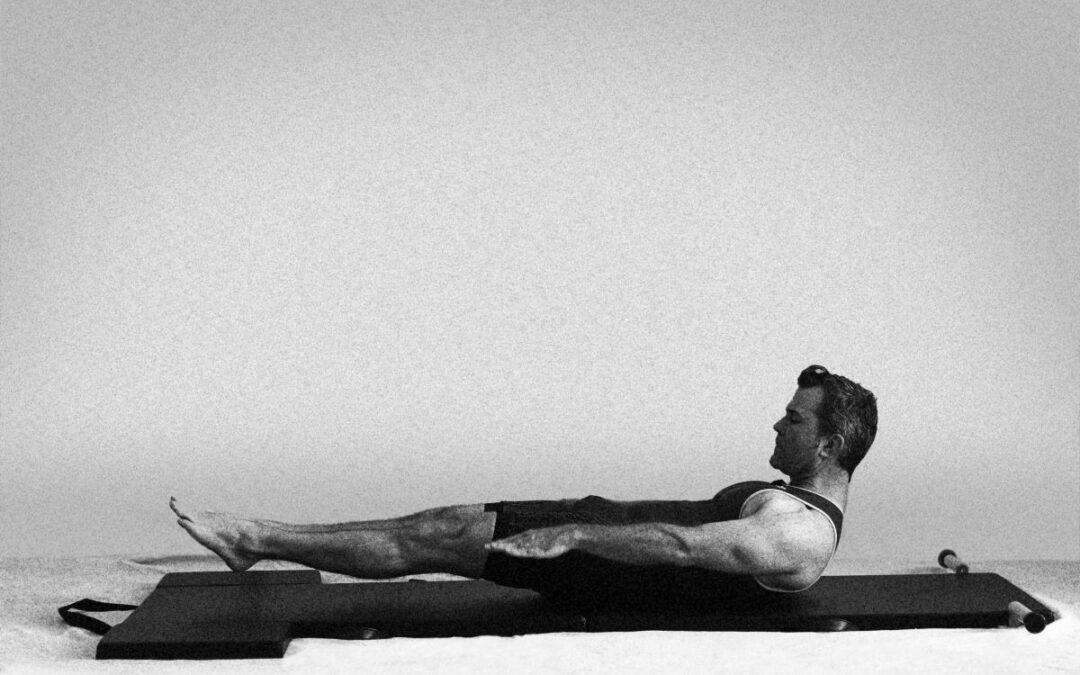
It All Starts with the Hundred (The Hundred)
I’ve got a problem, okay, I’m basically dying trying to do The Hundred. Jay Grimes is standing over me, and I have the feeling he’s kind of chuckling. This is my first lesson with him, and after five years of regular practice and teaching Pilates, I feel like I’ve never done The Hundred before in my life.
At one point he stopped me and said:
— Did you know Pilates is one exercise and five hundred variations of it?
I shook my head, eyes wide open.
After a moment he added:
— And do you know which exercise that is?
Again, completely thrown off, I shook my head (still holding The Hundred and still dying).
— It’s the Double Leg Pull. It has everything: a strong center, two-directional stretch, and breath. And beyond that, you can find it within every single exercise.
And he was right.
And then I still had to finish The Hundred.
There’s one thing, though, about the theory of “one exercise.” In reality, any exercise can be that one exercise.
For me, right now, it’s The Hundred.
Often considered the signature exercise of the Pilates system, The Hundred contains everything: breath, abdominal strength, the connection between the lower and upper body, and that elusive two-directional stretch. It’s an exercise that many others lead into, and that many others flow out of.
In his book Return to Life, Joseph Pilates gives very precise instructions on how to perform the exercises. You can find plenty of gems and forgotten wisdom on nearly every page. When it comes to The Hundred, two points in particular are the key to success.
Return to Life begins with the following instructions:
- Lie flat on your mat or the floor.
- Stretch your arms straight out in front of you (shoulder-width apart, close to the body, palms facing down).
- Stretch your legs straight out in front of you (close together, knees straight).
- Point your feet, toes reaching forward and down.
TAKE A SLOW BREATH IN
- Lift both feet about 5 cm (2 inches) off the mat or floor.
- Lift your head, looking toward your toes.
- Lift both arms about 15–20 cm (6–8 inches) above your thighs.
Starting from the fundamentals
If we start the exercise lying down, with arms alongside the torso, lengthen the body, and move into the Hundred position “from the bottom up,” we build a strong, stable center thanks to the elongated C-curve. The back anchors into the mat, which lets the iliopsoas muscle (which can cause trouble even on a good day) move from lengthening into contraction. This, in turn, helps stabilize the back against the mat, rather than pulling it away from the mat while supporting the weight of the legs, and lets the glute muscles do their job.
Breath
Begin the exercise on an inhale, and start pumping the arms on the exhale. Entering the exercise on an inhale fills the lungs with air and opens the back and chest, creating the space and length needed to maintain the upper part of the C-curve. If we actively inhale during the movement, it also opens the throat and releases tension from the front of the neck.
When we exhale during the first five pumping movements, the body’s center engages and strengthens. This helps hold the position, anchors the back, and supports diaphragmatic breathing.
Learn more about Contrology – our classical equipment line.
This text is a translation of the article https://thecore.pilates.com/it-all-starts-with-the-hundred/

I am a mentor and teacher of teachers with over 30 years of experience in classical Pilates. My approach was shaped by my studies with first-generation masters – Jay Grimes and Romana Kryzanowska. It was from them that I understood that true mastery lies in detail and faithfulness to Joseph Pilates’ intentions.
As an educator, I support instructors around the world in building self-confidence, sharpening their eye, and teaching precision. I help them translate complex movement mechanics into a clear language that inspires clients. I believe that growth is a constant dialogue between tradition and curiosity – and it is precisely this world I want to invite you into.