


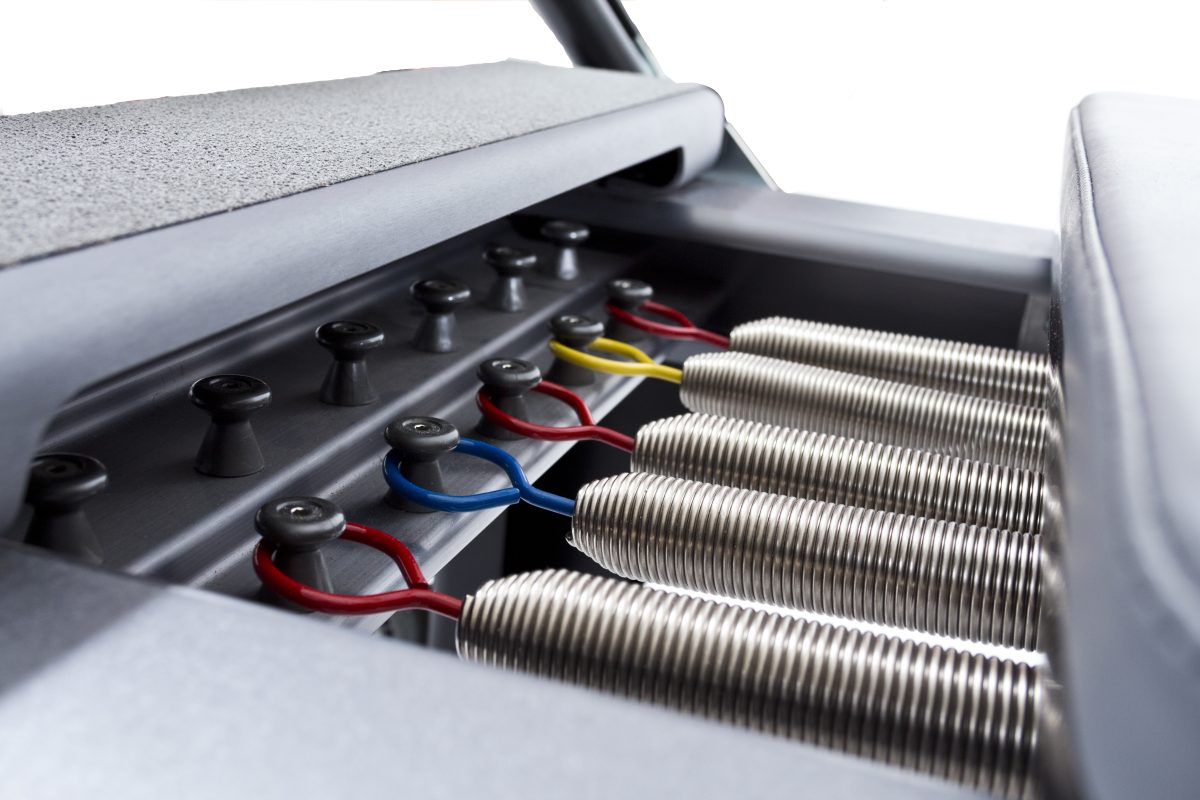
How to Store Springs When Not in Use?
Even if your studio is incredibly busy, running 8 or 10 classes on the reformer daily, six days a week, the truth is that the springs are used for a shorter time than they are not. Therefore, it is worth taking care of how they are stored, just as much as how they are used. That’s why we have prepared some tips on how to store the springs outside of working hours to extend their lifespan and maintain safety.
If you want to know when your springs are ready for replacement, check out the article: Balanced Body Garage: How to Recognize When to Replace Springs in Three Simple Steps
Attach at least one regular spring to the spring bar
When your students finish their classes, ask them to leave the reformer in any position with at least one regular spring attached to the spring bar. For Balanced Body machines, this means at least a red spring.
The reason is very simple – the cart should be anchored for the safety of your staff and clients. It should not have the ability to move freely if someone approaches and leans or sits on it. This could be very dangerous.
When attaching the spring, do not pre-load it by attaching it to the upper hooks or platform buttons, nor use a block to push the cart further away from the spring bar. The coils of the spring should remain closed or nearly closed.
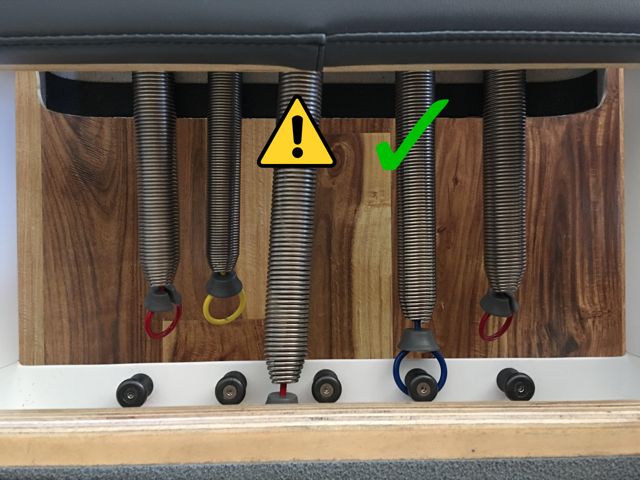
Store Trapeze Springs in a Straight Position
When storing Trapeze Springs (Cadillac), keep them either hung vertically or laid flat on any horizontal surface. Leaving the roll down bar or trapeze swing attached to the springs and hanging from the frame is fine, as their own weight plus gravity will not weaken them over time.
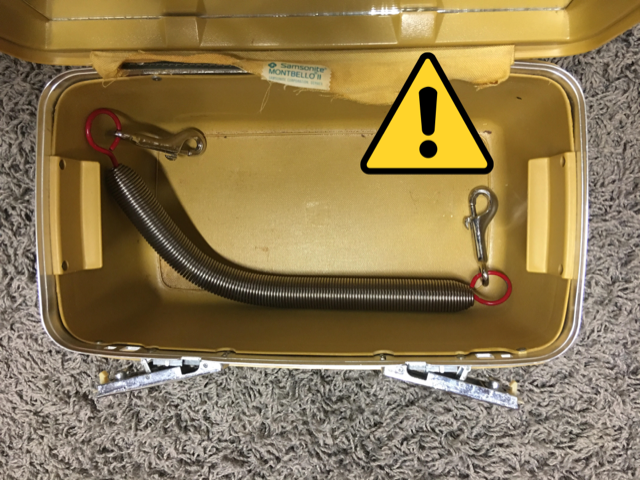
Avoid storing Trapeze Springs by loading the Push-Through Bar from above, placing them in a basket or other container on the floor, or in any other position that causes the coils of the springs to remain open.
If you notice that a spring is hanging and some coils are open (see the spring on the left in the photo below), this is a sign that the material’s integrity in that area is compromised and it should be replaced. Hanging springs for storage does not contribute to this deformation. This spring has likely been subjected to uncontrolled bouncing multiple times in its life or has been stored in a bent position.
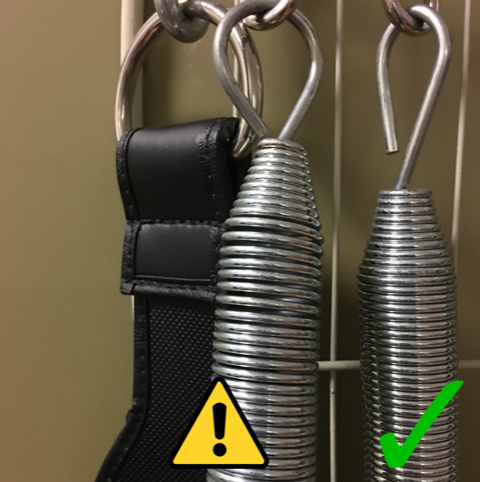
Does leaving a spring hanging or attached to the bar cause it to wear out faster?
No! When springs are wound from spring wire (known as Music Wire), the coils have initial tension, which is essentially the force needed to separate the coils at the very beginning. This value, plus the spring constant (how many kilograms of resistance per centimeter of stretch the spring provides), is based on gravity.
Combine the initial tension and spring constant with the principles of fatigue, and you will see that slight stretching of the spring will not weaken it to any point that would matter for your studio.
How to Store Springs? – Summary
Stretched springs have a maximum stretch limit, in our case about 2-3 times their length, beyond which they will begin to permanently deform (which means they lose resistance and may not close completely). They are designed to withstand over a million cycles below this maximum stretch range.
Greater stretch (larger range of motion) places more load on the spring than smaller stretches (smaller range of motion). If a spring is designed to stretch 2.5 times for a million times, it will likely withstand stretching 0.1 times (for example) its length much longer.
Springs are a fascinating topic and can easily lead to hours of discussions and lectures. Your guiding principle today should be: do not store springs in a way that causes their coils to remain separated.
Happy reforming!
This text is a translation of the article https://blog.fitreformer.com/spring-storage/
Author: Kaleen Canevari.

I have a degree in mechanical engineering and am an entrepreneur and certified Pilates instructor. My Pilates journey began at Balanced Body in 2014. I currently run The Fit Reformer, a company specializing in Pilates equipment servicing, and since 2020, I have launched a startup, Flexia, bringing innovation to the Pilates world. I also teach Pilates in Sacramento and travel the country on various Pilates-related projects.