


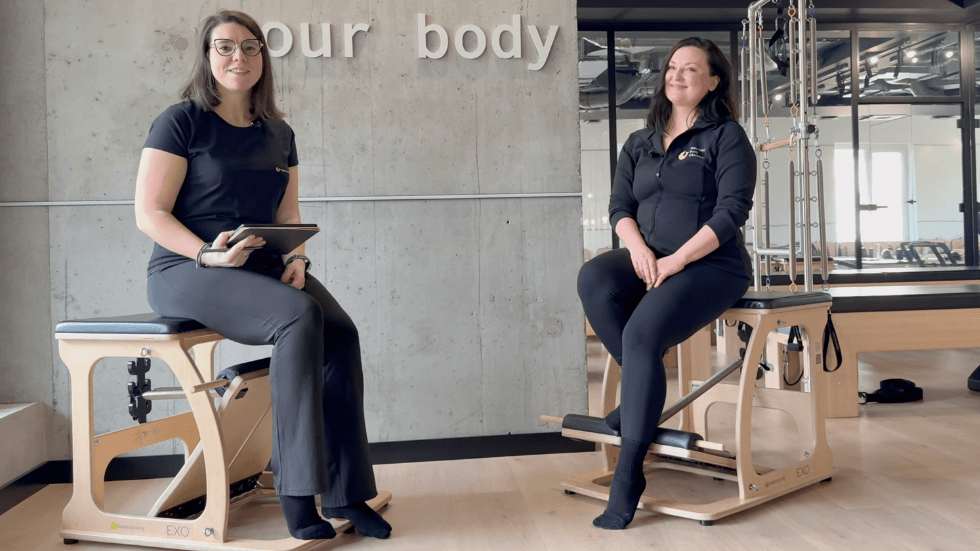
Dialogue with the Body – Interview with Balanced Body Educator Anna Tytus from at Studio Warsaw
Our interviewee was Anna Tytus – an educator from the prestigious Balanced Body school, a former dancer, teacher, and mentor to many instructors. Anna spoke to us with remarkable attentiveness about how dance and injuries shaped her path, why there are no shortcuts in movement education, and why high-quality equipment is primarily about safety and the foundation of a teacher’s work.
If you are wondering what the journey from a small studio to a space of over 200 square meters looks like, or if you are thinking about starting your own adventure as an instructor – this interview is for you. We invite you to read the conversation, where the person and responsibility always come first.
[Iza]: In the world of Pilates, there are places and people who redefine standards. Today we are in such a place with a person who knows almost everything about movement. We are in the heart of Warsaw at at Studio Warsaw. We are hosted by Anna Tytus, Master Educator of the Balanced Body school, former dancer and teacher, mentor to many Pilates instructors. Ania, do you remember the moment when you felt that movement is a dialogue between the past and the present?
[Ania]: Hi, welcome. First, let me greet you. Welcome to the studio. Welcome to you, Iza. Yes, yes. And that was actually my first Pilates class, because as a professional dancer, I had my injuries that kept me stuck in the past, and I wanted to look to the future and feel better. So Pilates helped me with that, along with my mentor at the time.
[Iza]: Your roots are in the stage. In movement, every millimeter matters, and it matters a lot. Is that where you learned the attentiveness that is now essential in your work?
[Ania]: Dance, like Pilates, is connected by principles. These are Pilates principles, or generally principles of movement. It’s concentration, breath, control, precision, flow, which I also find in dance, and in Pilates. Thanks to technique, dance taught me that. Through the technique I learn to work on myself, on my body, it gives me freedom. I am free because of that, whether my clients, the people I exercise with, or my students. It’s a freedom in body and spirit, being here and now. Yes, it’s that connection between the past and the future, where I am here and now. With my body, with my awareness.
[Iza]: And when you look at someone who is entering here for the first time, what do you see? Breath, history, posture?
[Ania]: I see a person. I see a person who has taken the effort, carved out a bit of time from… We are all very busy, people are very busy now. A little time for themselves. They have crossed the threshold of my studio and want to spend time meeting with me, or with my teachers and exercise, do something for themselves. So first and foremost, I see a person. Of course, I have a short conversation about how they feel today, not how they felt yesterday or how they will feel in the future, but how they feel today. And what their story is, whether they have any injuries, whether they have children, what kind of lifestyle they lead. And then we start to move. Of course, I also talk about the equipment, what a Pilates lesson consists of, what a Pilates session consists of, what equipment we will be exercising on. I tell a bit about that equipment, but the most important thing is movement. And then I can see how that person has concentration, what their movement is like, what their coordination and proprioception are like.
[Iza]: It’s interesting because many people talk about Pilates as a set of exercises, while you approach it more as a process of editing something that has been damaged over the years.
[Ania]: I wouldn’t call it damaged. I know that we all have something, I have something that holds me back or some traumas in my body. However, I try to understand it. And move away from it. In the sense that here and now matters again, we are starting a new path. For me, when I start working with a new client, and for that person who came to exercise with me.
[Iza]: And how much time does such a person need to straighten out those neglects a bit?
[Ania]: What do you think?
[Iza]: It depends?
[Ania]: Exactly, it depends. You know, I’m not Cinderella’s fairy godmother who will come and it’s a very important question you asked. Because I often encounter it and just: “how? when will I see results? And how will I…” – I say: tomorrow. And it’s: “oh, hmmm…”. I say: you’ve already taken the first step when you came to class.
[Iza]: Mhm..
[Ania]: You will already be a completely different person after the class because you did something for yourself, you came to exercise, to feel your body. Maybe you learned something new about yourself and took care of yourself. So that is already some progress in my eyes. I focus on what happens, not on what will be. Of course, from my own experience, I know that Pilates is a system of exercises. It is a system, not a collection of random movements. It is a system of exercises that includes both mat exercises and those on the tower, Cadillac, barrel, reformer. And this system gives us a sense of safety. For me as a teacher, I believe in it and I know it works, but also for the people who exercise with me, so: it depends. On how often, how disciplined you are. That is very important, yes.
[Iza]: Your path to this point where you are now has led through various countries, including Belgium, Austria, and the United States. Tell me, at what moment did that moment come when you thought: “Pilates, this is what I want to do”?
[Ania]: Pilates chose me a bit, because as I mentioned earlier, I studied contemporary dance and movement pedagogy at the University of Linz in Austria. By the way, it’s very well known. And there I had my first encounter with Pilates on the mat. We also practiced other techniques, like the Alexander Technique, various types of yoga, yoga styles, gyrokinesis, gyrotonic, and there was also Pilates. And you know, when you have to get up at 7:00 AM and do Pilates on the mat, it’s not very appealing when you’re 19 or 20 years old. However, then living in Belgium, I did various certifications in different techniques, including gyrotonic, gyrokinesis, and I met my mentor who ran a studio in the center of Brussels. And somehow she said: “give it a try”. That was my first lesson, very basic, which was quite a strong experience for me because I started with very simple exercises, I – a professional mover – and I had to start from the beginning due to an injury. And somehow that taught me humility. Pilates taught me humility, that I don’t have to put on a show, that I don’t have to go 1000% all the time, even when I don’t have the strength. It taught me humility and through teaching Pilates, I actually became more mature.
[Iza]: You are a Balanced Body Educator, a Master Educator. It is often said that Balanced Body training is the gold standard. Tell me, from your perspective as an educator: what differences do you notice between this school and others?
[Ania]: What do you mean by gold standard?
[Iza]: Wherever we appear and someone hears “Balanced Body”, if they are a Pilates teacher, they often say: “oh, those are good trainings”.
[Ania]: Okay. Yes. Well, to that, I agree with you. To earn that good reputation, you have to deserve it. It’s not something that comes out of thin air. Balanced Body is a leader when it comes to equipment and education. I don’t want to compare it to other schools. I can say what distinguishes Balanced Body in my opinion. It’s that they are constantly evolving. It’s not like: “oh, I’m a leader, I don’t have to do anything anymore”. They are constantly developing, trying to set trends, educate themselves, improve not only the equipment but also the education. A new online system is coming, a platform where you will be able to scan and see exercises. This platform will be interactive. In my opinion, manuals and all the books and everything is prepared from A to Z. It’s very readable. We have an incredibly large number of meetings regarding comprehensive training. Where we learn, you learn a lot of exercises, modifications to those exercises, traditional, classical exercises, because it should be emphasized that Balanced Body is a contemporary school, but we have a base in traditional classical Pilates. Classical. So we have that order, everything is thought out in a great, fantastic, and accessible way.
[Iza]: These programs are demanding and long. Tell me, why in this profession can the shortcut that is becoming more common be dangerous?
[Ania]: The work of a Pilates teacher is working with human material. You can’t cheat here. It’s not like that, and I know from the experience of my acquaintances who live in other cities and went to Pilates, you can’t cheat. Even a person who has never done Pilates or has never exercised even in PE knows and feels, they may not be able to articulate it, but whether something is good for them or not, whether they feel good after such a lesson, whether they understand the teacher’s instructions. Lack of education and shortcuts lead nowhere. It’s, you know, cheating yourself, and that can be felt. When someone comes to us, we feel whether the hairdresser is good, we have our favorite, or whether our doctor is good, or our body is our treasure. It’s not that we can teach something we don’t understand ourselves. That will come out immediately. It will translate into a lack of trust among clients. And then a lack of results. There can also be dangerous situations, like if we choose the wrong springs, exercise, or make the wrong progression. You can feel whether we are confident, confident in what we do or not. And I say, the lack of such understanding with the client and how we teach, whether we are understandable, leads to injuries, but also to a lack of clients. Because no one will come back to us, excuse me, no one will come back to us if we are not genuine in this, if we are not confident in what we teach. And that’s very… You can’t cheat that, you can’t gloss over it. However, that person, that teacher is very important.
[Iza]: You mentioned that you started on the mat. When did you first sit on the Balanced Body reformer?
[Ania]: It was in Brussels a very, very long time ago and it was Allegro1, because I think Allegro2 didn’t exist yet. Can you imagine that? Listen, Allegro2, that’s now all over Instagram, and I think Allegro2 was around in 2010. We can check that somewhere. [editor’s note: 2011]. However, at that time, those famous Allegro2 didn’t exist yet. I started on Allegro1, which is also wonderful. I have a great sentiment for them. Do I remember exactly? No. However, I know that after the first class, I continued my Pilates sessions. Yes, it captivated me with its simplicity, clarity, and discipline. Pilates is a very disciplined form of movement, in my opinion, so yes. Besides, it was a beautiful studio, and fantastic teachers, so I remember it very well.
[Iza]: For many outsiders, the reformer is just a machine, a tool. What does it mean to you, as someone with 20 years of experience, what is the reformer?
[Ania]: The reformer is a machine, it is a machine, indeed a machine. The reformer is a tool for me. It is a tool I use every day. So this reformer helps me conduct training from A to Z for the whole body. Very functional training and safe. Yes, so for me this equipment, whether it’s Cadillac, whether it’s the tower, whether it’s the reformer, the equipment is my tool of work, which I must trust 100%, which I – conduct several trainings a day – and that is my safe base of my work.
[Iza]: So it has to be like a partner you trust 100%.
[Ania]: Absolutely. Absolutely. The reformer is a teacher. I heard a fantastic statement. The reformer is a teacher, and I am the assistant.
[Iza]: That sounds beautiful, but it captures the essence.
[Ania]: But it’s true that thanks to the fact that the person feels and has reference points and there is this system of springs and this platform and works in different planes, I don’t have to use unnecessary words. I am very specific in this. The reformer is the teacher. I assist.
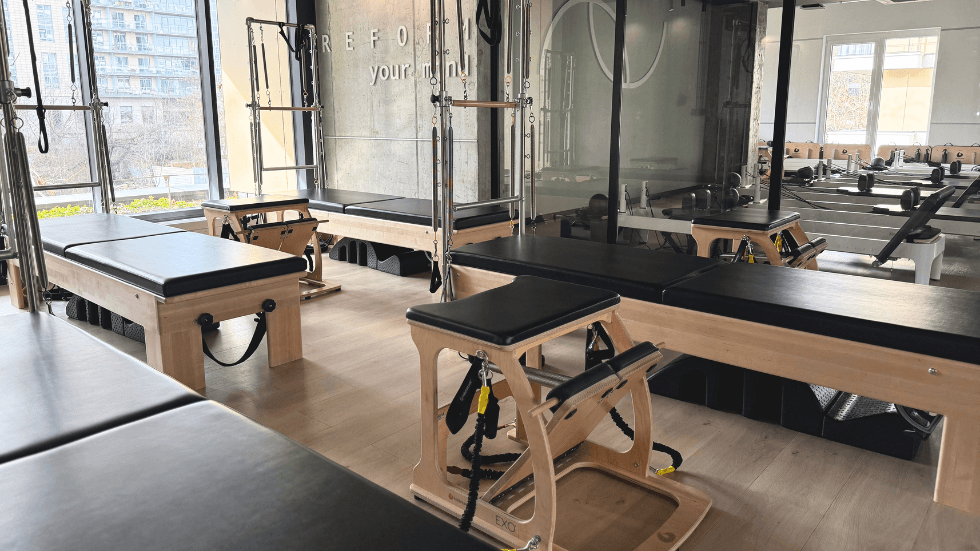
[Iza]: Well, we have a very large studio here, really. You don’t just have Allegro2, but there is also Reformer Trapeze Combinations, there is Cadillac. Tell me what makes…
[Ania]: and Studio Reformery.
[Iza]: and Studio Reformery and chairs and various other elements. So there is really a lot, it’s hard to list. What makes Balanced Body equipment give you that confidence in your work, that trust?
[Ania]: I started and also worked on classic equipment, which I really like. However, this Balanced Body equipment, contemporary, captivated me with its possibilities, functionality, design, because they are beautiful pieces of equipment. And I like to please my eye and I like my space to be soothing as well. So I love the design, and above all, safety. That when I exercise myself or teach on this equipment, I don’t have to worry whether the footbar will get stuck, whether the loops will get stuck, whether the spring will break, or… This is equipment, and I believe that every piece of equipment should be like a glove. Well-fitted, tailored. We teach group classes, so that safety is a priority and a foundation for me, so I value that.
[Iza]: Many new studio owners face the choice of either investing in quality or saving money. What would you say to such people from your perspective? Does equipment define the studio’s standard?
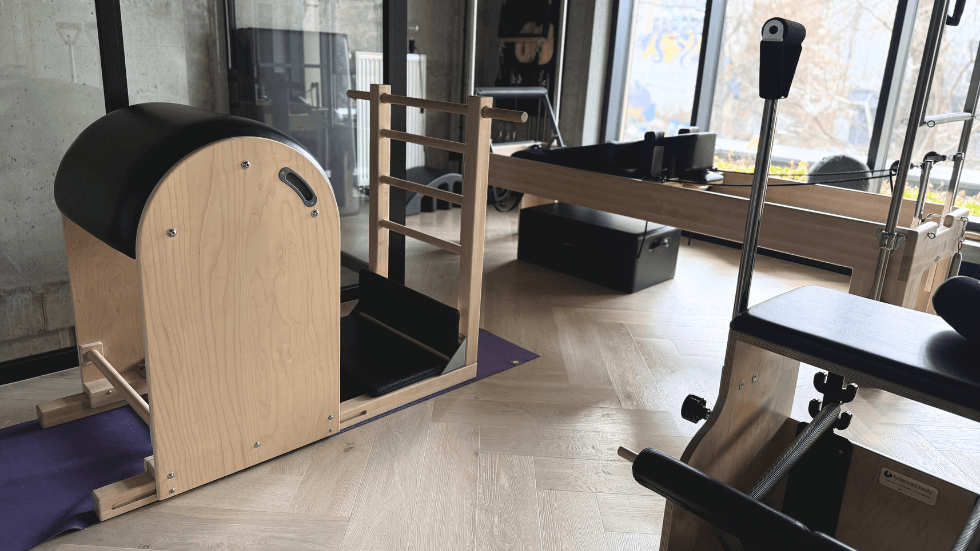
[Ania]: Of course, it does. Of course, it does. Equipment? Absolutely. It’s like a Mercedes S-Class. It’s something that I also know from the feedback of various people, we are in the center of Warsaw, as you said, so we have various travelers who come to our studio or people who have moved, I don’t know, to another district and come back to us because of the equipment and because of the teachers. Because you know, it’s beautiful now Instagram-wise when it comes to the world of Pilates, and studios have great designs and beautiful mirrors and everything around, but in reality, that equipment and the person who teaches on that equipment is the foundation and the most important.
[Iza]: And when you look at the development of Pilates in Poland today, what makes you the happiest?
[Ania]: What makes me happy? That it is so accessible and that it is so promoted. When I started, it was even, you know, in the States it was a bit different. However, in Europe there were also only a few studios, some larger, some smaller, but there was less accessibility. It was very elitist, so I’m glad that now many people are getting to know Pilates and its values and this system of exercises through social media, they have access to it. So just as it captivated me all those years ago, it now captivates a mass, a multitude of people who have fallen in love with this system.
[Iza]: And what raises your alertness?
[Ania]: Sometimes a lack of ethics. Just what you asked about saving money and running a business. In my opinion, if we want to run a business that is good for us and good for our clients and we want to succeed, there is no room for saving on important things – that is, on equipment and on the education of our teachers. Whether we are investors, we should also know what we are doing, what this business is about, what equipment is worth knowing and investing in. We can save money elsewhere. That’s what I believe.
[Iza]: Well, we are sitting here today in your very large studio. You have a lot of different equipment, as we have already mentioned, but I know you started from something much smaller. Tell me, what did your journey look like, from transitioning from that small space to what we have here now?
[Ania]: I also ran a studio abroad that was a bit larger than my first studio in Poland and smaller than this one. So for me, it was a natural path. Of course, I taught in a large studio in Brussels as well, so that taught me teamwork and working with clients and a certain maturity. However, I returned to Poland after 15 years, so I left as a young person who had never worked here, so the Poland I returned to was a completely different country that I had to learn anew. At that time, it was still the end of COVID, so I didn’t know how everything would go. And I set up my small studio, which I and my teachers, with whom I have worked for so many years, and clients who are still with me here, remember with great emotion. That studio had two reformers: Allegro2 with a tower and chairs. And